Glacial Outwash Sandy Forest Loam
Sandy Loam · Glacial outwash or sandy lake plain deposits, specifically characteristic of the Newaygo County/Lower Peninsula region of Michigan (Gerber Scout Reservation area).
AI Disclaimer
This soil report was produced by AI from a single photo. Treat it as a starting point, not laboratory truth.
pH, drainage, fertility, and composition are visual estimates — send a sample to an accredited lab before any decision that would be painful to get wrong.
Crop and amendment tips are general guidance — local climate, microclimate, and gardening history always win over an AI's best guess.
pH
Slightly to moderately acidic (5.5–6.5). The presence of oak leaves (tannins) and the glaciated sandy parent material typically lead to leaching of bases and acidic conditions.
Drainage
Well Drained to Excessively Drained. The coarse texture allows water to move rapidly through the profile, with little evidence of waterlogging or anaerobic gleying.
Organic Matter
Moderate (2–4%). The dark surface layer indicates a healthy O-horizon and A-horizon transition from decomposing forest litter, but the sand mineral base means it persists less than in heavier soils.
Erosion Risk
High risk for wind erosion when dry and water erosion on slopes. The lack of clay 'glue' means particles detach easily. Maintaining the leaf litter/mulch layer is the best mitigation.
Overall Read
This is a classic 'forgiving' soil for beginners because it is easy to dig and hard to overwater, but its low nutrient-holding capacity requires consistent organic maintenance. Verdict: Good for specialized crops and forestry, challenging for intensive vegetable production without amendments.
Texture
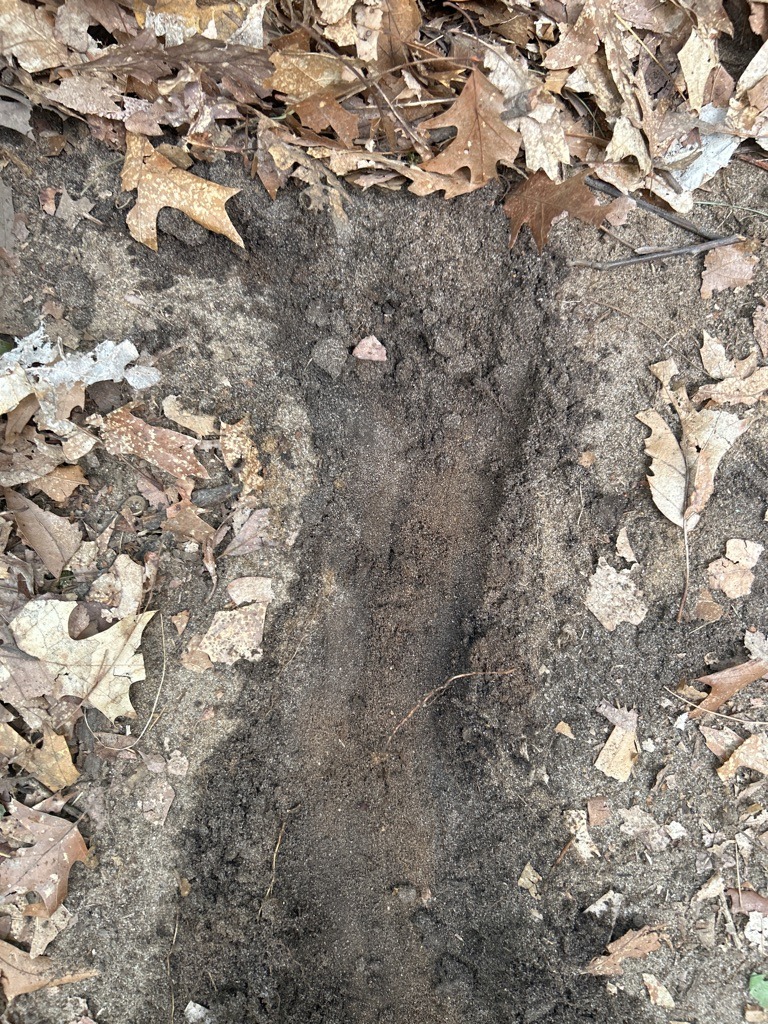
Coarse and gritty with modest silt influence; crumbly and friable under the leaf litter. It would likely fail to form a ribbon in a field test, instead breaking apart quickly, indicating high sand content.
Color Analysis
Dark grayish brown (10YR 4/2) at the surface due to organic accumulation, transitioning to a yellowish-brown (10YR 5/4) subsurface. This suggests good drainage and the presence of oxidized iron minerals.
Estimated Composition
70% Sand, 20% Silt, 7% Clay, 3% Organic Matter. High confidence in sand dominance due to visible graininess.
Water Retention
Low. This soil dries out quickly after rainfall and in direct sun. It has limited field capacity compared to a heavy loam or clay soil.
Aeration
Excellent. High macroporosity ensures significant oxygen availability for roots and aerobic microbes, preventing the sulfurous odors associated with wet silts or clays.
Compaction Level
Loose and friable. The visible footprint indicates easy displacement rather than heavy compaction, though sandy soils can become 'packed' if moisture levels are high during traffic.
Structure & Aggregation
Weak granular structure. Aggregates are fragile and easily crushed. This allows for excellent root penetration but provides little resistance to physical disturbance.
Fertility Indicators
Moderate. Visual signs of humus and active decomposition are positive, but nutrient leaching is a high risk in such sandy textures. Overall fertility rating: Moderate-Low.
Climate Suitability
Temperate humid climates with frequent rainfall. It thrives under forest canopy which prevents excessive evaporation from the sandy profile.
Crops Worth Trying
Oak and Pine forest species, blueberries, peppers, potatoes, and drought-tolerant herbs like lavender or rosemary that appreciate drainage.
Plants To Avoid
Water-loving species like Willows, or heavy feeders requiring high moisture stability like Broccoli or Cauliflower, unless heavily irrigated.
Home Garden Use
Excellent for native woodland gardens and drought-tolerant perennial borders. Best used in-ground with heavy mulching rather than in raised beds which would dry out too fast.
Agricultural Use
Suitable for orchards (especially cherries or apples) and vineyards where drainage is paramount. Requires 'spoon-feeding' of nutrients due to low Cation Exchange Capacity.
Landscaping Use
Ideal for areas requiring high infiltration, such as rain garden margins or drought-tolerant landscaping. Poor for turfgrass without significant organic amendment.
Common Problems
Rapid nutrient leaching (especially nitrogen and potassium), frequent drought stress, and potential for acidity to limit phosphorus availability.
Amendments Needed
Incorporate 2-4 inches of high-quality compost to increase water holding capacity. Add lime if pH is below 5.5 for specific plants. Use slow-release organic fertilizers.
Try These At Home Tests
Jar Test: Fill a jar 1/2 with soil and water, shake, and watch sand settle in seconds. Squeeze Test: A wet ball of this soil will crumble easily when poked.
Professional Lab Recommendation
Highly recommended for a Basic Nutrient and CEC (Cation Exchange Capacity) test to determine how well it can hold onto fertilizers. Costs roughly $15-$25 at Michigan State University Extension.
Fun Facts
The sandy soils of Michigan's 'Mitten' are the result of massive meltwater rivers at the end of the last Ice Age, 10,000 years ago, which sorted particles and left these deep sandy deposits.
Your Notes
Twin lakes, gerber scout reservation