Andean Volcanic Oxisol / Tropical Weathered Clay
Clay Loam to Clay · Weathered volcanic ash and metamorphic residuum of the high Andes (specifically Antioquia region, Colombia).
AI Disclaimer
This soil report was produced by AI from a single photo. Treat it as a starting point, not laboratory truth.
pH, drainage, fertility, and composition are visual estimates — send a sample to an accredited lab before any decision that would be painful to get wrong.
Crop and amendment tips are general guidance — local climate, microclimate, and gardening history always win over an AI's best guess.
pH
Strongly to moderately acidic (5.0–5.5) due to intense leaching in a tropical climate; a laboratory soil test is recommended for precise confirmation.
Drainage
Moderately well drained to well drained; despite high clay content, the strong aggregation and slope position allow good internal drainage, though surface sealing can occur.
Organic Matter
Low to moderate (1–3%) as this appears to be a subsurface cut profile where organic residues are sparse compared to the topsoil layer.
Erosion Risk
High risk of water and gully erosion when exposed on slopes without vegetative cover, due to high clay dispersion and susceptibility to surface crusting.
Overall Read
A challenging yet highly productive tropical clay soil when managed properly; strengths include good structural stability and deep rooting potential, while weaknesses involve high acidity and phosphorus tie-up requiring consistent organic amendments.
Texture
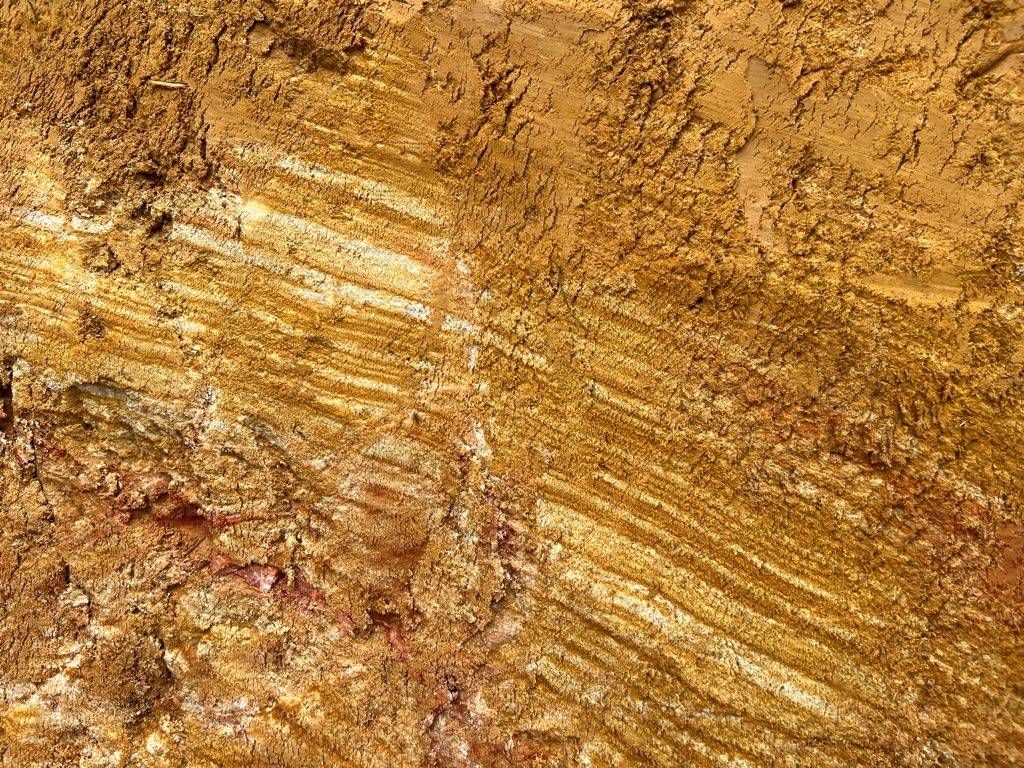
Fine, smooth, and plastic when wet; forms a long, flexible ribbon during a ribbon test, indicating high clay content and weathered mineral particles.
Color Analysis
Bright yellowish-brown to reddish-yellow (Munsell 10YR to 7.5YR hue), indicative of heavy concentration of oxidized iron (goethite and hematite) and well-drained tropical weathering conditions.
Estimated Composition
45% clay, 30% silt, 20% sand, 5% organic matter (visual estimate with moderate confidence for a subsoil or deep cut profile).
Water Retention
High water-holding capacity due to fine clay and oxide particles, but can develop high suction forces, making water less available to plants if severely dried out.
Aeration
Moderate to low; fine pores restrict rapid gas exchange, especially when wet, requiring organic matter management to improve macroporosity.
Compaction Level
Moderately firm to compacted in its native undisturbed state, typical of subsoil profiles exposed by road cuts or earthmoving.
Structure & Aggregation
Subangular blocky to massive structure with visible tool marks from excavation; moderate aggregate stability that breaks down under heavy mechanical tillage.
Fertility Indicators
Low natural fertility due to high weathering and phosphorus fixation by iron and aluminum oxides; requires fertilization and pH correction.
Climate Suitability
Tropical highland and montane climates with distinct wet and dry seasons; benefits from continuous cover cropping and terracing.
Crops Worth Trying
Coffee, avocados, citrus, pasture grasses (like Brachiaria), and native forestry species adapted to acidic tropical soils.
Plants To Avoid
Plants requiring high alkalinity or delicate root crops sensitive to heavy compaction (like certain long carrots) unless amended.
Home Garden Use
In-ground beds with heavy organic amendments, native perennial landscaping, and fruit tree orchards.
Agricultural Use
Coffee production, permanent pastures, and perennial tropical horticulture utilizing no-till or minimal disturbance.
Landscaping Use
Establishment of robust slope-stabilizing shrubs, native trees, and ornamental terraces.
Common Problems
Phosphorus fixation, nutrient leaching when exposed, surface crusting, and high susceptibility to erosion on slopes.
Amendments Needed
Agricultural lime to raise pH, heavy applications of compost or aged manure to build organic matter, and rock phosphate or mycorrhizal inoculants.
Try These At Home Tests
Perform a jar settling test for exact particle breakdown, and a ribbon test to confirm high clay content.
Professional Lab Recommendation
Send a sample to a regional agricultural lab for a complete fertility panel, CEC, organic matter, and exchangeable acidity/aluminum levels.
Fun Facts
Soils in the Antioquia region of Colombia are famous for supporting world-class coffee production due to their volcanic heritage and unique mineralogy.
Your Notes
Cut of soil near el retiro Antioquía