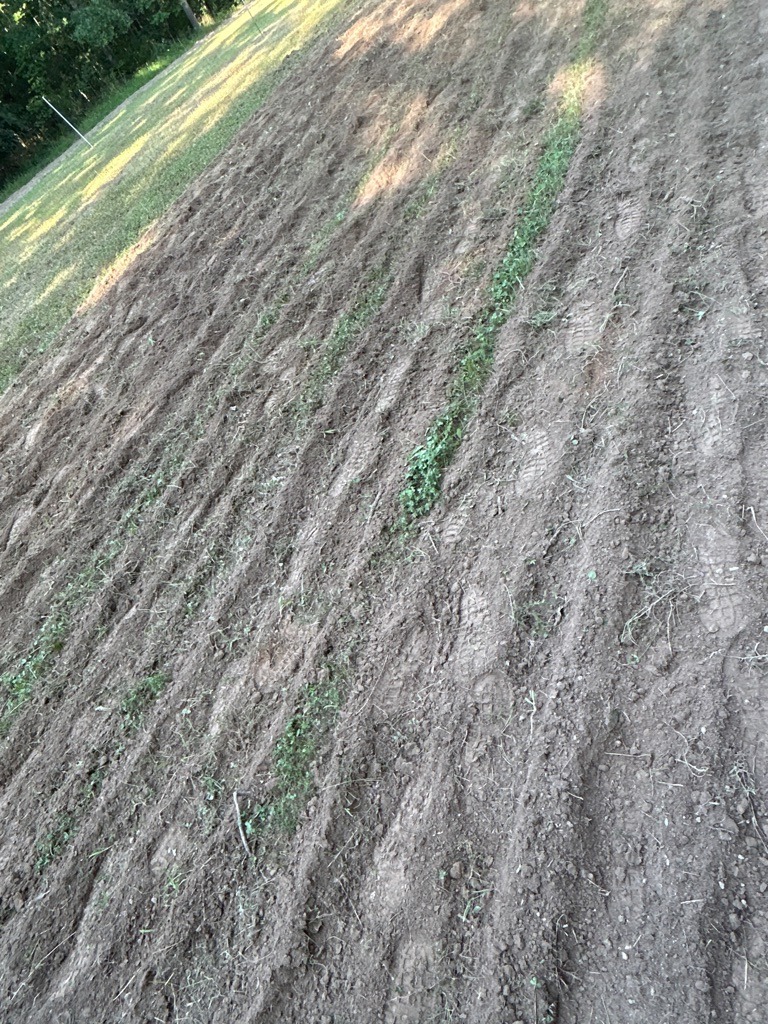
Tilled Piedmont Clay Loam
Clay Loam · Weathered residual soil or transported colluvium from upland agricultural regions, commonly found in the Southeastern Piedmont or mid-latitudes.
AI Disclaimer
This soil report was produced by AI from a single photo. Treat it as a starting point, not laboratory truth.
pH, drainage, fertility, and composition are visual estimates — send a sample to an accredited lab before any decision that would be painful to get wrong.
Crop and amendment tips are general guidance — local climate, microclimate, and gardening history always win over an AI's best guess.
pH
Slightly acidic (6.0 to 6.5), typical of weathered upland soils in humid temperate zones, though lab testing is required for verification.
Drainage
Moderately drained. Tilling creates temporary macropores, but the underlying clay fraction can retain water and lead to temporary saturation after heavy precipitation.
Organic Matter
Low to moderate (2% to 3%), suggested by the lighter brown hue and lack of deep dark humus coloring.
Erosion Risk
High water and tillage erosion risk due to the exposed, sloped furrowed surface lacking heavy residue cover.
Overall Read
A productive and versatile mineral soil with good nutrient-holding capacity, though it requires vigilant organic matter management and erosion control to prevent crusting and compaction.
Texture
Fine-textured, slightly gritty yet plastic when moistened, capable of forming a weak to moderate ribbon.
Color Analysis
Brown to yellowish-brown (approximately 10YR 5/4), indicating moderate weathering, oxidized iron presence, and low-to-moderate organic matter content.
Estimated Composition
45 percent sand, 20 percent silt, 25 percent clay, 10 percent organic matter and debris. Confidence level is moderate based on visual inspection of recently tilled surface fields.
Water Retention
Moderate to high water-holding capacity due to the clay and silt fractions, though tilled surfaces may dry out and crust on top rapidly under sun.
Aeration
Moderate. Good right after tillage, but susceptible to declining aeration if heavy rains cause surface crusting or subsoil compaction.
Compaction Level
Moderately firm to compacted in traffic areas (visible footprints), though freshly tilled rows offer temporary looseness.
Structure & Aggregation
Subangular blocky to disturbed granular structure resulting from recent mechanical tillage. Aggregate stability is vulnerable to breakdown under heavy rain.
Fertility Indicators
Moderate fertility. Sparse weed growth in furrows indicates some available nutrients, but overall pale color suggests regular fertilization or organic amendment is needed.
Climate Suitability
Thrives best in temperate climates with moderate rainfall, requiring careful moisture management during dry or excessively wet spells.
Crops Worth Trying
Corn, soybeans, winter wheat, fescue grass, clover, tomatoes, and squash.
Plants To Avoid
Root crops requiring loose, sandy profiles (like long carrots or parsnips) and delicate acid-loving plants like blueberries without substantial soil modification.
Home Garden Use
In-ground vegetable gardens, perennial beds, and turfgrass establishment after incorporating organic matter.
Agricultural Use
Well-suited for row crop production, pasture, and forage systems when managed with cover crops and conservation tillage.
Landscaping Use
Turf establishment, hardy shrub borders, and foundation plantings, provided surface compaction is managed.
Common Problems
Surface crusting after rain, hardpan formation, and erosion on sloped surfaces.
Amendments Needed
Compost or aged manure to boost organic matter and improve aggregation, alongside cover crops to protect the exposed surface.
Try These At Home Tests
Perform a jar settling test for exact sand-silt-clay ratios, a ribbon test for plasticity, and a simple infiltration test using a ring and water.
Professional Lab Recommendation
Submit a sample to a local agricultural extension office for a standard fertility, pH, and organic matter analysis before planting high-value crops.
Fun Facts
Clay loams possess a high cation exchange capacity, meaning they hold onto plant nutrients very effectively once those nutrients are established.