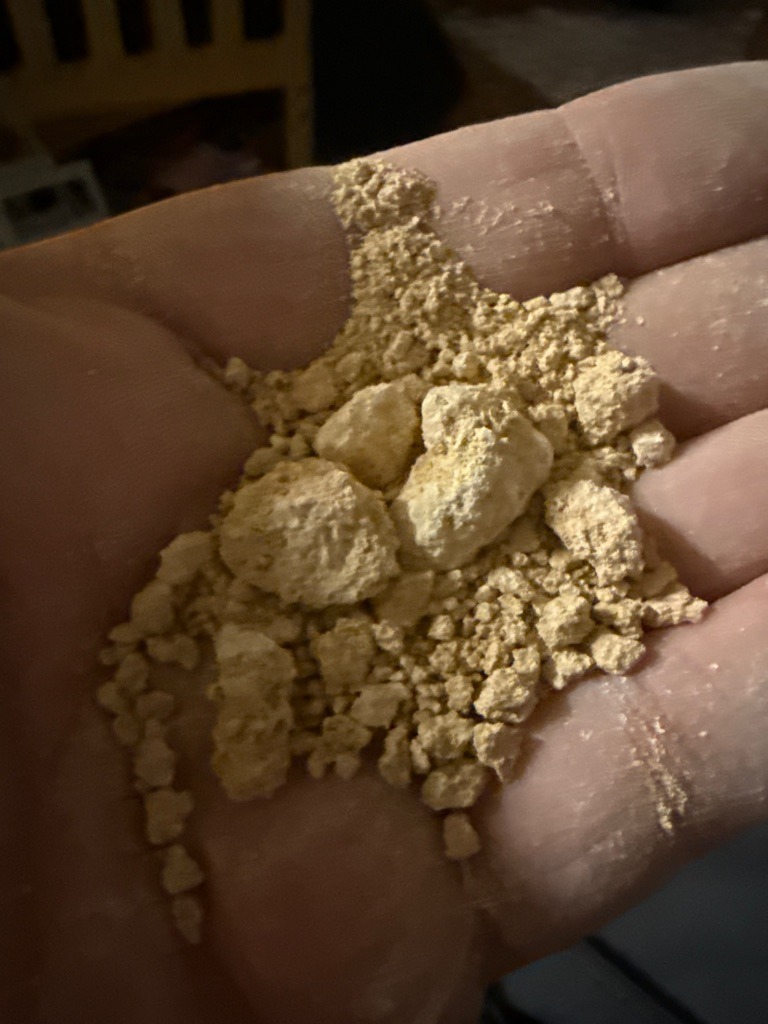
Pale Desert Caliche or Highly Weathered Silt Subsoil
Silt to Silt Loam / Calcareous Mineral Deposit · Arid or semi-arid region subsoil, loess deposits, or exposed calcareous geological strata where leaching and lack of vegetation have stripped organic layers.
AI Disclaimer
This soil report was produced by AI from a single photo. Treat it as a starting point, not laboratory truth.
pH, drainage, fertility, and composition are visual estimates — send a sample to an accredited lab before any decision that would be painful to get wrong.
Crop and amendment tips are general guidance — local climate, microclimate, and gardening history always win over an AI's best guess.
pH
Likely alkaline to strongly alkaline (7.8–8.5+), especially if caliche or calcium carbonate is present. This cannot be confirmed visually, so a lab test or pH strip is strongly recommended.
Drainage
Poorly drained when compacted due to extremely fine silt pores that restrict vertical water movement, though dry powdery fragments can initially absorb surface moisture before sealing over into a crust.
Organic Matter
Very low (less than 1%) based on the pale, bleached coloration, powdery dryness, and total absence of visible dark humus or plant residues.
Erosion Risk
High susceptibility to both wind erosion (due to fine, powdery dust particles) and water erosion (due to surface crusting leading to rapid sheet runoff on slopes).
Overall Read
This is a challenging, highly mineralized subsoil sample characterized by fine silt, lack of organic matter, and potential alkalinity. While poor in its raw state, it can be transformed over several seasons through aggressive additions of compost, organic mulches, and biological inoculants.
Texture
Extremely fine, powdery, and chalky, leaving a fine dust film on the skin. Likely exhibits little to no true plastic ribbon-forming capacity, instead breaking apart easily or crushing into a fine powder, pointing to a high silt or carbonate mineral makeup.
Color Analysis
Pale yellowish-white to light cream (Munsell approximation 2.5Y 8/2). This light hue indicates a distinct lack of organic matter, very low iron oxide content, and potentially high concentrations of calcium carbonate or leached silica minerals.
Estimated Composition
Sand: 10%, Silt: 75%, Clay: 10%, Organic Matter: less than 1%. Visual confidence is moderate to high regarding the dominant silt/powdery fraction and lack of organic matter.
Water Retention
High water-holding capacity due to microscopic silt pores, but much of that water may be held too tightly for plants to easily extract, leading to rapid surface drying and subsurface waterlogging.
Aeration
Poor aeration potential when wet or packed, as the tiny silt particles pack tightly together, cutting off oxygen diffusion to roots and beneficial microbes.
Compaction Level
Moderately firm to compacted when dry, forming a hard surface crust that can severely restrict root elongation and seedling emergence.
Structure & Aggregation
Weak, massive, or powdery single-grain structure with some fragile crust-like aggregates that break down easily under pressure into fine dust.
Fertility Indicators
Very low fertility overall. The extreme pale color, lack of organic matter, absence of earthworms or biological activity, and powdery texture indicate minimal native nutrient reserves.
Climate Suitability
Arid, semi-arid, or Mediterranean climates where native plants are adapted to poor, highly mineralized, or calcareous subsoils.
Crops Worth Trying
Drought-tolerant native grasses, specific desert shrubs, and certain adapted Mediterranean herbs that tolerate alkaline conditions and low organic matter.
Plants To Avoid
Acid-loving plants (blueberries, azaleas, rhododendrons), heavy feeders, and crops requiring loose, rich, well-aerated topsoil.
Home Garden Use
Unsuited for direct in-ground gardening without heavy remediation; best kept undisturbed or heavily amended before attempting raised beds or specialized xeriscaping.
Agricultural Use
Generally poor for conventional agriculture without extensive irrigation, pH balancing, and massive organic matter incorporation to build a functional topsoil layer.
Landscaping Use
Can be utilized as base fill in arid landscaping, but requires top-dressing with quality topsoil and mulch for any successful turf or ornamental planting.
Common Problems
Severe surface crusting, wind-blown dust, poor water infiltration, nutrient lockout due to high pH, and heavy compaction.
Amendments Needed
Massive quantities of high-grade compost, aged manure, and organic matter to build structure, followed by cover cropping and potentially elemental sulfur if pH reduction is necessary.
Try These At Home Tests
Perform a jar settling test to separate sand, silt, and clay percentages; conduct a vinegar test to check for effervescence indicating calcium carbonate; use a pH test strip.
Professional Lab Recommendation
Highly recommended to send a sample to an agricultural extension lab for a complete nutrient panel, organic matter percentage, cation exchange capacity, and precise pH/salinity analysis.
Fun Facts
Soils dominated by fine silt and pale mineral dust often originate from ancient wind-blown glacial flour known as loess, which can form incredibly deep, fertile soils only when properly weathered and enriched with organic matter.