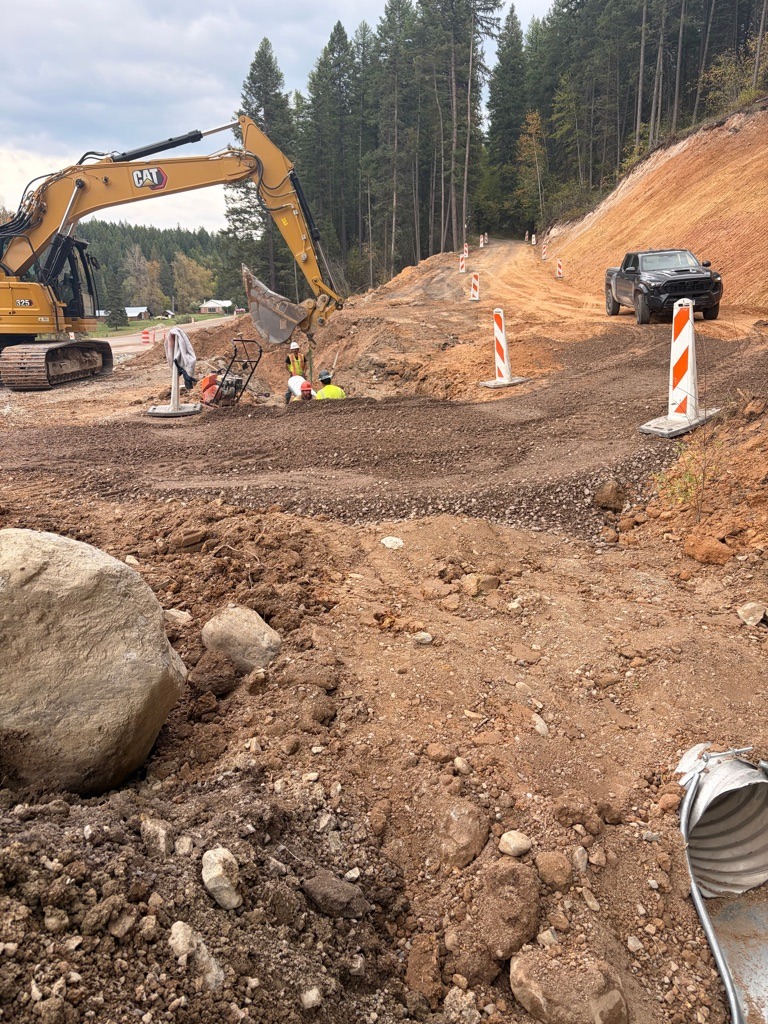
Glacial Outwash Rocky Subsoil and Regolith
Gravelly Sandy Loam · Glacial till or glaciofluvial outwash deposits in a mountainous or forested northern temperate region.
AI Disclaimer
This soil report was produced by AI from a single photo. Treat it as a starting point, not laboratory truth.
pH, drainage, fertility, and composition are visual estimates — send a sample to an accredited lab before any decision that would be painful to get wrong.
Crop and amendment tips are general guidance — local climate, microclimate, and gardening history always win over an AI's best guess.
pH
Slightly acidic to neutral (6.0 to 7.0), typical of upland forest subsoils developed on granitic or mixed glacial parent material. This cannot be confirmed visually and requires a lab test.
Drainage
Excessively drained due to the high coarse fraction, sandy matrix, and lack of fine particles or organic matter to hold water.
Organic Matter
Very low (<1%) because the sample represents deep subsoil exposed via excavation rather than topsoil horizon.
Erosion Risk
Extremely high erosion risk on exposed cut slopes by water and mass wasting, as seen on the steep bank cuts in the background.
Overall Read
This is a challenging, highly mineral, nutrient-poor subsoil material exposed by construction. While structurally stable as fill and exceptionally well-drained, it requires substantial organic amendments, topsoil capping, and erosion control to support plant life.
Texture
Coarse, highly gritty, and gravel-dominated with low cohesion. It would likely fail to form a ribbon during a ribbon test due to the high percentage of coarse fragments and sand-sized particles.
Color Analysis
Light yellowish-brown to strong brown (10YR 5/6 to 7.5YR 5/8), indicating well-oxidized iron minerals with minimal accumulated organic matter due to being excavated subsoil material.
Estimated Composition
70 percent sand, 20 percent silt, 10 percent clay, with less than 1 percent organic matter. Visual confidence is high regarding the high coarse fragment and sand content.
Water Retention
Very low plant-available water holding capacity. The soil dries out rapidly after precipitation and lacks the micropores needed to retain moisture against gravity.
Aeration
High macro-porosity and excellent oxygen diffusion due to coarse texture, though compacted traffic lanes can severely restrict gas exchange.
Compaction Level
Severely compacted in traffic and graded areas, though freshly excavated piles appear loose and friable temporarily.
Structure & Aggregation
Single-grain to massive structure with virtually no stable natural aggregation, highly susceptible to displacement when disturbed.
Fertility Indicators
Low fertility indicators; virtually devoid of humus, dark color, or biological activity like earthworm channels in the exposed subsoil matrix. Overall rating: Low.
Climate Suitability
Cool temperate or boreal forest climates with coniferous ecosystems where coarse, well-drained subsoils are common.
Crops Worth Trying
Native conifers, drought-tolerant pasture grasses, and deep-rooted tap-rooted pioneer species capable of handling low fertility and drought.
Plants To Avoid
Heavy feeders, moisture-loving garden vegetables, and delicate annuals that require high fertility and consistent soil moisture.
Home Garden Use
Unsuitable for direct in-ground gardening without extensive amendment; better suited as base fill or requiring complete topsoil replacement.
Agricultural Use
Poor agricultural potential for row crops; limited to low-intensity forestry, extensive grazing, or orchard production with heavy irrigation and fertilization.
Landscaping Use
Useful for sub-base fill, retaining wall backfill, and establishing robust native drought-tolerant roadside vegetation with heavy stabilization.
Common Problems
Severe drought stress, extreme nutrient leaching, high erosion rates on slopes, poor seed germination, and heavy compaction under equipment.
Amendments Needed
Heavy incorporation of finished compost (3 to 4 inches tilled in), organic mulches, slow-release fertilizers, and topsoil capping to establish biological life.
Try These At Home Tests
Perform a jar settling test to verify sand and gravel percentages, and try a squeeze test to confirm the lack of cohesive ribbon formation.
Professional Lab Recommendation
Recommended for commercial or large-scale projects to test bulk density, texture, cation exchange capacity, and baseline fertility before undertaking major revegetation.
Fun Facts
Glacial outwash soils are formed by massive torrents of meltwater carrying and sorting debris miles away from retreating glaciers over 10,000 years ago.