Rich Organic Silty Loam
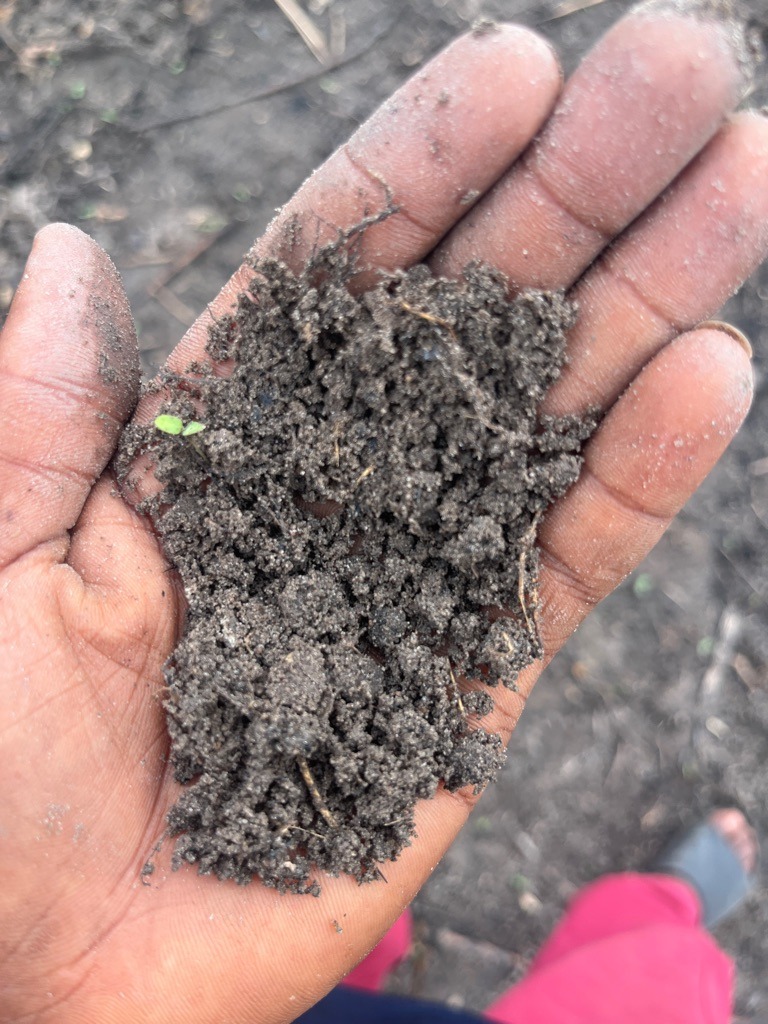
Silty Loam · Alluvial floodplain or managed agricultural garden topsoil enriched with compost over years of organic matter accumulation.
AI Disclaimer
This soil report was produced by AI from a single photo. Treat it as a starting point, not laboratory truth.
pH, drainage, fertility, and composition are visual estimates — send a sample to an accredited lab before any decision that would be painful to get wrong.
Crop and amendment tips are general guidance — local climate, microclimate, and gardening history always win over an AI's best guess.
pH
Slightly acidic to neutral 6.2–6.8 based on the dark organic coloration and healthy appearance; a standard soil pH test strip should be used to confirm.
Drainage
Well Drained. The granular structure and balanced particle size allow excess water to infiltrate steadily while retaining adequate moisture.
Organic Matter
Rich (4–8%). The deep coloration, visible crumbly aggregates, and presence of tiny plant seedlings suggest abundant microbial activity and active nutrient cycling.
Erosion Risk
Low to Moderate. While the granular structure resists water erosion well, bare tilled surfaces on slopes can still be vulnerable to heavy downpours without cover crops or mulch.
Overall Read
This is a premium-quality, highly fertile silty loam soil with exceptional structure, great organic content, and wonderful water retention. It provides an ideal medium for nearly any gardener or grower with very few inherent weaknesses.
Texture
Fine, crumbly, and friable with a slightly silky feel when rubbed between fingers; forms a weak ribbon that breaks easily, indicating a balanced mix of silt and clay bound together by rich organic matter.
Color Analysis
Dark brownish-gray (Munsell approximately 10YR 3/2) indicating a high content of decomposed organic matter (humus) combined with well-drained mineral components and active biological processes.
Estimated Composition
40% silt, 30% sand, 20% clay, and 10% organic matter (visual confidence is high based on crumb structure and dark coloration).
Water Retention
Excellent plant-available water holding capacity; holds moisture well during dry spells without becoming waterlogged or prone to severe puddling after moderate rainfall.
Aeration
High. The porous, crumbly granular peds allow oxygen to diffuse easily into the root zone while expelling excess carbon dioxide, supporting robust aerobic microbial life.
Compaction Level
Loose and friable with minimal to no surface crusting; shows great porosity and encourages deep, unhindered root growth.
Structure & Aggregation
Granular structure with high aggregate stability. Peds break apart easily under light pressure, creating optimal pore space for root penetration and gas exchange.
Fertility Indicators
High fertility indicated by the dark humus-rich coloration, visible organic debris, and the presence of a healthy tiny seedling actively germinating in the sample.
Climate Suitability
Thrives best in temperate and humid subtropical climates with moderate, well-distributed rainfall.
Crops Worth Trying
Leafy greens, tomatoes, peppers, root vegetables, corn, beans, squash, and cover crops like clover or rye.
Plants To Avoid
Extreme drought-loving desert species or plants requiring specialized extreme soils (like carnivorous bog plants), though very few plants struggle in this versatile soil.
Home Garden Use
Ideal for in-ground vegetable gardens, raised beds, flower borders, herbaceous perennials, and fruit orchards.
Agricultural Use
Highly suited for organic farming, intensive market gardening, diverse row crops, and rotational pasture systems.
Landscaping Use
Exceptional for turf establishment, ornamental planting beds, shrub borders, and foundation plantings.
Common Problems
Minor nutrient leaching during exceptionally heavy rains and potential surface crusting if left completely bare and exposed to harsh sun.
Amendments Needed
Minimal amendments needed; an annual top-dressing of finished compost will maintain its stellar organic matter levels and structure.
Try These At Home Tests
Perform a standard mason jar texture sedimentation test to verify the silt/sand/clay percentages and a squeeze test to confirm the soil's crumbly friability.
Professional Lab Recommendation
Send a sample to a local extension lab every 2 to 3 years for a complete macronutrient (NPK), micronutrient, and cation exchange capacity (CEC) panel to fine-tune fertilization.
Fun Facts
Silty soils feel remarkably smooth like flour when dry and silky like wet talc when moist, largely due to wind-blown loess deposits found in some of the most productive agricultural breadbaskets on Earth.