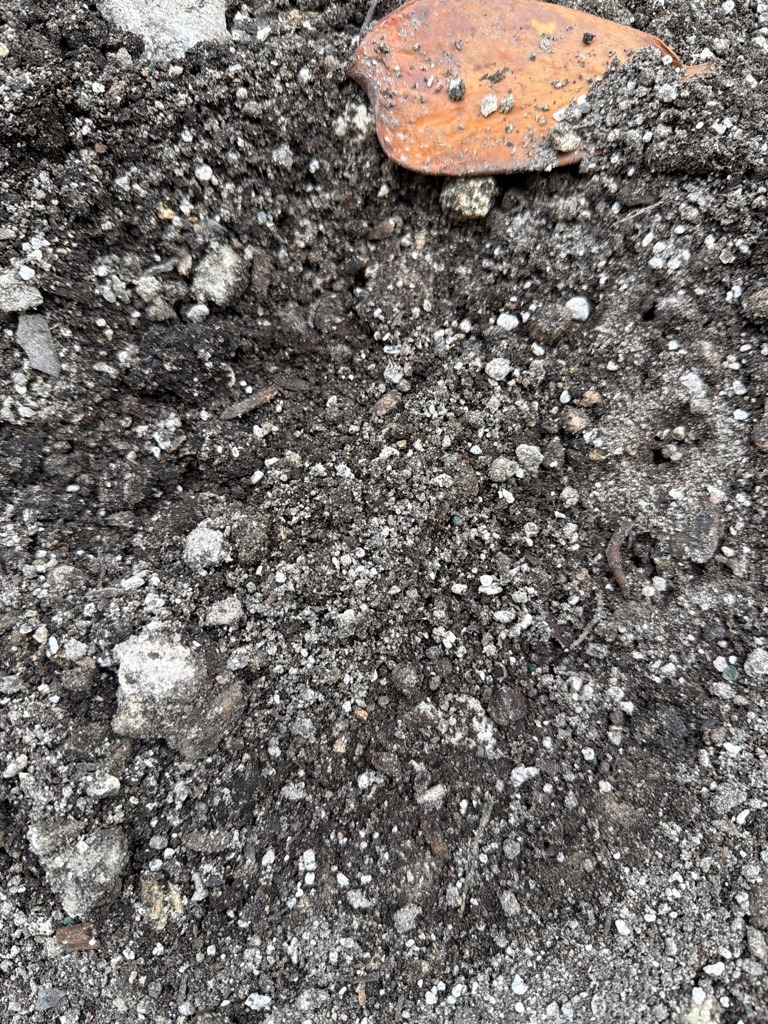
Dark Organic Potting Mix with Perlite
Sandy Loam / Artificial Soilless Blend · Manufactured or amended garden/potting soil blend utilizing local topsoil, compost, and expanded perlite.
AI Disclaimer
This soil report was produced by AI from a single photo. Treat it as a starting point, not laboratory truth.
pH, drainage, fertility, and composition are visual estimates — send a sample to an accredited lab before any decision that would be painful to get wrong.
Crop and amendment tips are general guidance — local climate, microclimate, and gardening history always win over an AI's best guess.
pH
Slightly acidic to neutral 6.0–7.0, typical of commercial organic potting soils balanced with peat or compost. Confirmation requires a pH meter or test strip.
Drainage
Well Drained. The inclusion of perlite and a sandy-loam matrix ensures rapid percolation of excess water while preventing waterlogging.
Organic Matter
Rich (4–8%). The dark coloration and crumbly texture strongly point to a high humus and compost fraction, supporting vibrant microbial life.
Erosion Risk
Low in containers or raised beds, but moderate to high if exposed to heavy wind or torrential rain on sloped ground due to its lightweight and loose nature.
Overall Read
An exceptionally grower-friendly, highly fertile, and well-aerated soil blend. Its primary strengths are excellent drainage and loose structure, making it a prime choice for containers and raised beds with minimal risk of compaction.
Texture
Coarse, gritty, and loose due to visible perlite amendments; particles feel light and friable, falling apart easily without forming a strong ribbon.
Color Analysis
Dark brownish-black (approx. 10YR 2/1 to 10YR 2/2) mixed with stark white perlite specks. The dark base indicates a high presence of humified organic matter and decomposed compost.
Estimated Composition
45% sand and perlite, 30% silt, 15% clay, 10% organic matter. Moderate-to-high confidence based on visible components typical of bagged mixes.
Water Retention
Moderate to high. The organic matter component holds moisture well, while the perlite prevents saturation, striking a balance ideal for container plants.
Aeration
Excellent. The open structure and white perlite particles create abundant macro-pores, ensuring high oxygen availability for roots and aerobic microbes.
Compaction Level
Loose and friable. There are no signs of hardpan or dense blocky peds; the soil is light and well-aerated.
Structure & Aggregation
Granular and loose, displaying excellent aggregate stability and a crumbly consistency that promotes easy root exploration and optimal gas exchange.
Fertility Indicators
Moderate to High. Dark humus coloring and visible organic debris suggest a steady nutrient release, though synthetic or organic fertilizers may be needed for heavy feeders.
Climate Suitability
Thrives in all temperate, subtropical, and tropical climates when used in controlled environments like raised beds, pots, and greenhouses.
Crops Worth Trying
Tomatoes, peppers, leafy greens, herbs, annual flowers, and container-grown ornamentals that prefer loose, well-draining media.
Plants To Avoid
Aquatic or marginal bog plants that require standing water and heavy anaerobic clay conditions.
Home Garden Use
Ideal for containers, raised beds, indoor potted plants, and starting seeds or transplanting seedlings.
Agricultural Use
Limited to specialty nursery container production, greenhouse operations, or high-value urban farming plots.
Landscaping Use
Excellent for annual flower beds, container gardening around patios, and amending planting holes for new shrubs and trees.
Common Problems
Quick nutrient leaching due to high drainage, rapid drying out in hot summer sun, and potential floatation of perlite during heavy watering.
Amendments Needed
Balanced organic slow-release fertilizer, worm castings, or occasional compost top-dressings to sustain long-term fertility.
Try These At Home Tests
Perform a squeeze test (should crumble easily without forming a hard ball) and a jar test to verify sand/silt/clay ratios.
Professional Lab Recommendation
Recommended only for commercial setups or persistent plant health issues; request a Saturated Paste Extract test for pH, EC, and macro-nutrients.
Fun Facts
Perlite, the white mineral visible in the soil, is actually a hydrated volcanic glass that expands up to 20 times its original volume when heated.