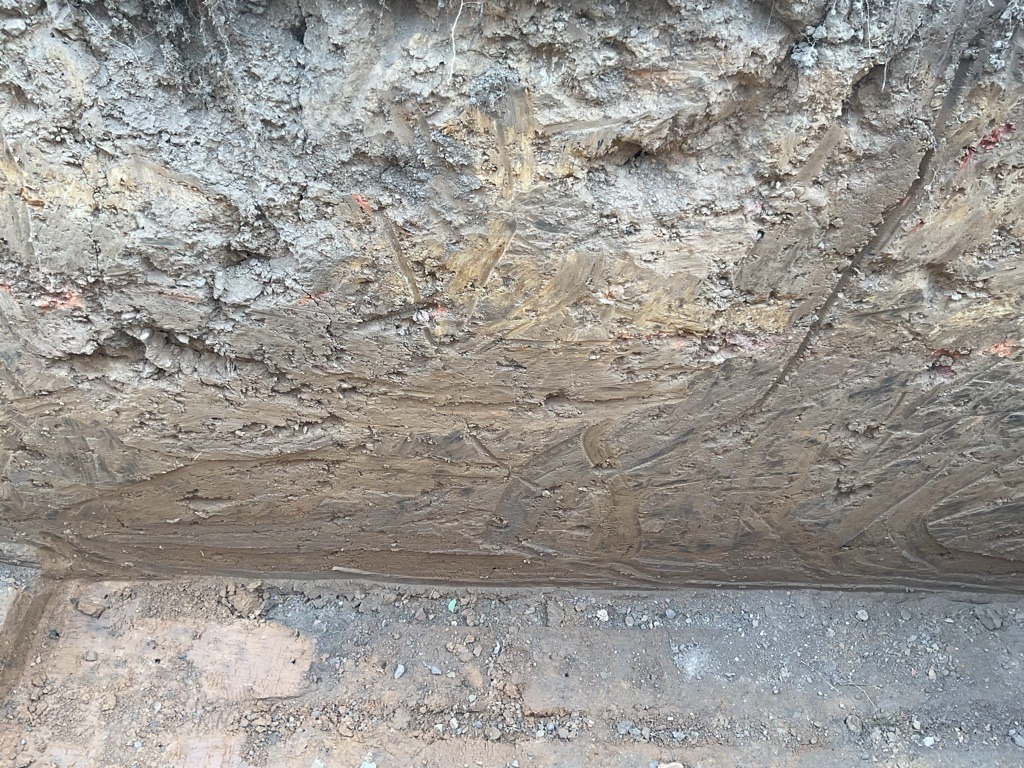
Weathered Glacial Subsoil Till
Clay Loam · Glacial till or deeply weathered parent material exposed in a construction cut, common in northern or midwestern continental regions.
AI Disclaimer
This soil report was produced by AI from a single photo. Treat it as a starting point, not laboratory truth.
pH, drainage, fertility, and composition are visual estimates — send a sample to an accredited lab before any decision that would be painful to get wrong.
Crop and amendment tips are general guidance — local climate, microclimate, and gardening history always win over an AI's best guess.
pH
Slightly acidic to neutral (6.2 to 7.2) based on mineralogy and typical subsoil leaching profiles, though a lab test is required for verification.
Drainage
Moderately Poorly Drained due to high clay content, compacted profile, and visible mottling which points to periodic water retention and slow internal drainage.
Organic Matter
Very low (<1%) due to this being a subsurface profile exposed via excavation, lacking surface litter and root accumulation.
Erosion Risk
Moderate on slopes when exposed, primarily susceptible to gully and sheet water erosion due to slow infiltration rates and lack of vegetative cover.
Overall Read
This exposed subsoil layer is dense, heavy, and structurally challenging for direct growing. It requires substantial organic amendments, mechanical loosening, and topsoil capping to become productive for gardening or landscaping.
Texture
Fine, smooth, and plastic when wet; capable of forming a long, flexible ribbon during a ribbon test indicating significant clay content combined with fine silt and sand fractions.
Color Analysis
Dull grayish-brown to yellowish-brown matrix (approx. 10YR 5/2 to 10YR 5/4) with distinct brownish-yellow and reddish mottling, indicating fluctuating water tables and oxidized iron minerals.
Estimated Composition
35% sand, 30% silt, 25% clay, and 10% coarse fragments/weathered rock fragments, with very low organic matter.
Water Retention
High total water holding capacity, but a significant portion of held water is tightly bound to clay particles, reducing plant-available water compared to an ideal organic loam.
Aeration
Restricted aeration due to fine texture, compaction, and moisture retention, increasing the risk of temporary anaerobic conditions following heavy rain.
Compaction Level
Compacted, dense subsoil layer showing clear mechanical smearing and high bulk density that restricts deep root penetration.
Structure & Aggregation
Subangular blocky to massive structure with smeared face marks from excavation equipment, showing moderate aggregate stability but limited natural macropores.
Fertility Indicators
Low fertility indicators; pale subsoil color, absence of humus, and lack of visible biological activity or root channels dictate low inherent nutrient status.
Climate Suitability
Cool to warm temperate climates with moderate rainfall, requiring careful moisture management and structural improvement.
Crops Worth Trying
Deep-rooted perennial grasses, alfalfa, or hardy trees and shrubs once the upper layer is amended and loosened.
Plants To Avoid
Sensitive shallow-rooted annual vegetables, delicate ornamentals, and plants requiring rapid, free-draining sandy conditions.
Home Garden Use
Unsuitable for direct in-ground gardening without extensive excavation, amendment, and topsoil replacement; better suited as sub-base for raised beds.
Agricultural Use
Requires deep ripping, subsoiling, and long-term cover cropping with deep-rooting species to break compaction and build organic matter for row crops.
Landscaping Use
Challenging for direct turf establishment or planting pits; requires breaking up side walls of holes to prevent the 'bathtub effect' and root girdling.
Common Problems
Severe compaction, poor drainage, surface crusting when exposed to sun, hardpan formation, and difficult digging conditions.
Amendments Needed
Heavy incorporation of compost, aged manure, and coarse organic matter into the top layers, along with gypsum if sodium-induced dispersion is present.
Try These At Home Tests
Perform a ribbon test to confirm clay content, a jar settling test for particle fractions, and a percolation test to measure infiltration speed.
Professional Lab Recommendation
Recommended before major structural landscaping or farming; request standard fertility, cation exchange capacity (CEC), heavy metals, and texture analysis.
Fun Facts
Subsoil layers like this often preserve geological history and glacial movement patterns over thousands of years before human exposure.