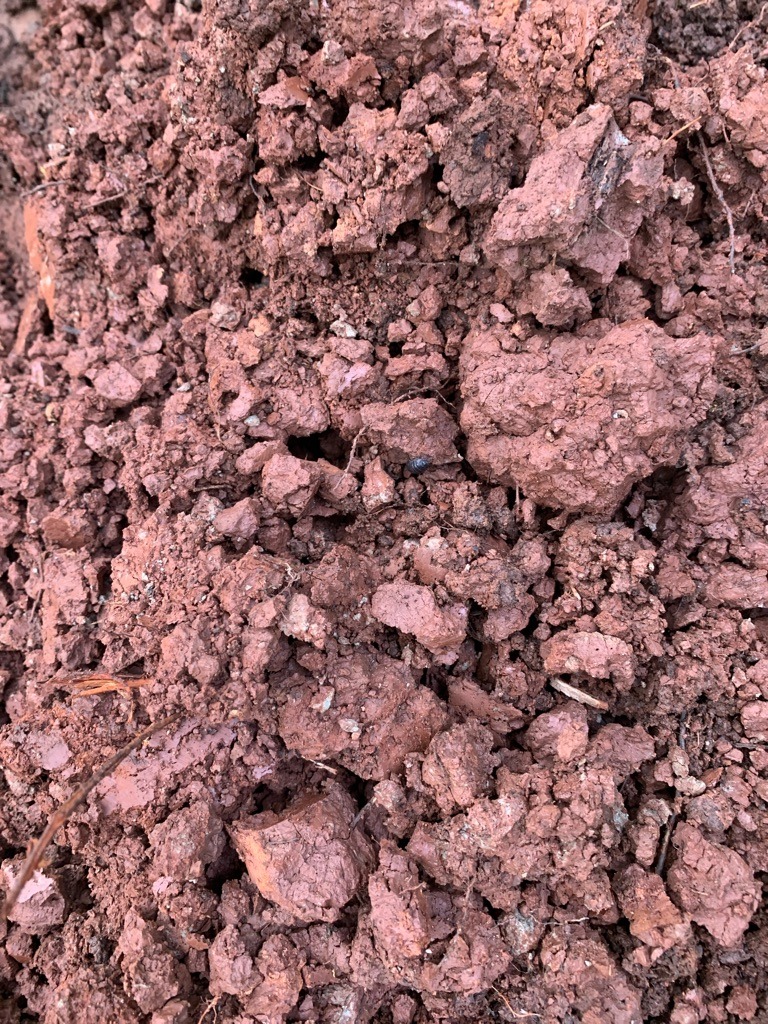
Upland Red Clay Residuum
Clay · Weathered residuum likely from the Southeastern United States (Piedmont region) or similar Ultisol/Oxisol tropical-temperate weathering zones.
AI Disclaimer
This soil report was produced by AI from a single photo. Treat it as a starting point, not laboratory truth.
pH, drainage, fertility, and composition are visual estimates — send a sample to an accredited lab before any decision that would be painful to get wrong.
Crop and amendment tips are general guidance — local climate, microclimate, and gardening history always win over an AI's best guess.
pH
Moderately acidic (5.0–6.0). Highly weathered red soils often have leached bases (calcium/magnesium), concentrating Aluminum and Iron which lowers pH.
Drainage
Moderately Poorly Drained. While the iron oxidation indicates some oxygen presence, the heavy clay content leads to slow percolation and potential surface ponding.
Organic Matter
Low to Moderate (2–3%). While there are visible roots and a wood-louse (isopod), the bright red color suggests iron dominates the visual profile over humus.
Erosion Risk
Moderate to High. On slopes, the lack of rapid infiltration leads to high runoff and sheet erosion. In dry states, it can be prone to wind erosion if pulverized.
Overall Read
A challenging but potentially productive 'heavy' soil. Excellent nutrient-holding capacity but requires significant organic matter to overcome its physical density. Rating: 6/10 for general gardening.
Texture
Fine-textured, smooth, and plastic. It would produce a long, flexible ribbon (over 2 inches) and feel extremely sticky when wet and rock-hard when dry.
Color Analysis
Dark reddish brown (2.5YR 3/4 to 5YR 4/4). This intense red hue indicates high concentrations of oxidized iron (hematite) and suggests a highly weathered, older soil with aerobic history.
Estimated Composition
5% Sand, 25% Silt, 65% Clay, 5% Organic Matter. Confidence is high regarding the dominant clay fraction due to the blocky peds and distinct coloring.
Water Retention
High field capacity. It holds moisture tenaciously but may hold it so tightly that plants reach a wilting point if the soil dries out and cracks.
Aeration
Moderate to Low. Oxygen exchange is limited to the cracks between blocky peds. Internal pore space within the clods is likely very small.
Compaction Level
High potential. The image shows large, dense clods which suggest it may have been mechanically disturbed or naturally compacted when wet.
Structure & Aggregation
Subangular blocky structure. The soil breaks into distinct chunks (peds) with flat faces. This provides some macro-pores but is overall quite dense.
Fertility Indicators
Moderate. It likely has high Cation Exchange Capacity (CEC) to hold nutrients, but Phosphorus may be chemically 'fixed' by the high iron content. Rating: Moderate.
Climate Suitability
Humid temperate or subtropical climates. Management requires careful timing of tillage to avoid 'smearing' the soil when it is too wet.
Crops Worth Trying
Stone fruits (peaches/plums) if drainage is managed, hardy grasses, okra, sweet potatoes, and native hardwoods like Oak or Hickory.
Plants To Avoid
Blueberries (if pH is not precisely managed), root vegetables like carrots (which will misshapen in the heavy clay), and Mediterranean herbs like Lavender.
Home Garden Use
Best for raised beds using imported mix or heavily amended in-ground perennial borders. Not suitable for direct-sown delicate flower seeds.
Agricultural Use
Pasture and hay production is ideal. Row crops like soy or cotton can work with no-till practices to preserve structure and moisture.
Landscaping Use
Utility for pond liners or dam cores due to low permeability. Requires massive organic amendment for ornamental turf or flower beds.
Common Problems
Surface crusting that prevents seedling emergence, slow warming in spring, and extreme hardness when dry making weeding impossible.
Amendments Needed
Gypsum (to improve aggregation), heavy applications of compost or aged leaf mold, and lime to raise the pH if it tests below 6.0.
Try These At Home Tests
Try the Squeeze Test: if the ball stays together after a poke, it’s high clay. Jar Test: the water will remain cloudy for days as fine clay settles slowly.
Professional Lab Recommendation
Highly recommended for a Basic Soil Suite (~$15-30). Key focus: Phosphorus fixation levels and Lime Requirement (Buffer pH) to neutralize acidity.
Fun Facts
The red color comes from the mineral Hematite, named after the Greek word for blood. These soils are so stable for building that they were historically used for making sun-dried bricks.