Texas Blackland Prairie Calcareous Clay
Clay · Cretaceous limestone-derived residuum and colluvium typical of the Texas Blackland Prairie or similar central Texas geological formations.
AI Disclaimer
This soil report was produced by AI from a single photo. Treat it as a starting point, not laboratory truth.
pH, drainage, fertility, and composition are visual estimates — send a sample to an accredited lab before any decision that would be painful to get wrong.
Crop and amendment tips are general guidance — local climate, microclimate, and gardening history always win over an AI's best guess.
pH
Alkaline 7.8 to 8.2 due to the presence of limestone bedrock and calcium carbonate, though this must be confirmed with a soil test kit.
Drainage
Moderately well to poorly drained depending on moisture status; highly permeable when dry due to deep cracks, but extremely slow draining once the clay swells shut.
Organic Matter
Low to moderate (1 to 3 percent) on the exposed subsoil surface, though native undisturbed topsoil can be much richer.
Erosion Risk
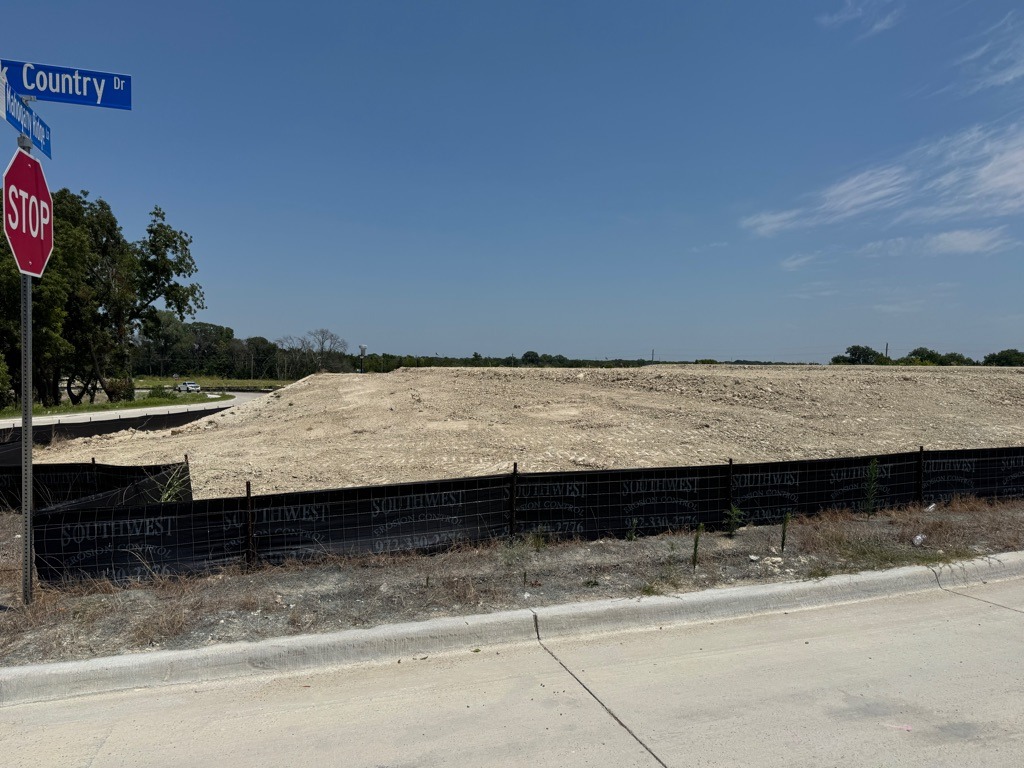
High water and sediment erosion risk on slopes, as evidenced by the silt fencing installed around the disturbed construction site.
Overall Read
A challenging yet inherently fertile calcareous clay subsoil requiring careful management of moisture, organic matter, and compaction to achieve optimal horticultural results.
Texture
Very fine, highly plastic, and sticky when wet, drying into hard, angular blocks with deep surface cracking.
Color Analysis
Light grayish-brown to pale cream with chalky marl inclusions, reflecting high calcium carbonate content, low organic matter on the exposed surface, and well-aerated oxidized minerals.
Estimated Composition
15 percent sand, 25 percent silt, 55 percent clay, and 5 percent organic matter, with a high confidence level based on regional geology and visual texture.
Water Retention
Extremely high water-holding capacity, but much of the water is held tightly at high tension and may not be fully plant-available.
Aeration
Good when dry and cracked, but severely restricted when wet due to the swelling clay sealing off pore spaces.
Compaction Level
Moderately firm to compacted due to heavy machinery grading and natural subsoil density, presenting hardpan tendencies.
Structure & Aggregation
Strong blocky to massive structure with high shrink-swell (vertic) properties and distinct aggregate stability when dry.
Fertility Indicators
Moderate to high inherent mineral fertility, though visible indicators are masked by excavation and exposure of subsoil materials.
Climate Suitability
Subtropical to temperate semi-humid climates with hot summers and mild winters, requiring drought management and erosion control.
Crops Worth Trying
Native prairie grasses, deep-rooting trees like live oaks and pecans, cotton, grain sorghum, wheat, and adapted warm-season turfgrasses.
Plants To Avoid
Acid-loving plants such as blueberries, azaleas, rhododendrons, and shallow-rooted annuals sensitive to extreme moisture swings.
Home Garden Use
In-ground native perennial gardens and established lawns, though raised beds are strongly recommended for annual vegetable production.
Agricultural Use
Large-scale row cropping of cotton and grains, and extensive cattle pasture, heavily reliant on no-till or timely tillage practices.
Landscaping Use
Drought-tolerant native landscaping, slope stabilization with deep-rooted grasses, and turf establishment behind retaining walls.
Common Problems
Severe shrinking and swelling, surface crusting, deep cracking that damages foundations and roots, and difficulty working when too wet or too dry.
Amendments Needed
Heavy applications of compost and organic matter to improve workability, coupled with expanded mulch layers to buffer moisture extremes.
Try These At Home Tests
Perform a ribbon test to confirm high clay content, a jar sedimentation test to break down particle percentages, and a basic pH strip test.
Professional Lab Recommendation
Submit a sample to a local agricultural extension office for a complete nutrient panel, cation exchange capacity, and salinity check before undertaking major landscaping.
Fun Facts
Vertisols like these are famous for self-mulching behavior through a natural process called argillipedoturation, where surface soil falls into deep cracks and pushes upward.