Red Piedmont Clay Loam
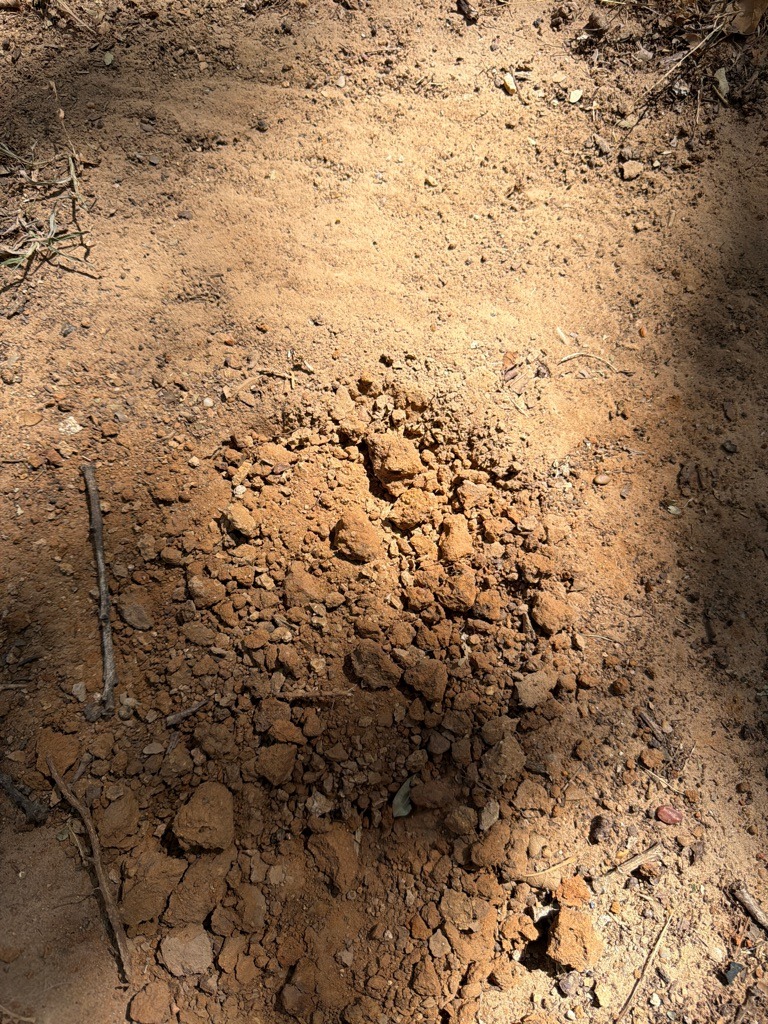
Clay Loam · Weathered residual soil or subsoil fill, typical of the Piedmont region or similar iron-rich clay-bearing geologies.
AI Disclaimer
This soil report was produced by AI from a single photo. Treat it as a starting point, not laboratory truth.
pH, drainage, fertility, and composition are visual estimates — send a sample to an accredited lab before any decision that would be painful to get wrong.
Crop and amendment tips are general guidance — local climate, microclimate, and gardening history always win over an AI's best guess.
pH
Slightly acidic to moderately acidic (5.5–6.5) based on the reddish iron oxide coloration and regional weathering patterns. Requires a test strip or probe for verification.
Drainage
Moderately well drained. The soil forms distinct structural peds that prevent immediate waterlogging, but the finer clay fraction will slow down infiltration compared to sandy soils.
Organic Matter
Low to moderate (1.5–3%), indicated by the lighter surface dust combined with the richer, darker brown organic debris trapped within the central aggregated mound.
Erosion Risk
Moderate water and tillage erosion risk on slopes, primarily due to the fine silt and clay particles that detach easily when unprotected by ground cover.
Overall Read
A robust, productive clay loam typical of lawn and garden environments. While structurally sound and rich in mineral potential, it benefits greatly from regular organic matter additions and aeration to combat surface compaction.
Texture
Fine and dense with crumbly aggregated peds in the center mound and a smoother, dusty surface profile. It would likely form a moderate to long ribbon in a ribbon test, indicating a significant clay fraction balanced by silt and sand.
Color Analysis
Warm reddish-brown to yellowish-red (approx. 5YR 4/6 or 2.5YR 5/6), strongly indicating the presence of oxidized iron minerals (hematite and goethite), typical of weathered residual soils with good historical drainage.
Estimated Composition
40% sand, 25% silt, 25% clay, 10% organic matter/residue. Moderate confidence based on visual aggregation and surface texture.
Water Retention
Good to high water-holding capacity. It retains plant-available moisture well after rainfall, though the surface can form a crust and dry out quickly under direct sun.
Aeration
Moderate. Good when freshly tilled or aggregated, but prone to reduced pore space and lower oxygen diffusion if surface compaction or crusting occurs.
Compaction Level
Moderately firm to compacted on the undisturbed surrounding surface, typical of high-traffic lawn areas, while the excavated mound shows friable clods.
Structure & Aggregation
Subangular blocky to granular structure in the central disturbed mound with moderate aggregate stability. Surface areas show some crusting tendency.
Fertility Indicators
Moderate fertility. The reddish mineral base offers decent mineral reserves, but low surface organic matter suggests a need for humus enrichment to optimize nutrient availability.
Climate Suitability
Thrives best in temperate to warm, humid subtropical climates with moderate rainfall patterns.
Crops Worth Trying
Fescue grasses, Bermuda grass, clover, tomatoes, peppers, fruit trees, and deep-rooting ornamentals that tolerate heavier clay profiles.
Plants To Avoid
Root crops like large carrots or parsnips that may deform in dense clay, and moisture-sensitive desert species.
Home Garden Use
Established lawns, perennial flower beds, and shrubs when amended with organic matter. Less ideal for unamended direct-seeding of fine root crops.
Agricultural Use
Pasture, forage production, orchards, and row crops managed with conservation tillage and cover cropping to prevent compaction.
Landscaping Use
Turf establishment, ornamental shrub borders, and foundation plantings, provided surface compaction is managed with core aeration.
Common Problems
Surface crusting after heavy rains, seasonal drying out leading to hardening, and compaction from foot traffic.
Amendments Needed
Compost or aged leaf mold to boost organic matter and improve surface aggregation; gypsum if sodium-induced dispersion is suspected.
Try These At Home Tests
Perform a mason jar sedimentation test for exact particle breakdown and a ribbon test between your thumb and forefinger to verify clay content.
Professional Lab Recommendation
Recommended if establishing a high-value garden or orchard. Request a standard fertility test, organic matter percentage, cation exchange capacity (CEC), and pH.
Fun Facts
The distinct red color of Piedmont-style soils comes from iron oxides that accumulated over thousands of years as surrounding minerals weathered away.
Your Notes
Back lawn T-house