Compacted Silt Loam Pathway Soil
Silt Loam · Alluvial floodplain deposits or loess-derived upland soils subjected to mechanical surface disturbance and heavy traffic.
AI Disclaimer
This soil report was produced by AI from a single photo. Treat it as a starting point, not laboratory truth.
pH, drainage, fertility, and composition are visual estimates — send a sample to an accredited lab before any decision that would be painful to get wrong.
Crop and amendment tips are general guidance — local climate, microclimate, and gardening history always win over an AI's best guess.
pH
Neutral to slightly alkaline (6.8 to 7.6), typical of mineral-rich subsoils or surface soils exposed to evaporation. Visual cues lack extreme acid leaching indicators. Confirmation requires a soil test kit or digital pH meter.
Drainage
Moderately drained to poorly drained when compacted. Surface sealing and compaction severely restrict infiltration, leading to water pooling during heavy rains despite moderate internal drainage capacity of uncompacted silt loam.
Organic Matter
Low (1 to 2 percent). The pale color and lack of dark crumbly surface residue or visible humus indicate minimal decaying organic matter, leading to reduced biological activity.
Erosion Risk
Moderate to high water and tillage erosion risk. The fine silty particles easily detach with rainfall impact, and surface crusting increases runoff volume down any slope.
Overall Read
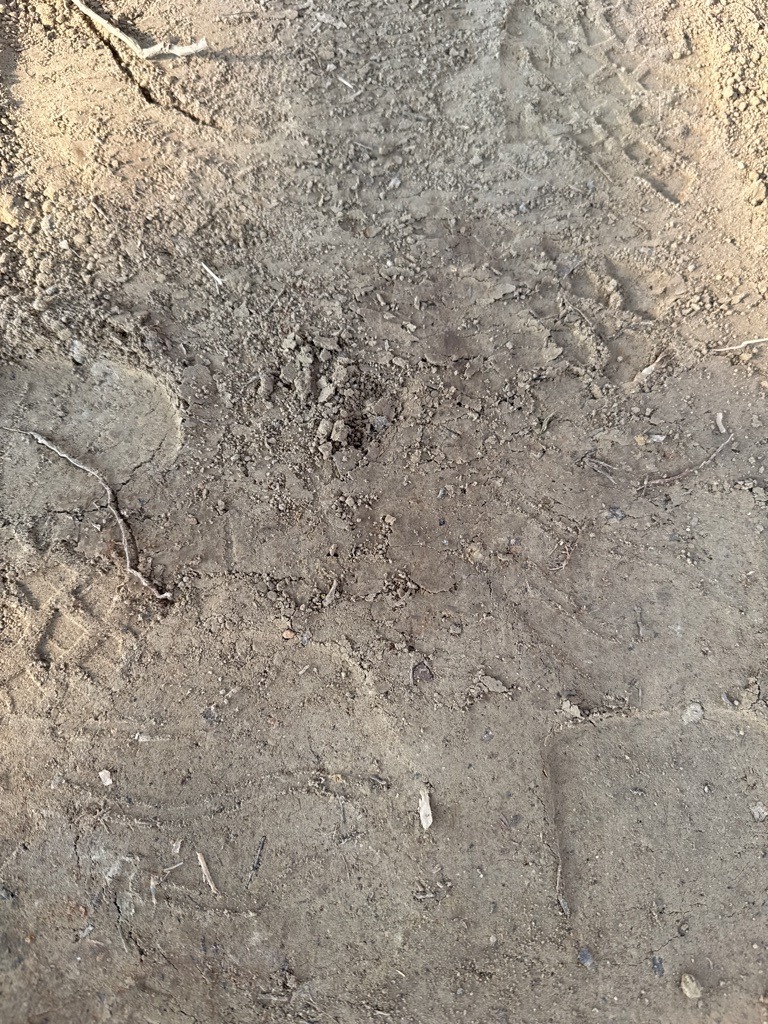
This pale, silt-dominant soil shows significant surface compaction and crusting with low organic matter. While mineralogically rich and capable of supporting plant life, its immediate utility is limited by dense traffic patterns and sealed pores. Success requires breaking the compaction layer, heavily incorporating organic compost, and establishing continuous living roots or mulches to protect the vulnerable surface.
Texture
Fine, silty, and powdery when dry, exhibiting a smooth, slightly slick feel with weak cohesion. In a ribbon test, it would form a short, fragile ribbon before breaking, indicating a high silt content mixed with minor clay.
Color Analysis
Light grayish brown to pale brown (Munsell 10YR 6/3 to 10YR 5/3). The light value and low chroma suggest a low organic matter content, well-aerated oxidizing conditions, and mineral-dominated composition without significant iron accumulation or dark humic staining.
Estimated Composition
70 percent silt, 20 percent clay, 8 percent sand, and 2 percent organic matter. Visual estimate confidence is moderate due to surface crusting and vehicle track compaction obscuring underlying peds.
Water Retention
Moderate to high water-holding capacity due to small pore sizes in the silt fraction, but plant-available water may be limited because water can be held tightly in micropores and roots struggle to penetrate the dense matrix.
Aeration
Low to moderate. Compaction squeezes out macropores, reducing the oxygen supply available to plant roots and beneficial soil microbes, potentially leading to marginal conditions for sensitive crops.
Compaction Level
Compacted to severely compacted. Clear vehicle tire tracks, surface crusting, and smooth flattened areas indicate heavy traffic and weight load, restricting root growth and gas exchange.
Structure & Aggregation
Massive to platy structure at the surface due to compaction and crusting, with weak, unstable granular fragments where disturbed. Aggregate stability is very low, making the surface vulnerable to breakdown.
Fertility Indicators
Low overall fertility. The light color, absence of earthworm casts, sparse organic residue, and surface crusting indicate low nutrient reserves and minimal biological cycling. Rating: Low.
Climate Suitability
Thrives in temperate and semi-arid climates where rainfall is gentle, but requires careful moisture management and surface protection in arid or high-rainfall regions.
Crops Worth Trying
Tough cover crops like daikon radish and cereal rye (to break compaction), drought-tolerant grasses, and established deep-rooted trees that can push through dense layers.
Plants To Avoid
Fine root vegetables like carrots and parsnips (which will deform in compacted soil) and moisture-sensitive perennials prone to root rot during surface ponding.
Home Garden Use
Needs heavy remediation before use; unsuited for direct in-ground vegetable beds without tilling, aeration, and organic amendment additions. Best used as a base layer for paths or completely rebuilt with raised beds.
Agricultural Use
Requires chisel plowing or subsoiling to break hardpan layers, followed by continuous cover cropping and no-till organic buildup to restore soil health for row crops.
Landscaping Use
Suitable for turf pathways or compacted areas after mechanical aeration and topdressing with compost, but poorly suited for new ornamental planting pits without extensive soil loosening.
Common Problems
Surface crusting that impedes seed germination, rapid runoff, puddling, poor root penetration, and seasonal drought stress due to restricted root zones.
Amendments Needed
Heavy applications of finished compost (2 to 3 inches tilled or worked in), gypsum if sodium-induced dispersion is present, and planting deep-rooting cover crops to naturally fracture the subsoil.
Try These At Home Tests
Perform a jar settling test to verify sand, silt, and clay percentages. Conduct a percolation test by digging a hole, filling it with water, and timing drainage rates to confirm compaction issues.
Professional Lab Recommendation
Send a sample to a local agricultural extension service for a standard fertility test, organic matter percentage, and cation exchange capacity to determine exact nutrient deficiencies.
Fun Facts
Silt particles are intermediate in size between sand and clay (0.002 to 0.05 mm). Wind-blown silt deposits, known as loess, cover vast areas of the central United States, Europe, and China, forming some of the world's most productive agricultural lands when properly managed.