Saturated Marl-Derived Urban Calcareous Loam
Clay Loam / Calcareous Marl Blend · Coastal or limestone-shelf urban fill, likely a blend of native calcareous marl, crushed limestone aggregate, and imported topsoil or excavated subsoil.
AI Disclaimer
This soil report was produced by AI from a single photo. Treat it as a starting point, not laboratory truth.
pH, drainage, fertility, and composition are visual estimates — send a sample to an accredited lab before any decision that would be painful to get wrong.
Crop and amendment tips are general guidance — local climate, microclimate, and gardening history always win over an AI's best guess.
pH
Alkaline 7.5–8.5, strongly influenced by the visible white limestone and calcareous gravel/marl parent material typical of coastal or limestone-shelf regions. Confirmation via digital meter or test strip is strongly recommended.
Drainage
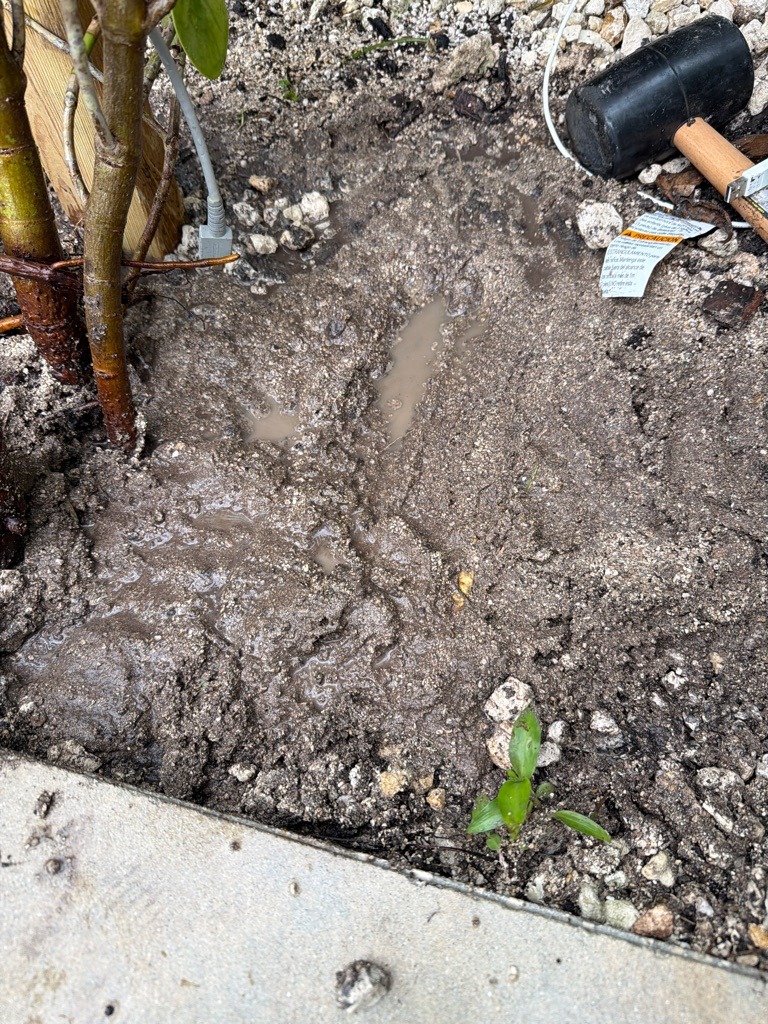
Poorly Drained. Standing water puddles visibly on the surface, and the soil shows severe puddling, smeared wheel or foot impressions, and saturated slumping, indicating restricted infiltration and perched water tables.
Organic Matter
Moderate (2–4%), visible primarily as dark surface humus mixed with mineral fines, though largely diluted by the dense mineral and calcareous parent material.
Erosion Risk
Moderate water erosion risk on slopes during heavy downpours due to surface sealing and high runoff rates, though flat areas are mostly prone to puddling and crusting upon drying.
Overall Read
A challenging, heavy, and alkaline soil currently suffering from severe saturation and compaction. While rich in mineral potential, it requires urgent drainage management, organic matter incorporation, and pH monitoring before it can reach high horticultural productivity.
Texture
Sticky and plastic when wet, showing smooth smeared surfaces under pressure with coarse mineral fragments and limestone chunks. A ribbon test would likely form a moderate to long ribbon before breaking, indicating a significant fine-particle (clay/silt) fraction mixed with coarse calcareous gravel.
Color Analysis
Dull brownish-gray with grayish-brown undertones (approx. 10YR 5/2 to 10YR 4/2). The cool, muted gray-brown tones suggest poor internal drainage, intermittent waterlogging, and lower mature organic matter relative to mineral content, with iron reduction in saturated zones.
Estimated Composition
35 percent sand and gravel, 35 percent silt, 20 percent clay, and 10 percent organic matter and weathered limestone fragments. Visual estimate confidence is moderate due to saturation masking true structural peds.
Water Retention
High water-holding capacity due to the fine silt and clay fraction, but tends to become waterlogged and poorly aerated rapidly following heavy rain or irrigation.
Aeration
Very low when saturated. The ponded water and smeared surface seal off oxygen diffusion, creating temporary anaerobic micro-sites harmful to sensitive plant roots.
Compaction Level
Moderately to severely compacted in the wet state, showing high plasticity and sealing at the surface which prevents proper gas exchange.
Structure & Aggregation
Massive to structure-reduced when wet, collapsing into a smeared, puddled matrix under minimal mechanical pressure. Low aggregate stability in a saturated state.
Fertility Indicators
Moderate fertility. Mineral reserves are decent due to parent material, but nutrient availability may be locked up by high pH (alkalinity) and restricted root respiration due to waterlogging.
Climate Suitability
Thrives best in Mediterranean or arid/semi-arid climates where excess moisture quickly evaporates, but presents challenges in humid or high-rainfall zones without drainage modifications.
Crops Worth Trying
Mediterranean herbs (rosemary, thyme), certain brassicas, figs, olives, and resilient turfgrasses that tolerate temporary saturation and alkaline conditions.
Plants To Avoid
Acid-loving plants (blueberries, azaleas, rhododendrons, conifers) and plants highly sensitive to root rot and poor drainage (such as certain delicate ornamentals and taprooted vegetables in wet seasons).
Home Garden Use
Raised beds built on top of the native grade, or heavily amended in-ground beds for alkaline-tolerant species. Not well-suited for direct in-ground root crop production without structural improvement.
Agricultural Use
Pasture, specialized orchards, or brassica production, provided subsurface tile drainage or raised hilling is implemented to manage excess water.
Landscaping Use
Drought-tolerant or limestone-adapted ornamental plantings using raised berms, or as a base layer beneath hardscaping if properly stabilized.
Common Problems
Surface crusting upon drying, waterlogging after rain, high alkalinity nutrient lockout, and susceptibility to compaction and smearing when worked wet.
Amendments Needed
Incorporate coarse organic compost, aged bark, and elemental sulfur (if lowering pH is desired) to improve structure, break up compaction, and enhance drainage. Avoid adding fine sand alone, which can create a cement-like mixture.
Try These At Home Tests
Perform a jar settling test to separate sand, silt, and clay percentages. Do a ribbon test by rolling moist soil between your thumb and forefinger. Test drainage by digging a small hole, filling it with water, and timing the percolation rate.
Professional Lab Recommendation
Send a sample to a local extension service for a complete saturated paste pH test, cation exchange capacity (CEC), calcium carbonate equivalent, and micronutrient panel to address potential alkaline nutrient lockouts.
Fun Facts
Marl and calcareous soils have been used for centuries to neutralize acidic agricultural lands and provide essential calcium for crop cell wall development, forming the foundation of many historic agricultural regions over limestone beds.