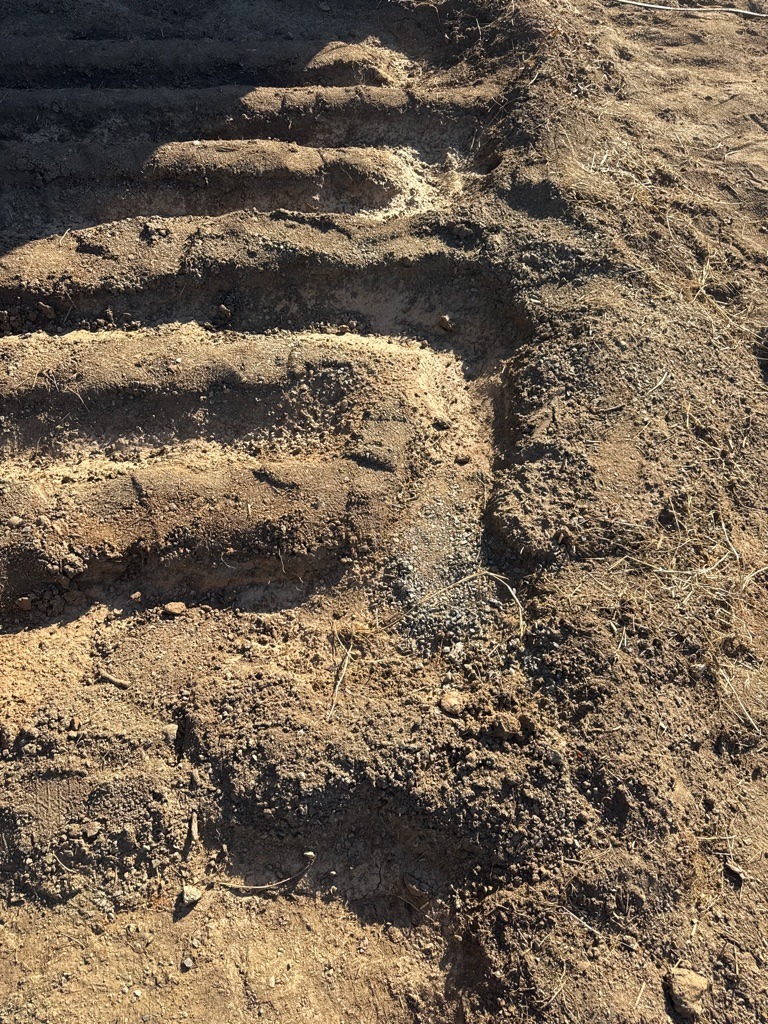
Arid Disturbed Sandy Loam
Sandy Loam · Alluvial or colluvial deposits likely from the Southwestern United States or similar Mediterranean/Semi-Arid climates.
AI Disclaimer
This soil report was produced by AI from a single photo. Treat it as a starting point, not laboratory truth.
pH, drainage, fertility, and composition are visual estimates — send a sample to an accredited lab before any decision that would be painful to get wrong.
Crop and amendment tips are general guidance — local climate, microclimate, and gardening history always win over an AI's best guess.
pH
Slightly alkaline (7.3–8.2) based on the arid appearance and lack of dark humus coloration typical of acidic soils.
Drainage
Well Drained to Excessively Drained; high sand content and visible porosity allow for rapid water infiltration.
Organic Matter
Low (1–2%); minimal visible plant residue and a pale color indicate a lack of humic substances.
Erosion Risk
High for wind erosion when dry; moderate for water erosion on slopes due to lack of stable aggregate binding.
Overall Read
A workable, high-drainage soil with a 'B-' rating. Its main strengths are ease of tillage and aeration, but it requires significant organic inputs to become highly productive.
Texture
Gritty and friable; likely to form a weak, crumbling ribbon less than 1 inch long before breaking.
Color Analysis
Light yellowish brown (10YR 6/4) when dry, darkening toward brown (10YR 4/3). The light value suggests low organic matter and well-oxidized minerals.
Estimated Composition
60% sand, 25% silt, 10% clay, 5% gravel/rock fragments, <2% organic matter.
Water Retention
Low; expects to dry out rapidly under sun exposure. Requires frequent irrigation due to low clay and organic sponge-effect.
Aeration
Excellent; large pore spaces between sand particles ensure high oxygen availability for root respiration.
Compaction Level
Moderately firm in tire tracks, but generally loose in the tilled ridges. High risk of surface crusting.
Structure & Aggregation
Weakly granular to subangular blocky; aggregates are present but appear fragile and susceptible to pulverization by machinery.
Fertility Indicators
Moderate to Low; lacks the deep darkness of high-nitrogen soils. Visual presence of gravel indicates a mineral-rich but nutrient-lean base.
Climate Suitability
Thrives in arid or semi-arid climates with controlled irrigation; requires heavy mulching in hot, dry summers.
Crops Worth Trying
Drought-tolerant herbs (lavender, rosemary), root vegetables (carrots, radishes), grapes, and stone fruits like peaches.
Plants To Avoid
Acid-loving plants (blueberries, azaleas) and water-intensive leafy greens without heavy amendment.
Home Garden Use
Excellent for in-ground Mediterranean herb gardens or drought-tolerant xeriscaping.
Agricultural Use
Suitable for orchards or vineyards with drip irrigation; also viable for small grains if moisture is managed.
Landscaping Use
Good for stabilized slopes or native plantings that require high drainage and low nutrient levels.
Common Problems
Rapid moisture loss, nutrient leaching (especially nitrogen), and potential for high alkaline salt buildup.
Amendments Needed
Incorporation of 3-4 inches of finished compost, followed by organic mulching to retain moisture.
Try These At Home Tests
A jar test (sedimentation) will likely show a thick bottom layer of sand settling in seconds, following by a thin silt/clay layer.
Professional Lab Recommendation
Request a basic nutrient profile and a soluble salts (EC) test to check for salinity issues common in these soil colors.
Fun Facts
Sandy loams like this are often called 'early soils' because they warm up much faster in the spring than heavy clay soils.