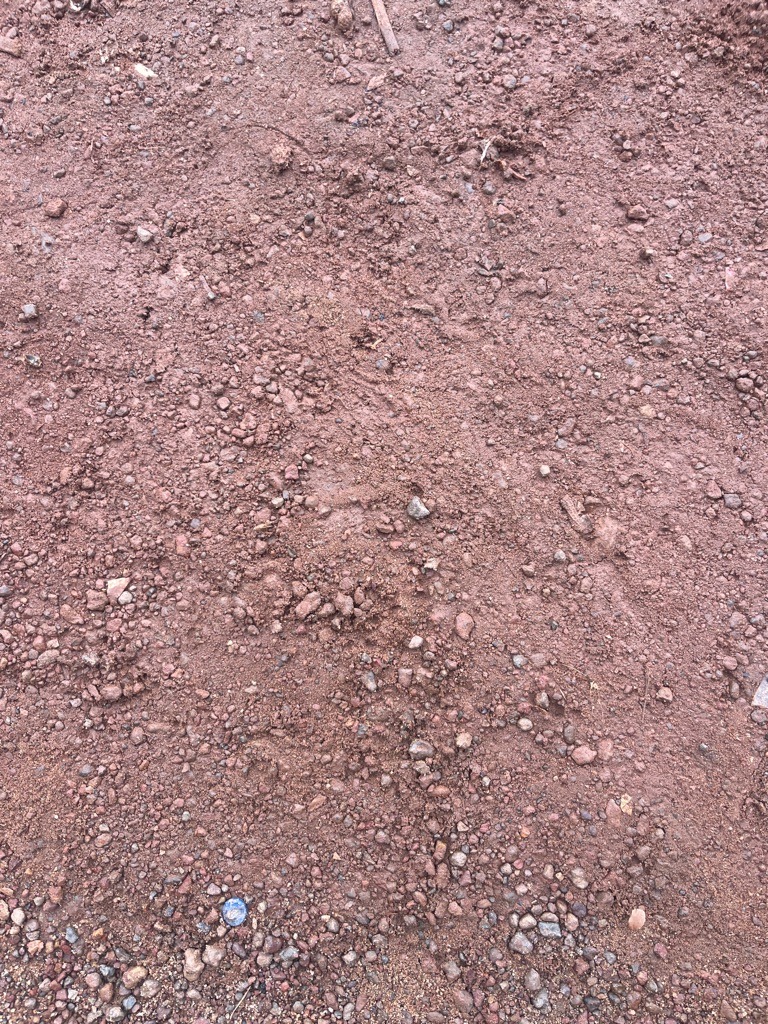
Red Sandy Clay Loam with Gravel
Sandy Clay Loam / Gravelly Clay Loam · Weathered igneous or metamorphic residual soil (e.g., Piedmont region, Ultisols/Oxisols) or alluvial/colluvial deposits rich in iron-bearing minerals like granite or basalt.
AI Disclaimer
This soil report was produced by AI from a single photo. Treat it as a starting point, not laboratory truth.
pH, drainage, fertility, and composition are visual estimates — send a sample to an accredited lab before any decision that would be painful to get wrong.
Crop and amendment tips are general guidance — local climate, microclimate, and gardening history always win over an AI's best guess.
pH
Moderately acidic to neutral (5.5 - 6.5). Highly weathered reddish soils rich in iron oxides are typically acidic to slightly acidic due to leaching of cations.
Drainage
Well Drained to Somewhat Excessively Drained. Macro-porosity from coarse sand and small stones allows fast initial infiltration, though clay fines may seal surface if compacted.
Organic Matter
Very Low (<1%). Lacks dark humus tones, earthy crumble, or visible organic plant residues.
Erosion Risk
High Risk for Water Erosion. Coarse grains lack organic binding agents, making surface particles easily detached by rain drop impact and transported by runoff on slopes.
Overall Read
Low fertility, gravelly reddish soil with poor organic content but decent structural drainage. Best suited for native plants, xeriscaping, or tree crops unless heavily amended with organic matter and compost for vegetable production.
Texture
Coarse and gritty mixed with fine plastic clay particles. When moist, it would likely form a short ribbon (1-2 cm) before breaking due to high sand and gravel content.
Color Analysis
Reddish brown to reddish orange (Munsell approximately 2.5YR 4/6 to 10R 4/6). This distinct red color indicates high oxidized iron (hematite) content, good historical drainage, and highly weathered mineralogy with low visible organic matter.
Estimated Composition
45% Sand, 25% Silt, 25% Clay, 5% Coarse Gravel/Rock Fragments, <1% Organic Matter (Visual confidence level: Moderate).
Water Retention
Moderate to Low. Holds some moisture within the clay fraction, but high sand and gravel content reduces overall plant-available water capacity compared to ideal loam.
Aeration
Good to Moderate oxygen availability near the surface due to coarse particle spacing, though fine particle settling can reduce Macropores if heavy rains occur.
Compaction Level
Moderately Firm at surface, susceptible to severe crusting and subsoil hardpan formation under heavy traffic or rainfall impact.
Structure & Aggregation
Weakly structured to Single-Grain/Granular coarse particles. Poor aggregate stability; peds easily break down into loose gravel, sand, and fine silt/clay dust.
Fertility Indicators
Low Fertility. Pale reddish hue, absence of dark organic matter, minimal biological activity indicators (no earthworm casts or fungal mycelium), high gravel ratio. Rated: Low.
Climate Suitability
Subtropical to Warm Temperate or Mediterranean climates. Requires regular irrigation, thick organic mulching, and continuous cover crop management to prevent drying out and erosion.
Crops Worth Trying
Drought-tolerant native shrubs, pine trees, sweet potatoes, peanuts, lavender, rosemary, grapes, and deep-rooting leguminous cover crops (e.g., crimson clover, cowpeas).
Plants To Avoid
Moisture-loving greens (spinach, lettuce), shallow-rooted vegetables, and plants sensitive to acidic, low-organic soil unless heavily amended.
Home Garden Use
Ideal sub-base or fill; suitable for native drought-tolerant flower beds or rock gardens. Best used for vegetable gardening only after creating raised beds filled with compost.
Agricultural Use
Pastureland, orchards, vineyards, or timber forest. For row cropping, requires extensive cover cropping, no-till practices, and heavy compost/manure additions.
Landscaping Use
Excellent for native plant landscaping, Mediterranean-style gardens, pathways, slope stabilization with deep-rooted groundcovers, or xeriscaping.
Common Problems
Rapid moisture loss, nutrient leaching, low CEC (cation exchange capacity), surface crusting, high ambient heat retention in summer, and low nitrogen/phosphorus availability.
Amendments Needed
Heavy application of compost or aged manure (3-4 inches tilled or mulched), biochar to boost nutrient/water retention, nitrogen-fixing cover crops, and top dressing with mulch.
Try These At Home Tests
Perform a Jar Test (settling will quickly separate gravel and sand at the bottom, silt in the middle, and clay on top), Mason jar infiltration test, and a basic vinegar test to check for carbonates (no fizz expected).
Professional Lab Recommendation
Recommended for agricultural or food gardening projects. Request a standard soil test for pH, Organic Matter (OM%), CEC, and macronutrients (P, K, Ca, Mg). Cost ranges from $15 to $35.
Fun Facts
The vibrant red color comes from iron oxide (hematite), the same mineral that gives rust its color. Historically, soils like this were widely used to make clay bricks and pottery across Southeastern regions.