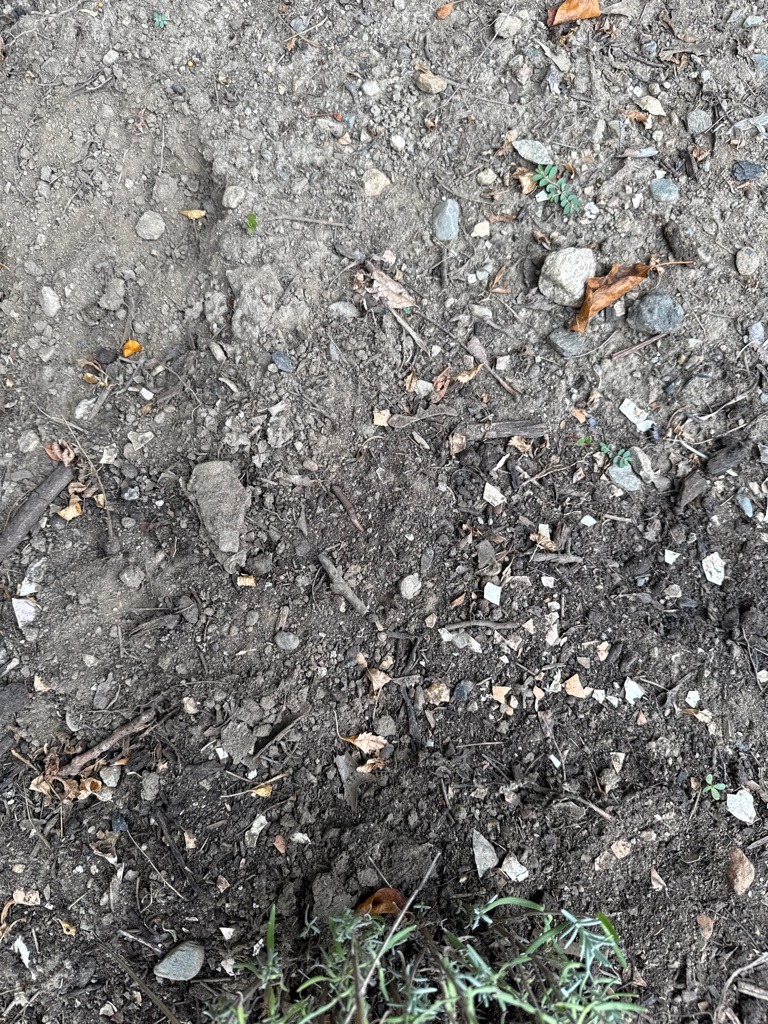
Dry Sub-Urban Sandy Loam
Sandy Loam · Weathered glacial outwash or alluvial terrace deposits common in temperate suburban regions.
AI Disclaimer
This soil report was produced by AI from a single photo. Treat it as a starting point, not laboratory truth.
pH, drainage, fertility, and composition are visual estimates — send a sample to an accredited lab before any decision that would be painful to get wrong.
Crop and amendment tips are general guidance — local climate, microclimate, and gardening history always win over an AI's best guess.
pH
Slightly alkaline to neutral (6.8–7.5), suggested by light mineral hues and scattered light debris. Confirmation requires a lab or test strip.
Drainage
Well Drained. The coarse texture, open aggregation, and absence of standing water or mottling indicate rapid percolation.
Organic Matter
Low (1–3%). Surface litter is sparse and scattered, implying limited baseline biological activity without regular amendments.
Erosion Risk
Moderate wind and water erosion risk on sloped or bare patches due to low cohesion and loose surface gravels.
Overall Read
A workable, highly aerated sandy loam with good drainage but low inherent fertility and moisture retention. With consistent organic matter additions, it becomes a highly productive and versatile growing medium.
Texture
Coarse and gritty with visible mineral fragments and small pebbles; low cohesiveness suggesting a weak ribbon test.
Color Analysis
Dull grayish-brown to light brownish-gray (approx. 10YR 5/2); indicates low-to-moderate organic matter and well-drained conditions with minimal gleying.
Estimated Composition
65% sand, 20% silt, 10% clay, 5% organic matter (visual estimate with moderate confidence).
Water Retention
Low to moderate. Dries out relatively quickly in direct sun due to the high sand fraction, requiring regular supplemental irrigation.
Aeration
High. The coarse particle matrix ensures abundant oxygen diffusion to root zones and aerobic microbes.
Compaction Level
Moderately firm to slightly compacted on the surface, with small hard crust patches exposed to direct weathering.
Structure & Aggregation
Weak granular to single-grain structure with low aggregate stability, susceptible to surface crusting when heavily impacted by heavy rainfall.
Fertility Indicators
Moderate-low overall fertility. Sparse organic residues and visible mineral gravel suggest limited native nutrient reserves requiring supplementation.
Climate Suitability
Thrives best in temperate climates with moderate rainfall; requires careful water management in arid or drought-prone conditions.
Crops Worth Trying
Root vegetables like carrots and radishes, drought-tolerant herbs like rosemary and lavender, tomatoes, peppers, and various turfgrasses.
Plants To Avoid
Water-loving bog plants and heavy clay-adapted species that suffer in fast-draining, loose soils.
Home Garden Use
Ideal for raised beds, perennial borders, herb gardens, and cultivated in-ground vegetable plots amended with organic matter.
Agricultural Use
Suitable for irrigated row crops, orchards, and vineyards where root zone aeration and rapid dry-down are beneficial.
Landscaping Use
Great for drought-tolerant xeriscaping, ornamental borders, pathway edges, and general turf establishment.
Common Problems
Rapid nutrient leaching, low moisture retention during dry spells, and surface crusting after heavy rains.
Amendments Needed
Incorporate well-rotted compost, aged manure, and organic mulches to boost water retention, fertility, and structural stability.
Try These At Home Tests
Perform a standard jar test to verify sand/silt/clay percentages, and a ribbon test to check plasticity and cohesion.
Professional Lab Recommendation
Send a sample to a local extension lab for a complete nutrient panel, pH, and organic matter analysis to guide targeted fertilizer inputs.
Fun Facts
Sandy loam soils are often considered a gardener's best friend because they are easy to till and work with across a wide range of weather conditions.