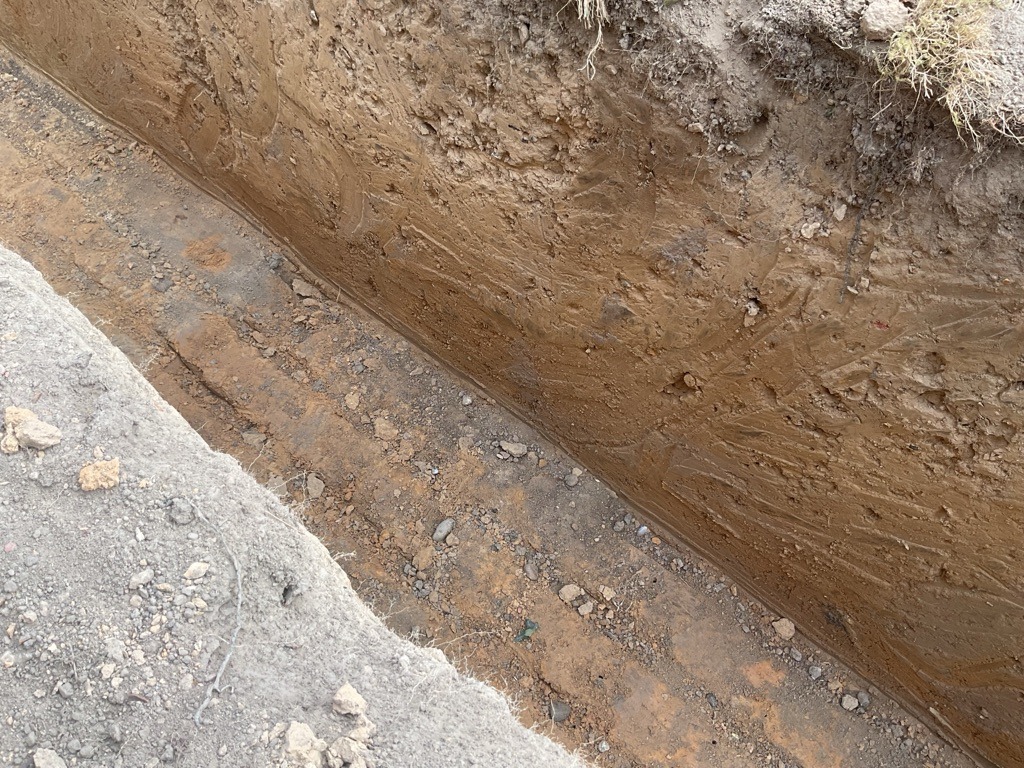
Alluvial Silt-Clay Subsoil Profile
Clay Loam · Alluvial floodplain or glacial outwash deposit showing clear stratigraphic profile development in a excavated trench.
AI Disclaimer
This soil report was produced by AI from a single photo. Treat it as a starting point, not laboratory truth.
pH, drainage, fertility, and composition are visual estimates — send a sample to an accredited lab before any decision that would be painful to get wrong.
Crop and amendment tips are general guidance — local climate, microclimate, and gardening history always win over an AI's best guess.
pH
Slightly acidic to neutral (6.2 to 7.2) based on the warm brown hues and lack of surface efflorescence, though laboratory testing with a probe or test strips is necessary for verification.
Drainage
Moderately well drained; the dense profile and fine texture slow water movement, but the lack of intense gray mottling suggests it does not remain permanently saturated.
Organic Matter
Low (1-2%), which is expected for an exposed subsoil horizon removed from surface accumulations of humus and plant litter.
Erosion Risk
Moderate on vertical trench walls where slumping can occur, but low to moderate on graded slopes if properly vegetated due to the cohesive nature of clay.
Overall Read
A structurally sound but dense and nutrient-poor subsoil horizon. While challenging in its raw excavated state, it provides a stable foundation that can be transformed into productive soil with deep ripping and substantial organic amendments.
Texture
Fine, cohesive, and smooth with moderate stickiness when moist; forms a strong, flexible ribbon in hand tests, indicating a balanced yet dominant clay and silt fraction.
Color Analysis
Medium yellowish-brown to brownish-yellow (Munsell 10YR 5/4 to 10YR 6/4), indicating well-oxygenated mineral weathering with moderate iron oxide presence and lower organic matter content typical of subsurface horizons.
Estimated Composition
35% sand, 35% silt, 30% clay, and less than 2% organic matter, representing a typical subsoil layer exposed in a trench.
Water Retention
High water-holding capacity due to the fine silt and clay matrix; it holds onto plant-available water tightly but may drain slowly after heavy rain events.
Aeration
Moderate to low; the dense packing of fine particles limits pore space, making good soil management and tillage essential to maintain adequate oxygen levels for deep roots.
Compaction Level
Moderately firm to compacted, exhibiting distinct excavator bucket scrape marks that indicate high bulk density and resistance to natural root penetration in its current state.
Structure & Aggregation
Subangular blocky structure visible in the trench wall, showing moderate mechanical strength and cohesion when excavated.
Fertility Indicators
Low fertility rating for the exposed layer due to minimal organic matter and lack of biological activity, though the underlying mineral reserves are chemically rich.
Climate Suitability
Thrives in temperate and continental climates where seasonal moisture balances help prevent extreme shrink-swell cycles.
Crops Worth Trying
Deep-rooting trees, established shrubs, and hardy perennial grasses that can break through dense subsoil layers once established.
Plants To Avoid
Fine-seeded annuals, delicate root vegetables, and moisture-sensitive species that struggle with heavy, compacted subsoils.
Home Garden Use
Requires significant amendment and loosening before use in home gardens; best utilized as deep base soil rather than surface topsoil.
Agricultural Use
Suitable for row crops and pastures once subsoiling or ripping is performed to break up the dense compacted layer and incorporate organic amendments.
Landscaping Use
Good for structural sub-base in landscaping, but topsoil must be layered on top for turf establishment, ornamental planting beds, and tree pits.
Common Problems
Prone to surface crusting when exposed to rain, hard cracking when dry, slow infiltration rates, and high resistance to root penetration.
Amendments Needed
Heavy incorporation of compost, aged manure, and organic mulches to build topsoil depth, alongside mechanical subsoiling or cover cropping with deep-taproot species.
Try These At Home Tests
Perform a ribbon test to check plasticity, a jar settling test for particle fractions, and an infiltration test to measure drainage speed.
Professional Lab Recommendation
Send a sample to a local agricultural extension service for a complete fertility, CEC, and texture analysis if planning large-scale agricultural or landscaping projects.
Fun Facts
Subsoils exposed in construction trenches often display ancient geological history, preserving mineral bands and ancient weathering patterns formed thousands of years ago.