Managed Landscape Sandy Loam with Wood Mulch Topdressing
Sandy Loam · Alluvial, coastal plain, or heavily amended urban/suburban landscape fill soil containing weathered granitic minerals and added organic mulch.
AI Disclaimer
This soil report was produced by AI from a single photo. Treat it as a starting point, not laboratory truth.
pH, drainage, fertility, and composition are visual estimates — send a sample to an accredited lab before any decision that would be painful to get wrong.
Crop and amendment tips are general guidance — local climate, microclimate, and gardening history always win over an AI's best guess.
pH
Slightly acidic to neutral (6.0–7.0) based on typical landscape maintenance practices and woody mulch weathering. pH cannot be confirmed visually, and a test strip or electronic probe is recommended for absolute certainty.
Drainage
Well drained, bordering on excessively drained. The gritty sandy texture and coarse particle profile allow water to infiltrate rapidly and move downward with minimal risk of pooling or waterlogging.
Organic Matter
Moderate (2–4% overall, heavily front-loaded at the surface). While the native mineral soil is likely low in humus, the visible wood bark mulch provides a substantial organic cushion that slowly breaks down into the profile.
Erosion Risk
Moderate water and wind erosion risk on bare spots, primarily mitigated here by the protective wood chip mulch cover. Uncovered slopes or heavy downpours could displace fine particles easily.
Overall Read
A highly workable, forgiving, and responsive soil type. While its natural nutrient retention and water holding capacities are somewhat low, the presence of organic mulch and good aeration make it a fantastic foundation for ornamental landscaping and responsive gardening with proper management.
Texture
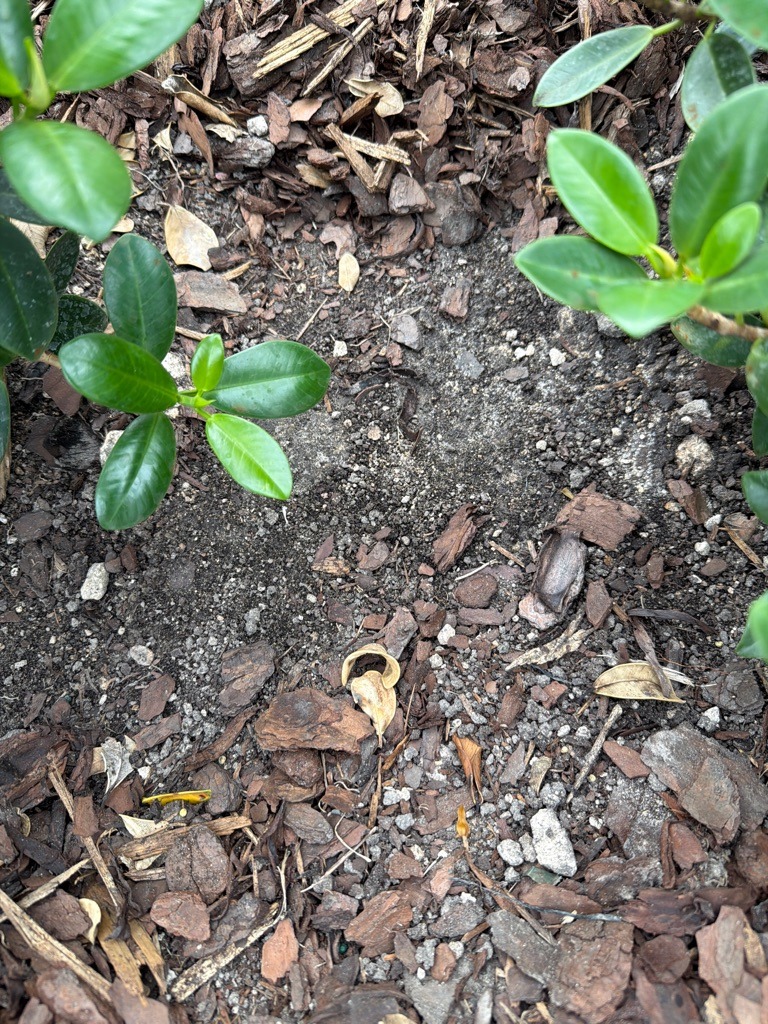
Coarse and gritty with visible mineral grains, moderately loose particle size profile, forms a weak and fragile ribbon that easily breaks apart, indicating a higher proportion of sand with just enough silt and clay to hold minor cohesion.
Color Analysis
Light to medium brownish-gray with grayish mineral exposure and dark brown organic highlights (approx. 10YR 4/2 to 5/2). Suggests moderate weathering, quick-draining mineral base, and surface organic accumulation primarily from applied mulch rather than deep humus development.
Estimated Composition
Approximately 65% sand, 20% silt, 10% clay, and 5% organic matter concentrated heavily in the surface mulch layer. Visual confidence is moderate due to surface mulching obscuring the underlying sub-layer.
Water Retention
Low to moderate plant-available water holding capacity. The soil will dry out relatively quickly under direct sun and wind due to the high sand fraction, though the surface wood mulch layer significantly aids in mitigating evaporation.
Aeration
Excellent. The open, coarse texture and high sand content ensure high air-filled porosity, providing abundant oxygen to plant roots and soil aerobic microbes.
Compaction Level
Loose to moderately firm at the surface, typical of maintained ornamental garden beds. No severe hardpan or massive structure is visible, allowing straightforward root penetration.
Structure & Aggregation
Single-grain to weakly granular structure. Aggregates are fragile and lack strong binding agents, resulting in low structural stability if disturbed frequently without organic reinforcement.
Fertility Indicators
Moderate overall fertility. Visual clues include healthy green foliage on adjacent ornamentals and active surface organic breakdown, though natural mineral nutrient reserves are likely limited compared to heavier loams or clays.
Climate Suitability
Thrives well across temperate, subtropical, and Mediterranean climates, provided adequate irrigation is supplied during dry periods to compensate for rapid drainage.
Crops Worth Trying
Ornamental shrubs (such as the visible Ficus or similar broadleaf evergreens), root vegetables (carrots, radishes), drought-tolerant perennials, herbs like rosemary and thyme, and warm-season turfgrasses.
Plants To Avoid
Bog and wetland plants that require consistently saturated conditions, or plants highly sensitive to rapid moisture fluctuations and drying out.
Home Garden Use
Ideal for ornamental shrub beds, perennial borders, pollinator gardens, and raised beds amended with additional compost for moisture retention.
Agricultural Use
Suitable for specialized root crop production, orchards, and vineyards with supplemental drip irrigation and regular fertility management.
Landscaping Use
Excellent for foundation plantings, turf establishment, sloped areas when stabilized, and decorative mulch-covered garden beds.
Common Problems
Rapid nutrient leaching, quick drying during heat waves, crusting if fine silts separate on top, and the need for frequent irrigation and fertilization.
Amendments Needed
Aged compost and well-rotted manure to boost moisture retention, continuous replenishment of organic mulch, and balanced slow-release organic fertilizers.
Try These At Home Tests
Perform a mason jar soil texture test to verify the exact sand-silt-clay ratios, and do a simple ribbon test to check plasticity.
Professional Lab Recommendation
Send a sample to a local extension service for a standard fertility, cation exchange capacity (CEC), and organic matter test if planting high-demand crops or experiencing poor plant vigor.
Fun Facts
Sandy loam soils are often considered a 'gardener's dream' for their ease of working and excellent tillage capabilities, though they require more frequent management of water and nutrients.