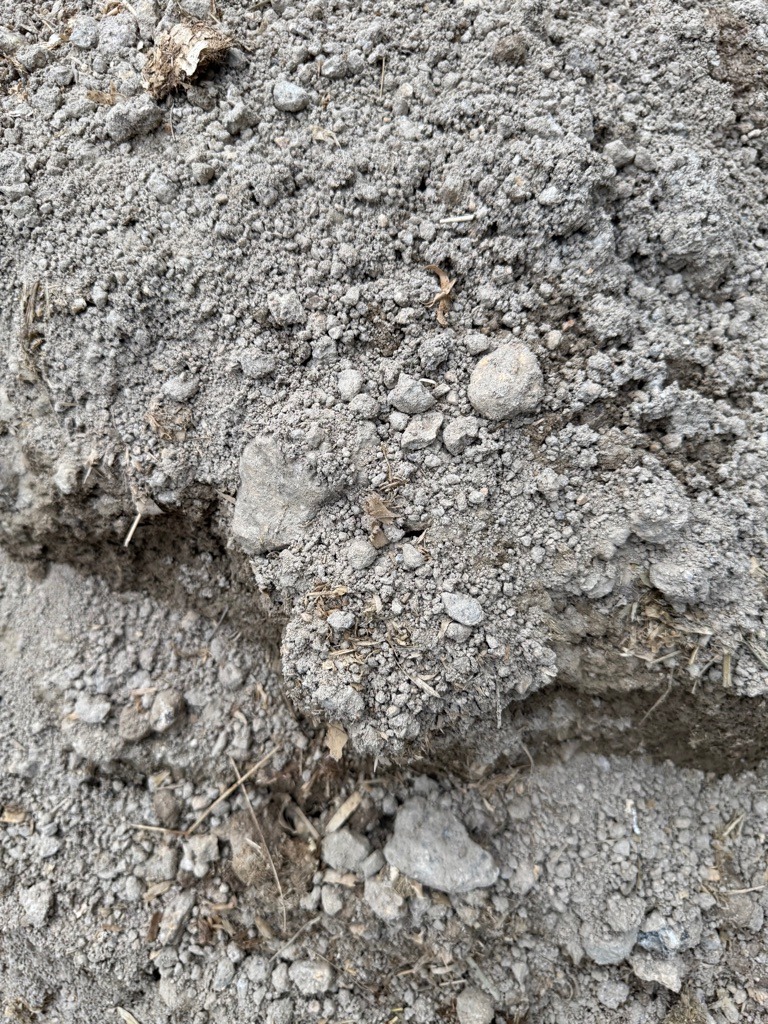
Gray Glacial Silt Loam
Silt Loam · Glacial loess deposits or glaciolacustrine sediments found across the Midwest, Pacific Northwest, or European agricultural plains.
AI Disclaimer
This soil report was produced by AI from a single photo. Treat it as a starting point, not laboratory truth.
pH, drainage, fertility, and composition are visual estimates — send a sample to an accredited lab before any decision that would be painful to get wrong.
Crop and amendment tips are general guidance — local climate, microclimate, and gardening history always win over an AI's best guess.
pH
Slightly acidic to neutral, likely in the range of 6.2 to 7.0, typical of leached parent materials in temperate zones. A test strip or digital meter should be used for confirmation.
Drainage
Moderately Well Drained to Somewhat Poorly Drained. The high silt content and weak aggregation can lead to surface sealing and slowed internal drainage, creating temporary waterlogging after heavy rain.
Organic Matter
Low to moderate (estimated around 2 to 3 percent), as evidenced by the pale gray coloration and limited visible decomposing plant debris.
Erosion Risk
High susceptibility to water and tillage erosion. Silt particles detach very easily from the soil matrix during heavy downpours and wash away downslope.
Overall Read
A fertile-potential yet structurally fragile silt loam. While it holds moisture well and supports many crops, its low organic matter and susceptibility to crusting and erosion require active management through cover cropping and organic amendments for-life additions.
Texture
Fine, floury, and powdery when dry, becoming smooth and slightly plastic when moist. It forms weak to moderate ribbons that break easily, indicating a high proportion of silt-sized particles with moderate clay bonding.
Color Analysis
Light gray to brownish-gray (Munsell equivalent approximately 10YR 5/1 to 5/2). This cool, muted color tone suggests low organic matter content, leached minerals, and possible periods of saturation or gleying in its formation history.
Estimated Composition
Roughly 20 percent sand, 65 percent silt, 12 percent clay, and 3 percent organic matter. This visual estimate carries moderate-to-high confidence based on the floury surface texture and pale coloration.
Water Retention
High plant-available water holding capacity due to the fine silt and clay fraction, but it can dry out quickly at the surface, forming a hard crust that restricts further evaporation and infiltration.
Aeration
Moderate to low. When saturated, the fine pores fill rapidly with water, restricting oxygen diffusion to roots and beneficial microbes.
Compaction Level
Moderately firm to compacted. The lack of robust organic binding agents and high silt content make it prone to surface crusting and subsurface compaction under heavy traffic.
Structure & Aggregation
Weak subangular blocky to massive structure with fragile granular peds at the surface. Aggregates tend to slake and break down easily under heavy rainfall impact, increasing vulnerability to crusting.
Fertility Indicators
Low fertility overall. Pale coloration indicates low humus levels, minimal visible biological activity, and a lack of dark humic compounds. Primary nutrients like nitrogen and phosphorus are likely limited.
Climate Suitability
Thrives best in temperate, sub-humid climates with moderate, well-distributed rainfall. Requires careful irrigation management in arid zones to prevent crusting.
Crops Worth Trying
Small grains like wheat and barley, corn, soybeans, forage grasses, and root vegetables like carrots if loosened properly.
Plants To Avoid
Deep-rooted woody perennials or plants sensitive to temporary waterlogging and root hypoxia unless the soil is heavily amended.
Home Garden Use
Suitable for raised beds, perennial borders, and vegetable gardens once amended with substantial organic matter to improve structure.
Agricultural Use
Extensively farmed for commodity row crops under conventional or no-till systems, provided erosion control practices and cover cropping are utilized.
Landscaping Use
Good for turfgrass establishment and general ornamental beds, though slope stabilization and amendments are necessary on sloped terrain.
Common Problems
Surface crusting after rain, hardpan formation, susceptibility to water erosion, and poor water infiltration when dry.
Amendments Needed
Heavy applications of finished compost, aged manure, or leaf mold to boost organic matter, improve aggregation, and prevent surface crusting.
Try These At Home Tests
Perform a jar settling test to separate sand, silt, and clay fractions. Conduct a ribbon test to verify the high silt content and a squeeze test to check for crusting tendencies.
Professional Lab Recommendation
Send a sample to a local agricultural extension service for a comprehensive nutrient analysis, CEC, and organic matter test to guide precise fertilizer and lime applications.
Fun Facts
Silt loams derived from loess (wind-blown glacial dust) cover millions of acres of the world's most productive agricultural regions, providing an exceptional balance of water retention and workability when managed correctly.