Weathered Glacial Clay Till with Organic Topsoil Overlay
Clay to Clay Loam · Glacial till or alluvial deposit, commonly found in the UK (e.g., London Clay or Gault Clay) or the Midwestern United States (glaciated plains).
AI Disclaimer
This soil report was produced by AI from a single photo. Treat it as a starting point, not laboratory truth.
pH, drainage, fertility, and composition are visual estimates — send a sample to an accredited lab before any decision that would be painful to get wrong.
Crop and amendment tips are general guidance — local climate, microclimate, and gardening history always win over an AI's best guess.
pH
Likely Neutral to Slightly Alkaline (pH 7.0-8.2). Common for deep glacial tills with limestone parent material; presence of stony fragments suggests possible carbonate content.
Drainage
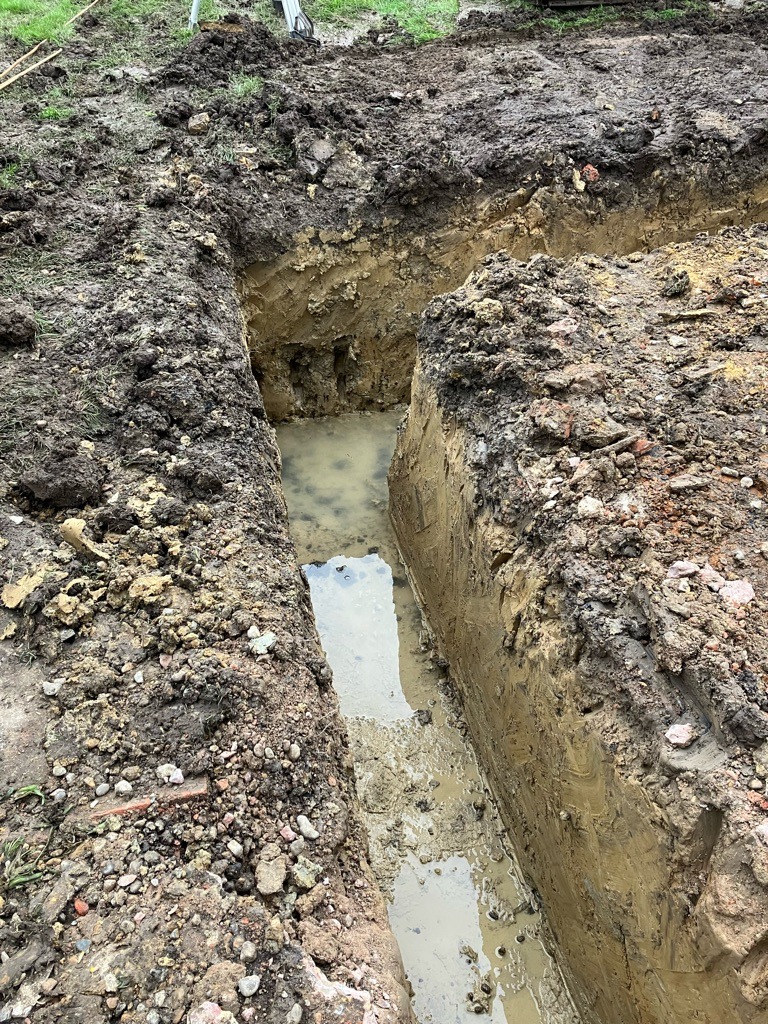
Poorly Drained. Standing water in the trench and massive structure in the subsoil indicate very slow hydraulic conductivity.
Organic Matter
Moderate (2-4%) in the top layer; very low (<1%) in the yellowish-tan subsoil exposed in the trench walls.
Erosion Risk
High Surface Risk. Bare clay is prone to heavy runoff and gully erosion. Excavated piles are susceptible to slumping during rain events.
Overall Read
This is a challenging but nutrient-rich soil defined by poor drainage and high clay content. It is excellent for holding nutrients but requires structural management (organic matter and drainage) to prevent plant suffocation.
Texture
Smooth, plastic, and sticky when wet; likely produces a long-lived ribbon (>5cm) indicating high clay content. Heavy and dense when moved.
Color Analysis
Surface: Dark grayish brown (10YR 4/2) indicating moderate organic matter. Subsurface: Yellowish brown to light olive brown (2.5Y 5/4) with visible gray mottling, suggesting iron oxidation and periodic saturation.
Estimated Composition
Sand 15%, Silt 35%, Clay 45%, Organic Matter 5% (Topsoil only). High confidence in subsurface clay dominance due to standing water and wall smoothness.
Water Retention
Very High. The clay particles hold moisture tightly, staying wet for long periods but potentially becoming inaccessible to plants during extreme droughts due to high suction.
Aeration
Poor. Standing water and dense packing significantly limit oxygen exchange for root systems and aerobic microbial life.
Compaction Level
Highly Compacted. The trench walls are smooth and vertical, indicating high density and cohesive strength characteristic of heavy clay.
Structure & Aggregation
Massive to angular blocky in the subsoil; minimal natural aggregation which limits vertical water movement. Large clods are visible in the excavated piles.
Fertility Indicators
Moderate Overall. High Cation Exchange Capacity (CEC) from clay allows for good nutrient holding, but poor physical structure limits root access to those nutrients.
Climate Suitability
Temperate maritime or continental climates with consistent rainfall. Requires careful management in wet seasons to avoid boggy conditions.
Crops Worth Trying
Brassicas (cabbage, kale), roses, fruit trees on specific rootstocks (like M9), and deep-rooted grasses or legumes (alfalfa).
Plants To Avoid
Lavender, Mediterranean herbs, blueberries (due to pH/drainage), and root vegetables like carrots which may become misshapen in heavy soil.
Home Garden Use
Raised beds are highly recommended to bypass drainage issues. Perennial borders with moisture-tolerant species are also viable.
Agricultural Use
Pasture or grassland; cereal crops (wheat/barley) if subsurface drainage (tile) is installed to manage the high water table.
Landscaping Use
Suitable for rain gardens or pond liners. Requires significant drainage infrastructure for turf or paved paths.
Common Problems
Waterlogging, anaerobic 'sour' soil, compaction, and working the soil when wet resulting in 'clodiness' that lasts for years.
Amendments Needed
Apply 2-4 inches of organic compost to the surface annually. Avoid adding sand (creates concrete-like texture); use gypsum to improve structure if sodium is present.
Try These At Home Tests
Perform a 'Jar Test': settle soil in water to see layers. A 'Percolation Test': fill a hole with water and time how many hours it takes to drain.
Professional Lab Recommendation
Recommended for pH and Phosphorus/Potassium levels. Request a 'Sodicity' or 'CEC' test to determine if chemical amendments like gypsum are necessary.
Fun Facts
Clay soils are often called 'heavy' not because of weight, but because of the 'heavy' pull required by horses or tractors to plow through their sticky, dense matrix.
Your Notes
I would like to know the ground type in the trench