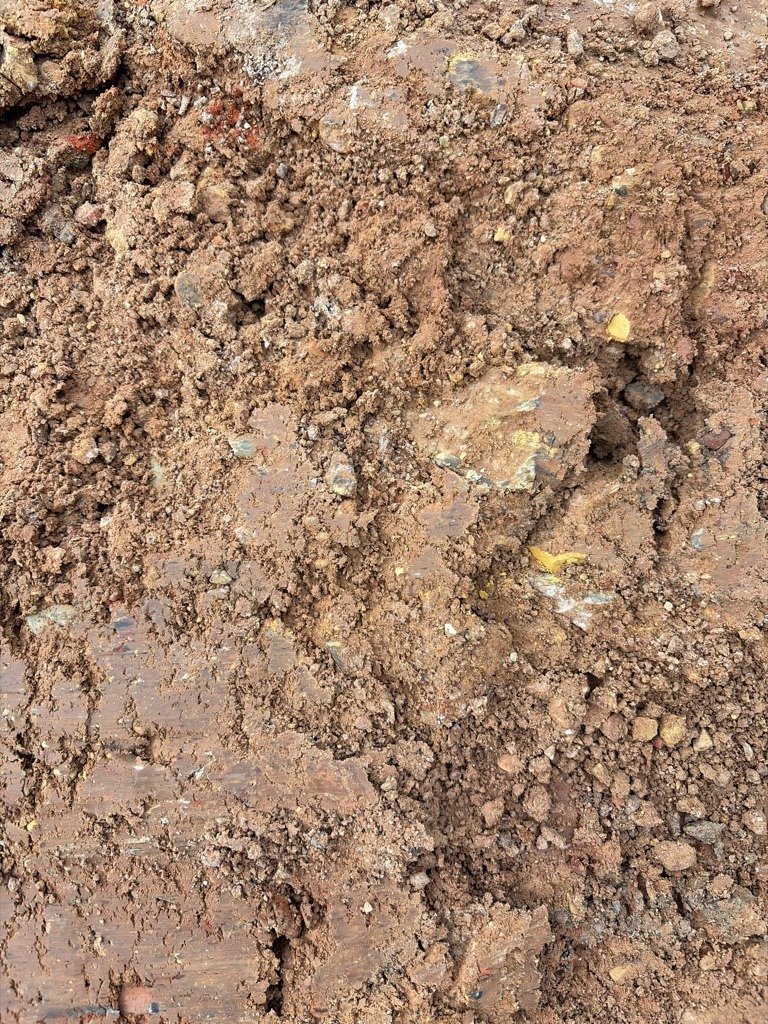
Red Piedmont Clay Loam
Clay Loam · Weathered residual soil from crystalline rock formations, such as the Piedmont region of the eastern United States or similar tropical-to-temperate weathered profiles.
AI Disclaimer
This soil report was produced by AI from a single photo. Treat it as a starting point, not laboratory truth.
pH, drainage, fertility, and composition are visual estimates — send a sample to an accredited lab before any decision that would be painful to get wrong.
Crop and amendment tips are general guidance — local climate, microclimate, and gardening history always win over an AI's best guess.
pH
Strongly to moderately acidic (5.0 to 6.0), typical of weathered regional clay soils with leached basic cations. Confirmation requires a lab test or pH meter.
Drainage
Moderately well drained to somewhat poorly drained due to the high clay content and dense subsoil structure which can restrict internal water movement.
Organic Matter
Low to moderate (1.5-3 percent) as indicated by the lighter reddish mineral color rather than a deep, dark humus-rich black.
Erosion Risk
Moderate to high risk of water erosion on slopes because fine particles detach easily in heavy rain and runoff can be rapid over saturated surfaces.
Overall Read
A fertile yet physically challenging clay loam with high nutrient-holding capacity and strong water retention, requiring consistent organic matter additions and careful tillage timing to unlock its full agricultural and gardening potential.
Texture
Fine-textured, sticky when wet, and capable of forming a strong, long ribbon during a ribbon test, implying a significant clay fraction along with silt and fine sand.
Color Analysis
Reddish brown to strong brown (approx. 5YR 4/6), indicating well-aerated conditions with high concentrations of oxidized iron (ferric iron oxides like hematite and goethite) and relatively low organic matter.
Estimated Composition
40 percent clay, 35 percent silt, 20 percent sand, 5 percent organic matter based on visual estimation with moderate confidence.
Water Retention
High water-holding capacity, holding moisture tightly against gravity, though much of it may be held at tension limits that make it harder for plants to extract compared to a loamy soil.
Aeration
Moderate to low, particularly when wet or compacted, as the small pore spaces fill with water and limit rapid gas exchange for roots.
Compaction Level
Moderately firm to compacted, especially where machinery or foot traffic has smeared the wet clay surfaces, showing smooth peds and resistance to penetration.
Structure & Aggregation
Subangular blocky to massive in undisturbed areas, with moderate aggregate stability. Can form hard crusts when dried rapidly after heavy wetting.
Fertility Indicators
Moderate inherent chemical fertility due to a high cation exchange capacity (CEC) from the clay minerals, but limited by low organic matter and potential nutrient lock-up.
Climate Suitability
Thrives in humid subtropical or temperate climates with consistent seasonal rainfall, though management must account for wet sticky periods and dry cracking phases.
Crops Worth Trying
Fescue grasses, alfalfa, soybeans, corn, certain fruit trees like apples and pears, and deep-rooted perennials that can tolerate heavier soils.
Plants To Avoid
Root crops requiring loose, sandy soil (like carrots or parsnips) and plants highly sensitive to wet feet or root rot without proper soil conditioning.
Home Garden Use
In-ground beds with heavy amendment, established perennial borders, and native clay-tolerant plantings, but poorly suited for containers or fine seed-starting without major conditioning.
Agricultural Use
Well-suited for permanent pasture, forage production, and large-scale row cropping when managed with conservation tillage and regular organic amendments.
Landscaping Use
Good for turf establishment, retaining wall backfill (with drainage considerations), and hardy ornamental trees and shrubs, but requires amendment for delicate perennials.
Common Problems
Surface crusting, seasonal waterlogging, deep cracking when dry, difficult tilling windows, and root restriction due to compaction.
Amendments Needed
Heavy applications of finished compost and aged manure to improve aggregation, gypsum to help flocculate clay particles, and cover crops to build organic matter.
Try These At Home Tests
Perform a ribbon test by rolling moist soil between your thumb and forefinger to check length, and conduct a mason jar sedimentation test to verify exact sand, silt, and clay ratios.
Professional Lab Recommendation
Recommended before establishing permanent crops or orchards; request a standard nutrient analysis, cation exchange capacity (CEC), organic matter percentage, and buffer pH.
Fun Facts
The characteristic red color of these soils comes from rust-like iron oxides formed over thousands of years of chemical weathering under warm, humid conditions.