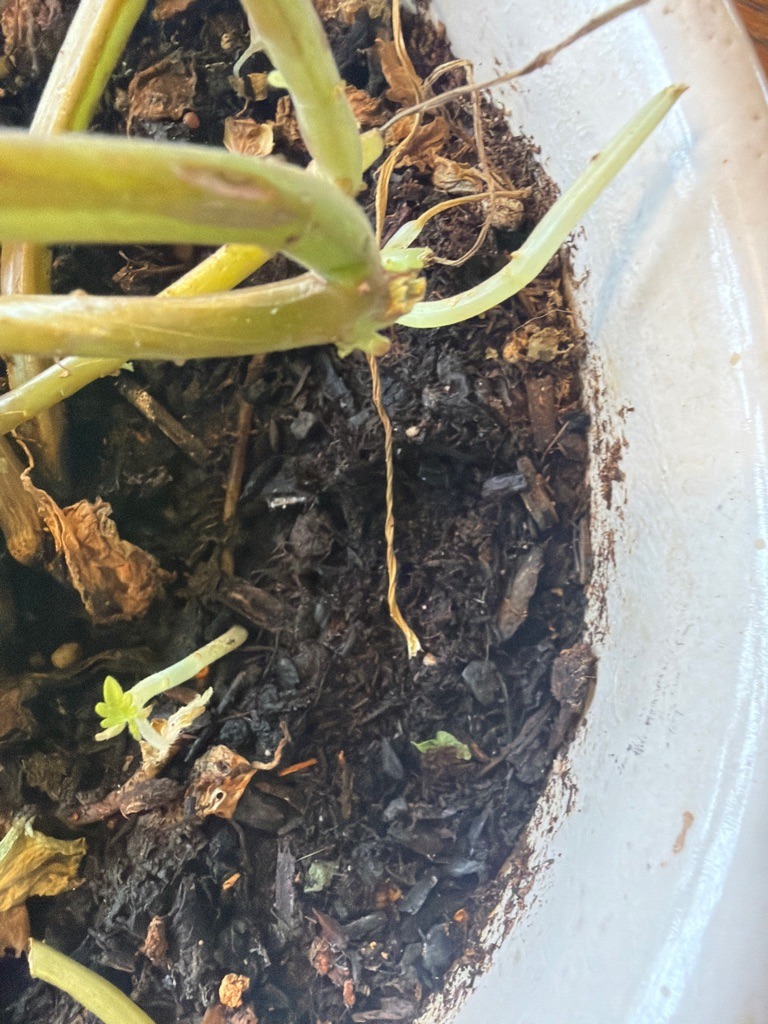
Container Organic Potting Mix
Peaty Loam with Organic Amendments · Commercial or custom-blended horticultural potting medium rather than native in-situ field soil.
AI Disclaimer
This soil report was produced by AI from a single photo. Treat it as a starting point, not laboratory truth.
pH, drainage, fertility, and composition are visual estimates — send a sample to an accredited lab before any decision that would be painful to get wrong.
Crop and amendment tips are general guidance — local climate, microclimate, and gardening history always win over an AI's best guess.
pH
Slightly acidic 6.0–6.8, common for bagged organic potting soils containing peat and compost; confirm with a soil test kit.
Drainage
Well drained, due to the high proportion of porous organic debris and coarse particles preventing compaction in a container setting.
Organic Matter
Rich (4–8%), evident from the dark coloration, loose crumbly structure, and visible partially decomposed plant fragments.
Erosion Risk
Low erosion risk when used in containers, though it could be susceptible to splashing or wind displacement if allowed to dry out completely.
Overall Read
An excellent, highly fertile, and well-structured organic growing medium tailored for containers and raised environments, offering great water retention and aeration for healthy plant growth.
Texture
Crumbly, friable, and porous with visible bits of decomposed organic matter; would form a weak, easily broken ribbon, indicating a balanced mix of fine mineral particles and organic fibers.
Color Analysis
Dark brownish-black (approximate Munsell 10YR 2/1 to 2/2), suggesting high organic matter content, active microbial breakdown, and good moisture retention without severe waterlogging.
Estimated Composition
40% sand, 30% silt, 10% clay, and 20% organic matter (high confidence for container potting media).
Water Retention
Moderate to high; excellent plant-available water holding capacity due to the spongy nature of the organic components.
Aeration
High oxygen availability for roots and microbes thanks to the porous, chunky organic matrix and loose crumb structure.
Compaction Level
Loose and friable, showing no signs of hardpan or surface crusting, which is ideal for root development.
Structure & Aggregation
Granular structure with good aggregate stability, promoting excellent root penetration, gas exchange, and resistance to packing down.
Fertility Indicators
High overall fertility indicated by the dark humus color, active plant growth, and visible organic residues breaking down into nutrients.
Climate Suitability
Universal climate suitability for containers; performs well in controlled indoor, greenhouse, or temperate outdoor environments.
Crops Worth Trying
Leafy greens, indoor houseplants, annual flowers, herbs, and container vegetables like tomatoes or peppers.
Plants To Avoid
Large native trees or deep-rooting perennials unsuited for pots, or plants requiring extreme alkalinity.
Home Garden Use
Ideal for potted plants, hanging baskets, raised bed top-offs, and starting seedlings.
Agricultural Use
Limited to greenhouse production, nursery container stock, and specialty seedling propagation.
Landscaping Use
Containerized patio plants, rooftop gardens, and decorative urn plantings.
Common Problems
Potential for the organic matter to break down over time leading to shrinkage, or occasional water repellency if allowed to dry out excessively.
Amendments Needed
Periodic top-dressing with fresh compost or balanced organic granular fertilizer to maintain nutrient levels over time.
Try These At Home Tests
Perform a squeeze test to check for ideal moisture and crumbly texture, or a simple pH test strip on run-off water.
Professional Lab Recommendation
Generally unnecessary for home container mixes unless persistent plant nutrient deficiencies occur; request a Saturated Media Extract test if lab analysis is needed.
Fun Facts
Container potting soils often replace native soil entirely to eliminate weeds, soil-borne diseases, and heavy compaction risks in urban gardening.