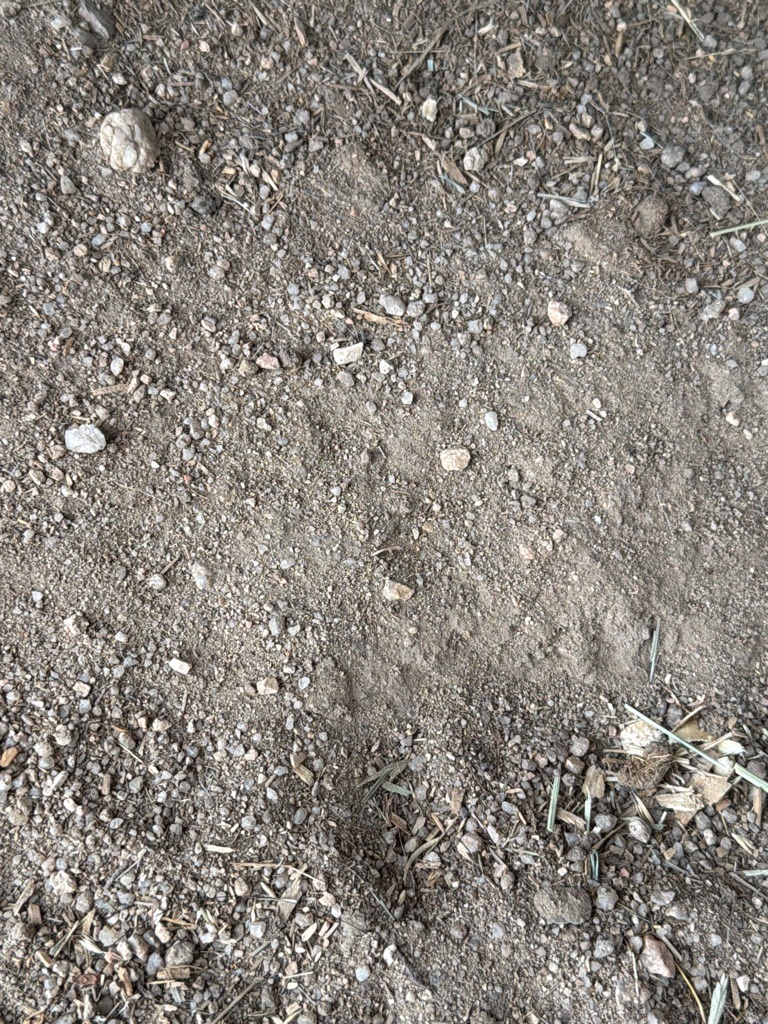
Arid Granitic Sandy Loam
Sandy Loam · Alluvial outwash or weathered granitic residuum typical of arid to semi-arid intermountain valleys or dry southwestern regions.
AI Disclaimer
This soil report was produced by AI from a single photo. Treat it as a starting point, not laboratory truth.
pH, drainage, fertility, and composition are visual estimates — send a sample to an accredited lab before any decision that would be painful to get wrong.
Crop and amendment tips are general guidance — local climate, microclimate, and gardening history always win over an AI's best guess.
pH
Slightly alkaline 7.2–7.8, typical of arid or semi-arid regions where basic cations like calcium and magnesium have not been heavily leached by rainfall. Confirmation via pH test strip is recommended.
Drainage
Excessively drained. The high proportion of coarse sand and small gravel fragments allows water to percolate rapidly through the profile, leaving little standing moisture.
Organic Matter
Low (1-2%). Very little dark humus or visible decomposed plant material is present on the surface, indicating limited biological activity and low natural nutrient reserves.
Erosion Risk
High risk of wind erosion when dry and bare, and moderate risk of water erosion on sloped surfaces during heavy, intense downpours due to weak aggregate stability.
Overall Read
A well-aerated, fast-draining sandy loam with low organic matter and fertility. While challenging for water-intensive crops, it is exceptionally workable and responds brilliantly to organic matter additions and drip irrigation.
Texture
Coarse, gritty, and loose with low cohesion. Will form a very weak, fragile cylinder in a ribbon test that breaks immediately under its own weight, indicating a high sand fraction with minimal clay binder.
Color Analysis
Light grayish-brown to pale olive-gray (Munsell 10YR 6/2), suggesting low organic matter content, weathered parent material minerals like quartz and feldspar, and an arid or semi-arid weathering environment with minimal iron oxide accumulation.
Estimated Composition
Sand: 70%, Silt: 20%, Clay: 8%, Organic Matter: 2%. Confidence level is moderate based on visual particle size distribution and surface texture.
Water Retention
Low. Water drains quickly beyond the root zone, and the soil dries out rapidly under sun and wind exposure, offering poor plant-available water holding capacity compared to an ideal loam.
Aeration
Excellent. The high sand and gravel content ensures plentiful large pore spaces, allowing abundant oxygen diffusion to plant roots and aerobic soil microbes.
Compaction Level
Loose and friable at the surface, though subsurface layers may experience moderate packing if subjected to heavy foot or vehicle traffic when dry.
Structure & Aggregation
Single-grain to weakly granular. Aggregates are poor and unstable due to the lack of clay and organic matter bonding agents, making the soil vulnerable to disruption.
Fertility Indicators
Low fertility overall. Clues include pale coloration, sparse organic residue, minimal earthworm activity visible, and gritty mineral composition lacking nutrient-holding humus complexes.
Climate Suitability
Arid, semi-arid, and Mediterranean climates characterized by hot, dry summers and limited seasonal rainfall, requiring diligent irrigation and mulching.
Crops Worth Trying
Drought-tolerant crops, Mediterranean herbs (rosemary, thyme, lavender), root vegetables like carrots and radishes (in loose sandy conditions), figs, grapes, and certain heat-loving succulents.
Plants To Avoid
Moisture-loving bog plants, heavy feeders requiring high organic fertility, and shallow-rooted crops prone to moisture stress without consistent drip irrigation.
Home Garden Use
Well-suited for xeriscaping, rock gardens, cactus and succulent beds, and herb gardens. Poor for standard lawns or water-intensive vegetable plots without heavy amending.
Agricultural Use
Suitable for irrigated orchards, vineyards, and specialized dry-land farming if supplemented with frequent irrigation and fertigation systems.
Landscaping Use
Ideal for drought-tolerant native plantings, rock garden features, pathways, and slope stabilization when paired with appropriate geotextiles and drought-hardy ground covers.
Common Problems
Rapid nutrient leaching, frequent moisture stress, low natural fertility, susceptibility to wind erosion, and difficulty establishing fine turfgrass or delicate seedlings.
Amendments Needed
Heavy incorporation of finished compost, aged manure, or leaf mold to boost organic matter and water retention, supplemented by slow-release organic fertilizers.
Try These At Home Tests
Perform a jar settling test to separate sand, silt, and clay fractions. Try the ribbon test to check for stickiness and plasticity. Conduct a simple infiltration test by pouring water into a ring to measure drainage speed.
Professional Lab Recommendation
Send a sample to a commercial or extension lab for a standard fertility, cation exchange capacity (CEC), and organic matter analysis to determine precise nutrient deficiencies and salinity levels.
Fun Facts
Sandy loam soils derived from granitic parent material are prized in certain wine regions because they warm up quickly in the spring and impart unique mineral terroir characteristics to grapes.