Backyard Weathered Clay-Loam Subsoil
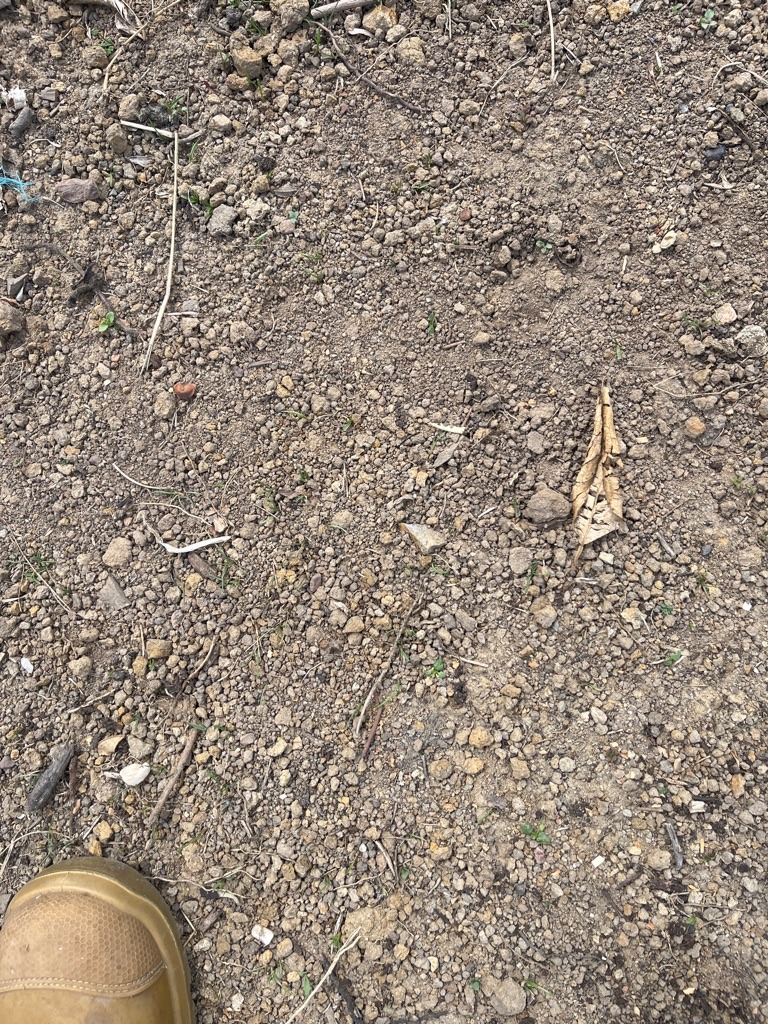
Clay Loam · Weathered residual urban or suburban residential fill/subsoil, common in cleared backyard environments where topsoil has been disturbed or stripped during construction.
AI Disclaimer
This soil report was produced by AI from a single photo. Treat it as a starting point, not laboratory truth.
pH, drainage, fertility, and composition are visual estimates — send a sample to an accredited lab before any decision that would be painful to get wrong.
Crop and amendment tips are general guidance — local climate, microclimate, and gardening history always win over an AI's best guess.
pH
Slightly alkaline 7.2 to 7.8, typical of sub-surface or weathered residential topsoil exposed to mineral weathering, though pH cannot be confirmed visually and requires a test strip or electronic meter for certainty.
Drainage
Moderately Well Drained. The presence of small, stable peds allows for decent infiltration, but the higher clay fraction can slow down internal drainage after heavy rain events.
Organic Matter
Low (1-2%). The pale color, lack of rich dark humus, and sparse surface residue indicate a minimal active organic layer, which limits native microbial activity and nutrient cycling capacity.
Erosion Risk
Moderate water and tillage erosion risk, especially on slopes or during heavy downpours when the dry surface crust prevents rapid absorption and promotes sheet runoff.
Overall Read
This soil is a sturdy, workable clay-loam with low organic matter and a tendency to form surface crusts. While currently lacking in biological activity and fertility, it has a strong mineral foundation that can be transformed into a highly productive garden bed with consistent additions of organic compost and protective mulch.
Texture
Fine-textured with gritty mineral inclusions, forming firm, hard peds that break down into small, irregular crumbs. A ribbon test would likely produce a medium-length ribbon of 1 to 2 inches before breaking, indicating a balanced yet substantial clay fraction.
Color Analysis
Light to medium brownish-gray, approximating Munsell 10YR 5/3. This dry, muted tone indicates low organic matter content, well-oxidized iron minerals, and an absence of prolonged waterlogging or gleying.
Estimated Composition
45% sand, 20% silt, 25% clay, and less than 2% organic matter. This visual estimate carries moderate-to-high confidence based on the blocky peds and surface crusting behavior.
Water Retention
Moderate to High. Because of the clay and fine silt fraction, this soil holds onto moisture well once saturated, though it tends to dry out and form a hard crust on the surface under intense sun.
Aeration
Moderate. While dry surface peds allow some gas exchange through cracks, wetting causes swelling that can temporarily reduce macro-porosity and limit oxygen diffusion to deeper roots.
Compaction Level
Moderately firm to compacted. The surface shows signs of crusting and hard ped formation, which can restrict early root elongation and water infiltration if left unmanaged.
Structure & Aggregation
Subangular blocky to granular structure with moderate aggregate stability. The peds are somewhat resistant to weathering when dry but can easily crust over under the direct impact of raindrops.
Fertility Indicators
Low to Moderate overall fertility. Visual clues show pale coloration, sparse weed growth, and very little visible humus or earthworm activity, pointing to a need for external nutrient inputs.
Climate Suitability
Thrives best in temperate to Mediterranean climates with moderate rainfall, though supplemental irrigation and mulching are crucial during dry summer months to prevent severe crusting.
Crops Worth Trying
Hardy turfgrasses, establishment-stage shrubs, deep-rooting native perennials, and tougher root crops once amended with significant organic matter.
Plants To Avoid
Delicate shallow-rooted annuals, heavy-feeding vegetables that require loose, ultra-rich loam, and acid-loving plants like blueberries unless drastic pH and texture modifications are made.
Home Garden Use
Well-suited for established perennial borders, native pollinator gardens, or raised bed gardening built directly on top, but poorly suited for direct in-ground seed starting without surface amendments.
Agricultural Use
Suitable for pasture or extensive grain production with regular tillage and cover cropping, but requires careful management to prevent compaction and runoff at a commercial scale.
Landscaping Use
Good for turf establishment and tough slope stabilization plantings, but tree planting pits must be carefully amended to avoid the 'bathtub effect' in heavier subsoils.
Common Problems
Surface crusting, weed seed germination difficulties, summer drying out into hard clods, and restricted root penetration due to moderate sub-surface compaction.
Amendments Needed
Heavy incorporation of finished compost, aged manure, and organic mulches to build organic matter, improve aggregation, and soften the surface crust. Apply 2-3 inches of compost and work into the top few inches.
Try These At Home Tests
Perform a jar test to accurately separate sand, silt, and clay percentages over 24 hours. Conduct a ribbon test by moistening a handful and squeezing it between your thumb and forefinger to check plasticity.
Professional Lab Recommendation
Send a sample to a local extension service for a comprehensive nutrient analysis, cation exchange capacity (CEC), and organic matter percentage test, especially if planning a large vegetable garden. Cost is typically between $20 and $50.
Fun Facts
Clay-loam soils like this store immense amounts of mineral nutrients over time because clay particles carry a negative electrical charge that holds onto positively charged plant nutrients like calcium, magnesium, and potassium.
Your Notes
Backyard backyard