Calcareous Rocky Skeletal Fill or Limestone Gravel Substrate
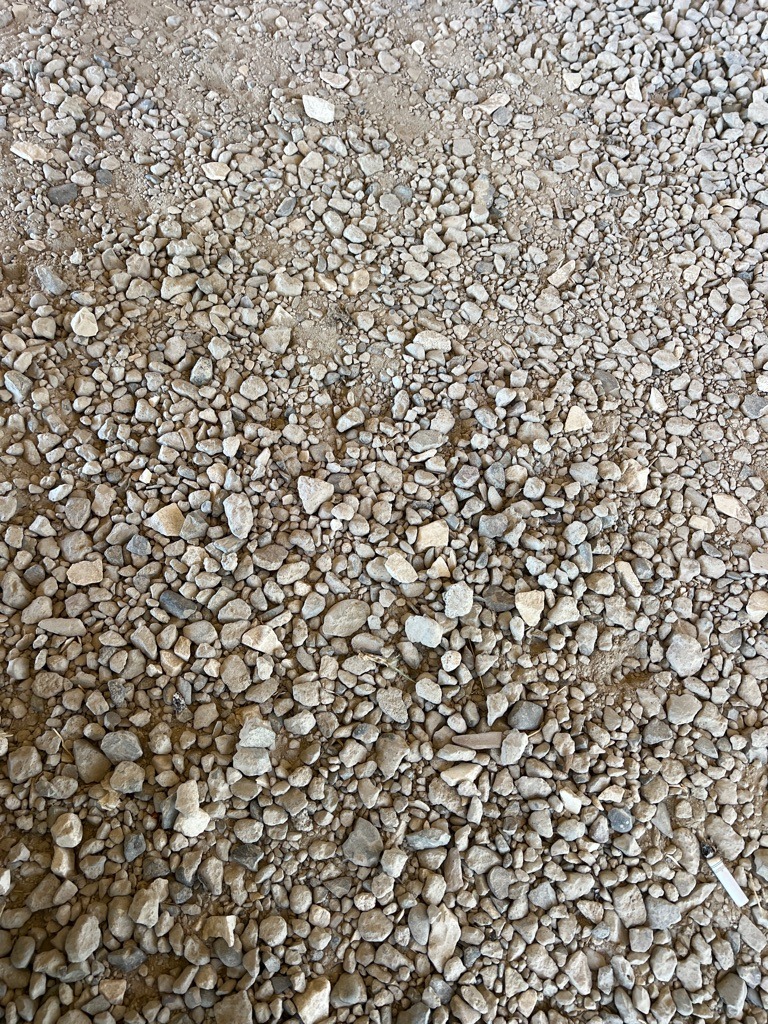
Skeletally Coarse Gravelly Sand / Calcareous Lithic Material · Quarry-crushed limestone aggregate, glacial outwash gravel, or arid alluvial fan deposit composed primarily of carbonate rock fragments.
AI Disclaimer
This soil report was produced by AI from a single photo. Treat it as a starting point, not laboratory truth.
pH, drainage, fertility, and composition are visual estimates — send a sample to an accredited lab before any decision that would be painful to get wrong.
Crop and amendment tips are general guidance — local climate, microclimate, and gardening history always win over an AI's best guess.
pH
Alkaline 7.8–8.5, strongly driven by the presence of limestone parent material and free calcium carbonates.
Drainage
Excessively drained due to the high macroporosity, loose single-grain structure, and massive percentage of coarse rock fragments allowing water to pass through almost instantaneously.
Organic Matter
Very low (<1%) due to the barren mineral nature of the stone surface, high aeration oxidizing residues quickly, and lack of stabilizing fine soil matrices.
Erosion Risk
Low risk of water or wind erosion for the gravel itself due to high particle weight, but fine interstitial soil particles are highly susceptible to washing away during heavy downpours.
Overall Read
This is not a true growing soil, but rather a stony aggregate or sub-base material. While it offers excellent drainage and stable load-bearing qualities for engineering and landscaping, it requires intensive, complete remediation with organic matter and topsoil before any meaningful plant cultivation can occur.
Texture
Extremely coarse, stony, and gritty with negligible fine earth; particles are angular to subangular rock fragments that will not form a ribbon and lack cohesion entirely.
Color Analysis
Light gray to pale yellowish-brown (Munsell approximately 10YR 7/2 to 10YR 8/3), indicating high calcium carbonate content, weathered limestone or dolomite, low organic matter, and absence of significant iron oxide staining.
Estimated Composition
90 percent coarse fragments and gravel, 8 percent sand, 2 percent silt and clay, and less than 0.5 percent organic matter.
Water Retention
Extremely low water-holding capacity; water drains right through without retention, causing plants to dry out rapidly during dry spells.
Aeration
Excessive aeration; oxygen levels are constantly at maximum saturation, which can prevent root suffocation but dries out root zones too quickly.
Compaction Level
Loose on the immediate surface layer, though potentially underlain by dense subgrade or hardpan depending on preparation; the visible layer is entirely loose and shifting.
Structure & Aggregation
Single-grain and structureless; individual rock fragments and mineral grains exist independently with no stable aggregates or peds.
Fertility Indicators
Very low overall fertility; visual indicators are complete absence of humus darkening, lack of earthworm activity, and pure mineral rock fragments showing no natural nutrient reserves for general horticulture.
Climate Suitability
Arid, semi-arid, or Mediterranean climates where drought-tolerant xerophytic plants naturally adapt to poor, rocky, fast-draining substrates.
Crops Worth Trying
Drought-tolerant native shrubs, junipers, succulents, certain Mediterranean herbs like rosemary and lavender (if planted with pockets of soil), and specialized alpine plants.
Plants To Avoid
Heavy moisture-loving plants, ferns, shallow-rooted heavy feeders, acid-loving plants like blueberries and azaleas, and delicate annual vegetables requiring consistent moisture.
Home Garden Use
Pathways, driveways, rock gardens, xeriscaping bases, French drain fills, or sub-base for raised beds; highly unsuited for direct in-ground vegetable gardening.
Agricultural Use
Unsuitable for traditional agriculture without extreme modification; utilized primarily as non-agricultural working land, farm roads, or feedlot surfaces.
Landscaping Use
Exceptional for decorative ground cover, drainage swales, xeriscape installations, modern minimalist rock landscaping, and backfill for retaining walls.
Common Problems
Severe drought stress, nutrient deficiency, extreme alkalinity limiting micronutrient availability, high surface reflectivity and heat retention, and complete lack of structural stability for planting.
Amendments Needed
Massive additions of well-rotted compost, organic mulches, peat moss, and topsoil to create growing pockets, combined with sulfur or acidifying organic amendments if neutralizing high pH is necessary.
Try These At Home Tests
A physical feel test will immediately reveal hard rocks rather than soil; a simple vinegar test will show immediate fizzing/effervescence, confirming high calcium carbonate content.
Professional Lab Recommendation
A standard agricultural soil test is unnecessary unless mixed with topsoil; if used for structural landscaping, a compaction and permeability test is more appropriate.
Fun Facts
Limestone-derived gravels and soils often form the unique terroir for famous wine-producing regions like Champagne and Burgundy, where vines struggle through stony ground to produce intensely flavored grapes.