Glacial Subsoil Excavation Fill
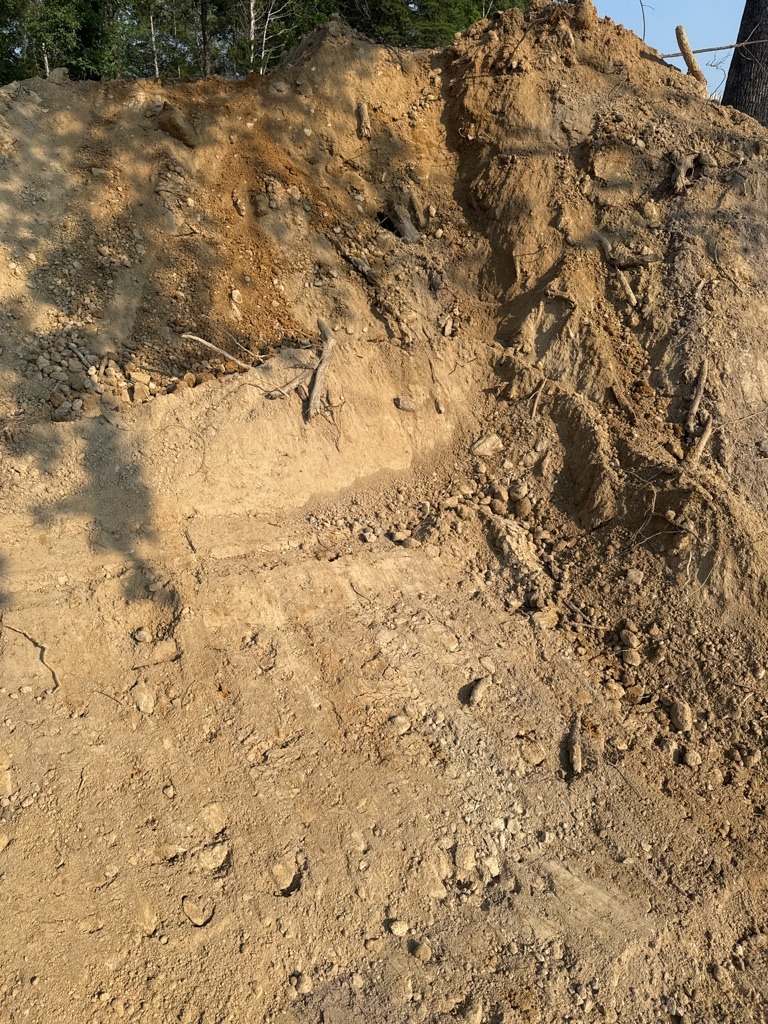
Sandy Loam to Loamy Sand · Glacial till or glaciofluvial deposit exposed via excavation or earthmoving in northern temperate regions.
AI Disclaimer
This soil report was produced by AI from a single photo. Treat it as a starting point, not laboratory truth.
pH, drainage, fertility, and composition are visual estimates — send a sample to an accredited lab before any decision that would be painful to get wrong.
Crop and amendment tips are general guidance — local climate, microclimate, and gardening history always win over an AI's best guess.
pH
Slightly acidic to neutral (6.0–7.0), typical of unweathered subsoil parent materials, though testing via probe is required for confirmation.
Drainage
Excessively to well-drained due to high coarse sand and gravel fraction, allowing water to infiltrate and percolate rapidly.
Organic Matter
Very low (<1%), as this material appears to be unweathered subsoil exposed from excavation, devoid of topsoil humus.
Erosion Risk
High water and tillage erosion risk on exposed slopes due to lack of vegetative cover and loose aggregate structure.
Overall Read
A raw, infertile subsoil pile requiring substantial organic amendments, rock removal, and topsoil capping before it can support productive gardening or landscaping.
Texture
Coarse and gritty with significant gravel and stone inclusions; low plasticity, will barely form a weak, crumbling ribbon in a ribbon test.
Color Analysis
Light yellowish-brown to brownish-yellow (Munsell roughly 10YR 6/4), indicating oxidized iron minerals and very low organic matter content.
Estimated Composition
70% sand, 20% silt, 7% clay, and 3% coarse fragments, with less than 1% organic matter.
Water Retention
Low water-holding capacity; dries out quickly in direct sun and lacks the finer pores needed to retain plant-available moisture.
Aeration
High natural aeration due to coarse texture, but mechanical compaction can severely restrict pore space locally.
Compaction Level
Moderately firm to compacted due to heavy equipment traffic and lack of organic cushioning during excavation.
Structure & Aggregation
Massive to single-grain structure with weak aggregate stability when disturbed, lacking biological binding agents.
Fertility Indicators
Low overall fertility; lacks dark humus, biological activity, and nutrient reserves, appearing as raw mineral earth.
Climate Suitability
Adaptable to temperate climates, but management requires careful irrigation and intensive soil building.
Crops Worth Trying
Deep-rooted trees, drought-tolerant native grasses, and establishment cover crops like cereal rye or clover once amended.
Plants To Avoid
Moisture-loving plants, delicate ornamentals, and heavy feeders requiring rich, high-organic topsoil.
Home Garden Use
Requires heavy topsoil layering; suitable only as a sub-base for raised beds or deep fill before being heavily amended.
Agricultural Use
Poor direct agricultural use without extensive land-forming, rock-picking, and long-term organic matter incorporation.
Landscaping Use
Useful for backfilling retaining walls or shaping slopes, provided it is capped with quality topsoil and seeded for erosion control.
Common Problems
Rapid nutrient leaching, severe drought stress, surface crusting, and difficulty establishing vegetation without amendments.
Amendments Needed
Massive additions of finished compost, aged manure, cover cropping, and a top layer of organic topsoil to build biological activity.
Try These At Home Tests
Perform a jar sedimentation test to verify sand/silt/clay ratios and a squeeze test to check for structural coherence.
Professional Lab Recommendation
Send a sample to a lab for a basic nutrient package, cation exchange capacity (CEC), and organic matter percentage to plan fertility recovery.
Fun Facts
Subsoils like this often preserve geological history and mineral profiles untouched by modern biological activity for thousands of years.