Arid Calcareous Clay Loam
Clay Loam · Alluvial valley deposit or weathered sedimentary residuum common in semi-arid interior regions or Mediterranean dryland basins.
AI Disclaimer
This soil report was produced by AI from a single photo. Treat it as a starting point, not laboratory truth.
pH, drainage, fertility, and composition are visual estimates — send a sample to an accredited lab before any decision that would be painful to get wrong.
Crop and amendment tips are general guidance — local climate, microclimate, and gardening history always win over an AI's best guess.
pH
Slightly to moderately alkaline (7.5–8.5) due to the pale coloring and likelihood of free calcium carbonates in arid or semi-arid parent materials.
Drainage
Moderately drained to poorly drained when compacted, as the dense clods and fine texture restrict rapid water infiltration after heavy rains.
Organic Matter
Low (1–2%) based on the light, dusty coloration and lack of visible dark humic layers or decaying surface residues.
Erosion Risk
Moderate to high for wind erosion when finely pulverized, and moderate water erosion risk on slopes due to surface crusting and reduced infiltration.
Overall Read
This pale, cloddy clay-loam offers decent mineral nutrient retention but suffers from low organic matter and a tendency to form hard surface crusts. With consistent additions of organic matter, careful tillage timing, and mulching, it can be transformed into a productive medium for adapted crops.
Texture
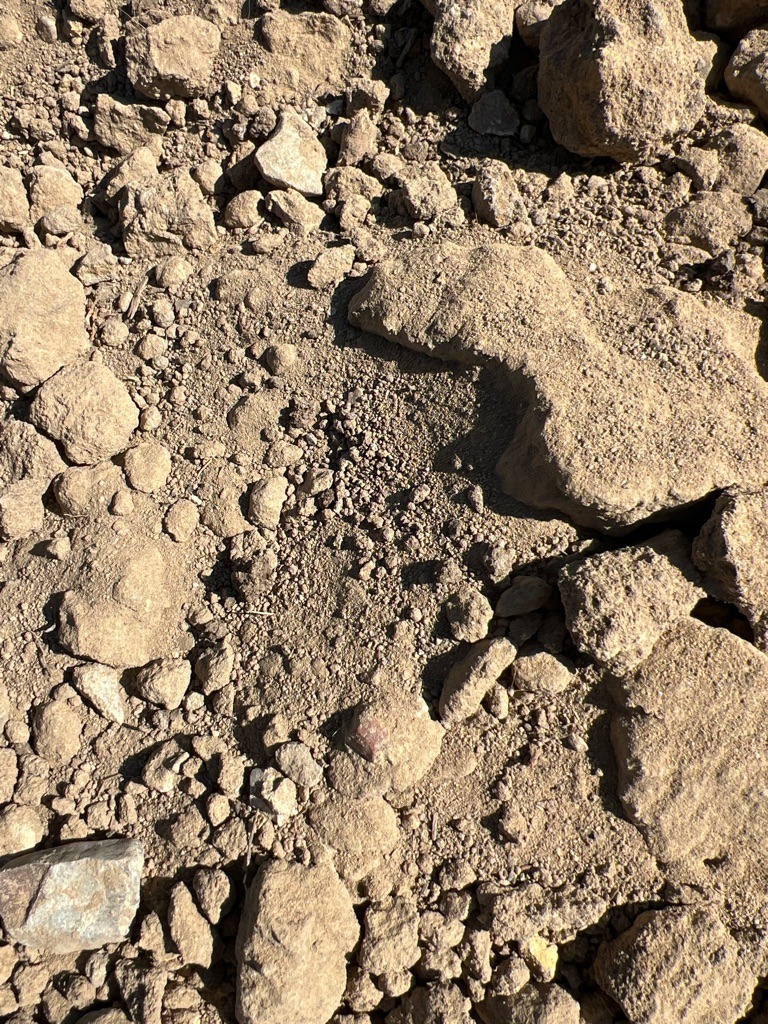
Fine and firm with prominent dry clods, showing high cohesion and forming hard, blocky aggregates that suggest a significant clay fraction mixed with silt.
Color Analysis
Light yellowish-brown to pale greyish-brown (approximately 10YR 6/4), indicating low organic matter content, well-aerated conditions, and the presence of oxidized iron and potentially calcium carbonates.
Estimated Composition
40% sand, 30% silt, 25% clay, and 5% organic matter (visual confidence: moderate).
Water Retention
High water-holding capacity due to the fine clay-loam matrix, though dry surface crusts can shed water initially before soaking through.
Aeration
Moderate to low when dry and compacted, as dense clods limit large pore spaces for optimal root and microbial gas exchange.
Compaction Level
Moderately to severely compacted, evidenced by hard, unbroken clods and smooth-faced breaking patterns typical of dried fine-textured earth.
Structure & Aggregation
Subangular blocky to massive when dry, forming hard structural peds (clods) that resist easy crumbling under light hand pressure.
Fertility Indicators
Low to moderate overall fertility; pale color and lack of dark humus point to limited active biological cycling, though mineral reserve capacity may be adequate.
Climate Suitability
Arid, semi-arid, or Mediterranean climates with seasonal rainfall patterns requiring careful moisture management.
Crops Worth Trying
Drought-tolerant grains, alfalfa, olives, figs, certain stone fruits, and adapted warm-season grasses that can tap subsoil moisture.
Plants To Avoid
Acid-loving plants (like blueberries), shallow-rooted delicate annuals, and species highly sensitive to waterlogging or heavy crusting during germination.
Home Garden Use
Established perennial borders, drought-tolerant native plant gardens, or heavily amended raised beds to bypass the dense native structure.
Agricultural Use
Extensive pasture, small grains, or irrigated row cropping provided proper tillage and organic amendments are utilized to break up clods.
Landscaping Use
Xeriscaping, establishment of drought-hardy turfgrasses, and structural backfill where immediate heavy settling is not a primary concern.
Common Problems
Surface crusting that impedes seedling emergence, hard clod formation upon drying, compaction, and potential alkalinity-induced nutrient lockouts.
Amendments Needed
Generous applications of compost, aged manure, or organic mulch to build structure, improve biological activity, and buffer pH over time.
Try These At Home Tests
Perform a jar settling test to separate sand, silt, and clay percentages; conduct a ribbon test to verify plasticity; and use a basic pH test strip.
Professional Lab Recommendation
Submit a sample to a local extension lab for a complete nutrient profile, cation exchange capacity (CEC), organic matter percentage, and salinity/pH analysis.
Fun Facts
Soils with high clay and silt fractions in arid regions often preserve ancient geological strata and archaeological records exceptionally well due to low leaching rates.