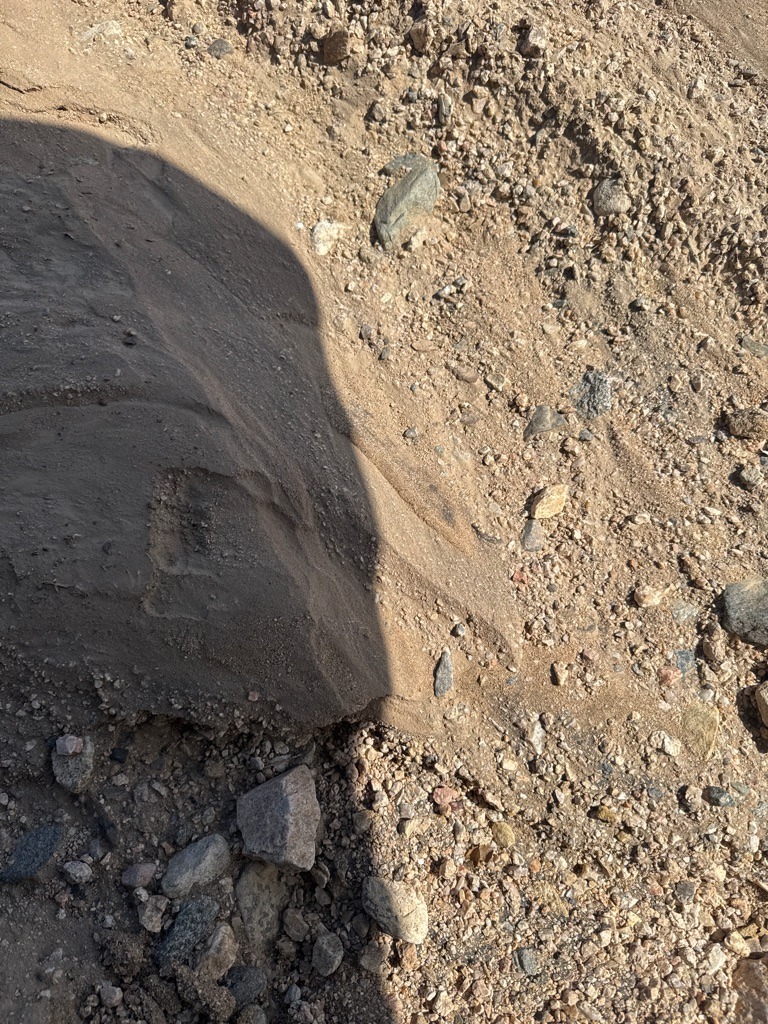
Arid Granitic Coarse Sandy Loam
Loamy Sand / Coarse Sandy Loam · Colluvial or alluvial outwash fan in an arid or semi-arid environment, derived from weathered granitic or crystalline parent rock.
AI Disclaimer
This soil report was produced by AI from a single photo. Treat it as a starting point, not laboratory truth.
pH, drainage, fertility, and composition are visual estimates — send a sample to an accredited lab before any decision that would be painful to get wrong.
Crop and amendment tips are general guidance — local climate, microclimate, and gardening history always win over an AI's best guess.
pH
Slightly alkaline to neutral 7.2–7.8, typical of arid regions where basic cations have not been heavily leached by rainfall. Confirmation via a soil testing probe or strip is recommended.
Drainage
Excessively drained. The high proportion of large sand particles and gravel creates large macro-pores that allow water to move rapidly downward through the profile with virtually no ponding.
Organic Matter
Very low (<1%). The pale color and absence of visible decomposing plant debris indicate minimal biological activity and carbon sequestration.
Erosion Risk
High risk for both wind and water erosion. Without cohesive structure, root mats, or organic binders, surface particles are easily displaced by heavy downpours or gusty winds.
Overall Read
This soil is structurally weak, nutrient-poor, and excessively well-drained, presenting high challenges for general gardening. However, with consistent additions of organic matter, mulch, and careful irrigation, it can be successfully adapted for specialized xeriscapic or drought-tolerant plantings.
Texture
Coarse and gritty with notable rock fragments and gravel. It lacks cohesion, shows single-grain behavior, and will fail to form a ribbon during a ribbon test, falling apart instantly due to the high percentage of sand-sized mineral particles.
Color Analysis
Light yellowish-brown to pale tan, typical of quartz-rich mineral sands with low organic matter. Munsell approximation is roughly 10YR 6/4. The pale hue indicates minimal humus accumulation and low levels of weathered iron oxides, suggesting arid or semi-arid weathering conditions.
Estimated Composition
75% sand, 15% silt, 5% clay, and less than 5% organic matter. This visual estimate carries moderate-to-high confidence given the prominent coarse mineral fraction and lack of structural aggregation.
Water Retention
Very low. This soil dries out rapidly after watering or rainfall, holding minimal plant-available moisture and suffering from low field capacity compared to an ideal loam.
Aeration
Excessive aeration. Oxygen levels are consistently high due to large pore spaces, which is beneficial for respiration but can lead to rapid oxidation of any added organic matter.
Compaction Level
Loose and friable in terms of bulk density, though subsurface traffic or natural cementation by minerals can occasionally create localized hard layers.
Structure & Aggregation
Single-grain structure with virtually no stable aggregates. The particles exist independently, making the soil loose when dry but prone to shifting and wind erosion.
Fertility Indicators
Low fertility. There is an absence of dark humus, earthworm activity, and fungal mycelium. The mineral profile is largely inert quartz and feldspar fragments.
Climate Suitability
Arid and semi-arid Mediterranean or desert-edge climates. Management must focus on frequent irrigation, heavy mulching, and shading to prevent rapid moisture loss.
Crops Worth Trying
Drought-tolerant native plants, succulents, Mediterranean herbs (rosemary, thyme, lavender), certain root crops like carrots if heavily amended, and heat-adapted fruit trees like olives or figs.
Plants To Avoid
Moisture-loving plants, heavy feeders requiring high cation exchange capacity, and plants susceptible to drought stress or nutrient deficiency.
Home Garden Use
Suitable for xeriscaping, succulent gardens, and rock gardens. Unsuitable for standard in-ground vegetable beds without substantial amendments.
Agricultural Use
Poor suitability for conventional row crops without intensive irrigation and fertilization. Can serve as pasture for hardy livestock or specialized vineyards with drip systems.
Landscaping Use
Ideal for drought-tolerant landscapes, rockery accents, and areas requiring fast-draining backfill around retaining walls, provided structural stability is managed.
Common Problems
Rapid nutrient leaching, extreme drought stress, low cation exchange capacity, wind erosion, and difficulty establishing fine-seeded turfgrass.
Amendments Needed
Heavy incorporation of compost, aged manure, and organic matter to build structure, boost water retention, and increase nutrient holding capacity.
Try These At Home Tests
Perform a jar settling test to separate sand, silt, and clay fractions. Try the squeeze test—squeezing moistened soil in your hand will yield a loose pile that crumbles instantly.
Professional Lab Recommendation
Send a sample to a commercial lab for a complete nutrient panel, organic matter percentage, and cation exchange capacity (CEC) to determine baseline fertility needs.
Fun Facts
Soils derived from weathered granite often contain sparkling flecks of mica and weather-resistant quartz crystals that endure for millions of years.