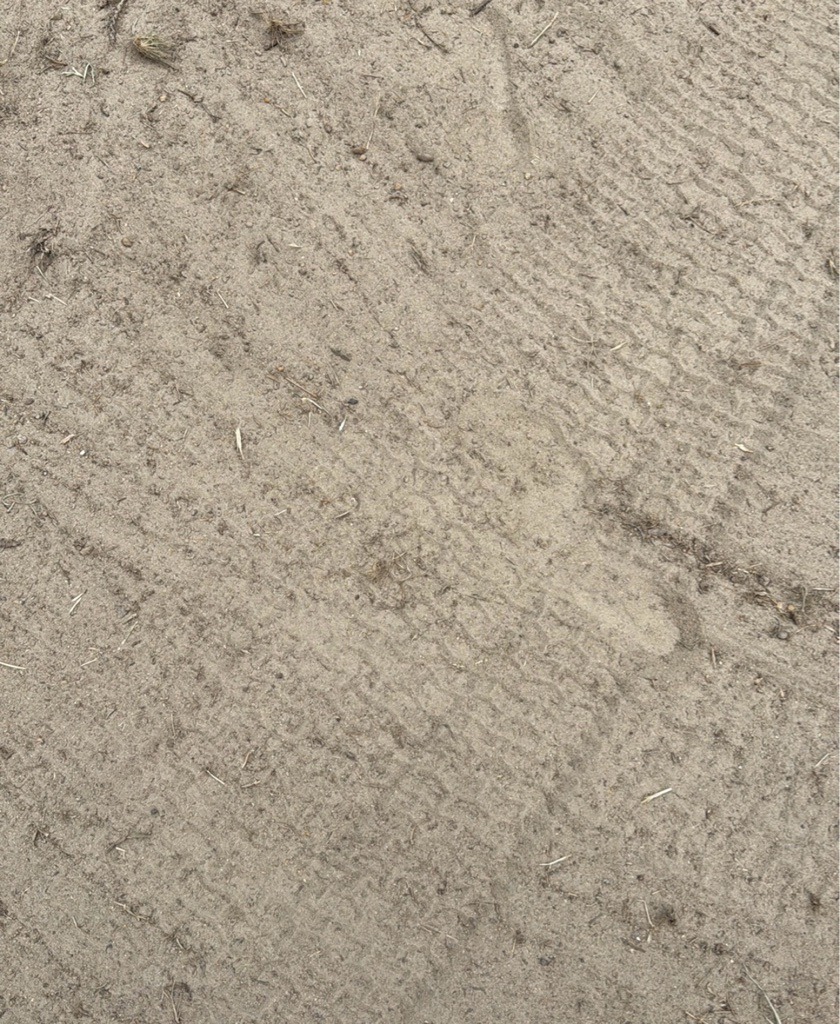
Fluvial Sandy Loam
Sandy Loam · Likely alluvial deposits from a river floodplain or glacial outwash; common in temperate regions like the American Midwest or coastal plains.
AI Disclaimer
This soil report was produced by AI from a single photo. Treat it as a starting point, not laboratory truth.
pH, drainage, fertility, and composition are visual estimates — send a sample to an accredited lab before any decision that would be painful to get wrong.
Crop and amendment tips are general guidance — local climate, microclimate, and gardening history always win over an AI's best guess.
pH
Likely neutral to slightly acidic (6.0–7.2); common for alluvial or disturbed sandy loams without excessive leaching or lime presence.
Drainage
Well Drained to Excessively Drained; high sand content allows for rapid macropore infiltration and low risk of ponding.
Organic Matter
Low to Moderate (1–3%); some visible plant debris and detritus are present, but the overall pale color suggests limited humus accumulation.
Erosion Risk
High risk for wind erosion when dry and water erosion on slopes due to low cohesive strength and weak aggregation.
Overall Read
A highly workable and well-drained soil with a grade of B-. Its physical structure is excellent for root growth, but its chemical fertility and water-holding capacity require active management through organic additions.
Texture
Gritty and crumbly texture with low plasticity; likely fails the ribbon test or forms a very short, brittle ribbon (<1 inch) that breaks easily.
Color Analysis
Light brownish gray (typically 10YR 6/2 or 5/2); the pale hue suggests low organic matter and well-oxidized minerals, likely quartz-dominated with minimal iron-rich clay.
Estimated Composition
70% Sand, 20% Silt, 5% Clay, 5% Organic Matter and detritus. Visual confidence is high regarding the sand fraction but moderate for silt/clay.
Water Retention
Low; expected to dry out rapidly in direct sun. Limited field capacity means frequent irrigation or moisture-retaining mulch is necessary for crops.
Aeration
Excellent; the porous sandy matrix ensures high oxygen availability for root respiration and aerobic microbial populations.
Compaction Level
Low to moderate; appears loose on the surface but shows evidence of mechanical tracks (treads), suggesting it is easily compressed when wet.
Structure & Aggregation
Weakly granular to single-grain; very low aggregate stability makes the surface prone to slaking and textural crusting after heavy rain.
Fertility Indicators
Moderate to Low; visual lack of dark humus or castings suggests low Cation Exchange Capacity (CEC) and potential for nutrient leaching.
Climate Suitability
Thrives in temperate or humid climates where regular rainfall compensates for low water retention; requires heavy mulching in arid zones.
Crops Worth Trying
Root vegetables (carrots, parsnips), tubers (potatoes), Mediterranean herbs (lavender, rosemary), and drought-tolerant grasses.
Plants To Avoid
High-water demand plants like Willows or heavy-feeding tropicals that require consistent moisture and high nutrient levels.
Home Garden Use
Excellent for in-ground vegetable gardens or pollinator meadows; not recommended for water-intensive ornamental beds without significant amendment.
Agricultural Use
Suitable for row crops like corn or soy with precision irrigation and fertilization; ideal for orchard sites needing good drainage.
Landscaping Use
Good for drought-tolerant xeriscaping, native grass establishment, or as a base for turfgrass if top-dressed with organic matter.
Common Problems
Rapid nutrient leaching (especially Nitrogen), frequent need for watering, and surface crusting that can hinder small-seed germination.
Amendments Needed
Heavy application of compost or well-aged manure (3-4 inches) to build CEC; use of cover crops (rye/vetch) to stabilize structure and add nitrogen.
Try These At Home Tests
The Jar Test will show a rapid sand layer settling in seconds; the 'Squeeze Test' will result in a ball that falls apart with the slightest touch.
Professional Lab Recommendation
Recommended for a standard fertility profile plus Organic Matter (OM) and CEC levels ($15–$30 range) to determine exact fertilizer requirements.
Fun Facts
Sandy loams are often called 'early soils' because they warm up much faster in the spring than clay soils, allowing for earlier planting dates.