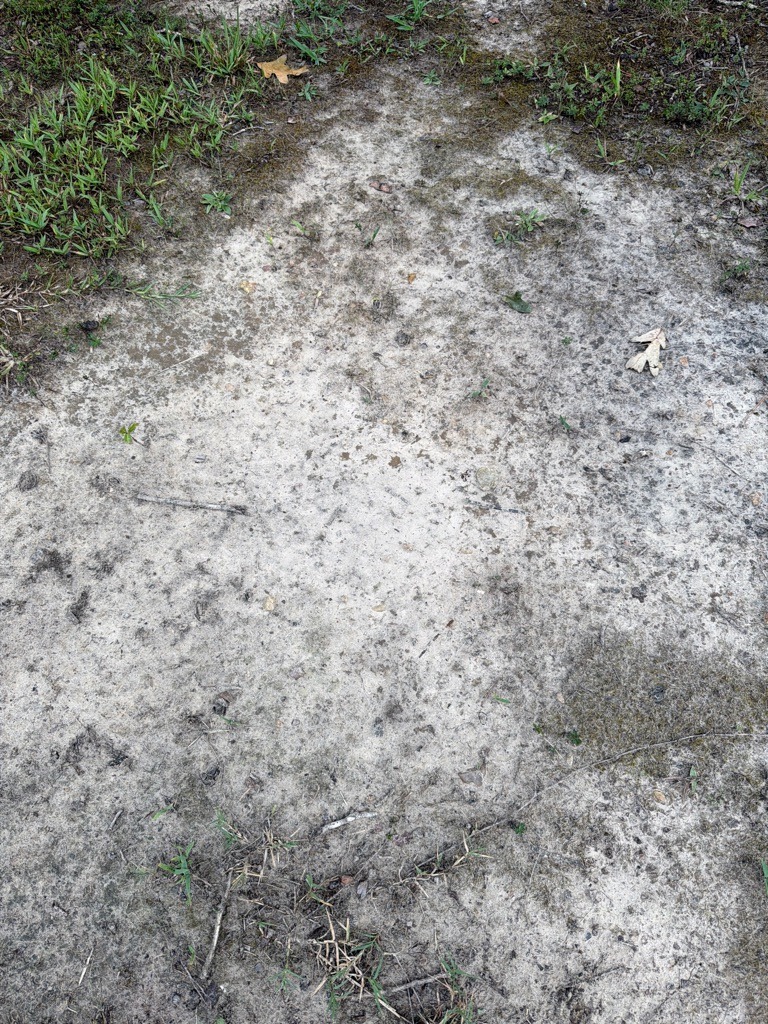
Bleached Coastal Sandy Loam with Hard Crust
Sandy Loam · Coastal plain marine deposits, weathered sandstone residuum, or inland outwash plain subject to heavy leaching.
AI Disclaimer
This soil report was produced by AI from a single photo. Treat it as a starting point, not laboratory truth.
pH, drainage, fertility, and composition are visual estimates — send a sample to an accredited lab before any decision that would be painful to get wrong.
Crop and amendment tips are general guidance — local climate, microclimate, and gardening history always win over an AI's best guess.
pH
Strongly to moderately acidic (5.0–6.0). Pale, leached sandy soils in humid regions are frequently acidic due to the washing away of basic cations like calcium and magnesium. Confirmation requires a test kit.
Drainage
Excessively to Well Drained internally, but the surface exhibits poor infiltration due to physical crusting. Water tends to run off or pool temporarily rather than soaking in smoothly.
Organic Matter
Low (1-2%). The pale color and lack of dark crumbly humus indicate very little biological residue incorporated into the mineral matrix.
Erosion Risk
Moderate to High. The loose sandy sub-particles are prone to water and wind erosion once the sparse surface vegetation or crust is disturbed.
Overall Read
Challenging for traditional gardening due to low fertility, crusting, and poor water retention, but highly manageable and responsive to consistent additions of organic matter and proper mulching.
Texture
Coarse and gritty with a heavy surface crust. In a ribbon test, it would barely form a short, fragile ribbon that quickly breaks, indicating low clay and high sand content.
Color Analysis
Light gray to whitish-gray (Munsell approximately 10YR 7/1 to 8/1) with mottled darker patches of brownish-gray. The pale, bleached surface strongly suggests intense leaching of iron and organic matter, often found in an eluvial E horizon or heavily weathered sandy soil.
Estimated Composition
Sand: 70%, Silt: 20%, Clay: 8%, Organic Matter: 2%. The confidence level for this visual estimate is moderate based on surface granularity and pale coloring.
Water Retention
Low. Because of the high sand fraction, this soil struggles to hold plant-available water and dries out rapidly under sun and wind exposure.
Aeration
High internally due to sandy texture, though the surface crust can temporarily restrict gas exchange until broken.
Compaction Level
Moderately firm to crusted at the surface, primarily due to raindrop impact forming a physical seal rather than deep machinery compaction.
Structure & Aggregation
Massive or single-grain underneath a weak, crusty platy surface layer. Aggregate stability is poor, making it vulnerable to sealing when hit by heavy raindrops.
Fertility Indicators
Low overall fertility. Pale coloring, sparse weed growth struggling at the edges, lack of visible earthworm activity, and surface crusting indicate low nutrient reserves and minimal biological activity.
Climate Suitability
Thrives best in temperate to subtropical humid climates where rainfall is frequent enough to prevent complete drought, though supplemental irrigation is usually required.
Crops Worth Trying
Drought-tolerant turfgrasses, root crops like carrots and radishes (if loosened), southern peas, sweet potatoes, and blueberries (if acidified further).
Plants To Avoid
Heavy feeders and moisture-loving plants that require rich, water-retentive loam, such as corn, squash, and many lush summer annuals without heavy amendment.
Home Garden Use
Suitable for native pollinator gardens adapted to sandy soils, herb gardens, or raised beds built on top of the native ground.
Agricultural Use
Requires heavy inputs and irrigation for row crops. Better suited for rotational grazing, tree crops, or specialized drought-hardy agriculture with intensive cover cropping.
Landscaping Use
Good for dry-scape landscaping, rock gardens, and areas planted with native drought-tolerant shrubs and ornamental grasses.
Common Problems
Surface crusting that impedes seed germination, rapid nutrient leaching, low moisture retention, and susceptibility to erosion.
Amendments Needed
Heavy applications of finished compost or aged manure to build organic matter, slow-release organic fertilizers, and mulch to prevent surface crusting and retain moisture.
Try These At Home Tests
Perform a jar test to accurately separate sand, silt, and clay percentages. Do a squeeze test to see if the soil crumbles instantly upon opening the hand.
Professional Lab Recommendation
Recommended before establishing a permanent garden or orchard to check CEC (cation exchange capacity), base saturation, and specific micronutrient deficiencies. Cost is typically modest through a local agricultural extension.
Fun Facts
Soils with this pale, bleached surface appearance often contain high amounts of quartz sand, which is chemically resistant to weathering and remains long after other minerals have dissolved away.