Urban Disturbed Subsoil Profile
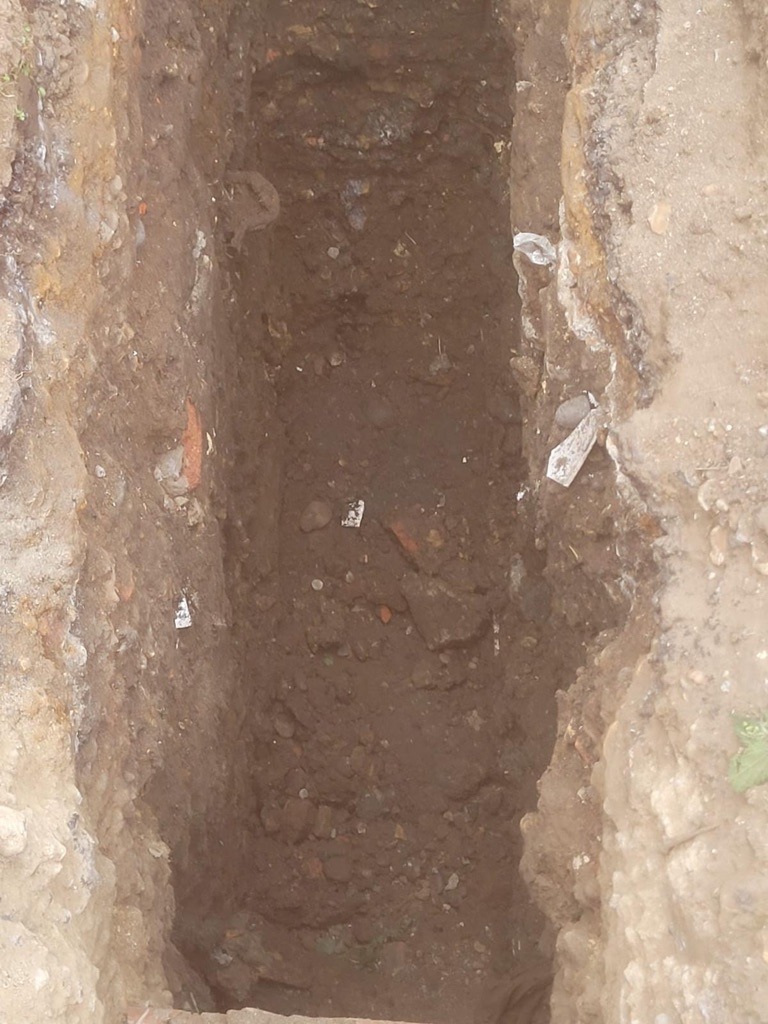
Gravelly Sandy Loam (Disturbed/Fill) · Urban or suburban anthropogenic fill profile, likely representing disturbed glacial till or alluvial subsoil mixed with construction debris.
AI Disclaimer
This soil report was produced by AI from a single photo. Treat it as a starting point, not laboratory truth.
pH, drainage, fertility, and composition are visual estimates — send a sample to an accredited lab before any decision that would be painful to get wrong.
Crop and amendment tips are general guidance — local climate, microclimate, and gardening history always win over an AI's best guess.
pH
Slightly alkaline to neutral (7.2–7.8), often influenced by the presence of mortar, concrete fragments, and masonry debris visible in the profile. Requires testing strips or a lab probe for confirmation.
Drainage
Well to excessively drained due to the high coarse fragment and sand content, allowing water to percolate rapidly through the profile, though lower compacted layers may perch water temporarily.
Organic Matter
Low (1-2%), as the image captures a deep excavation trench exposing subsoil layers and fill material devoid of significant surface humus or plant residue.
Erosion Risk
Moderate to high risk on exposed vertical trench walls or slopes due to weak structural aggregation and lack of cohesive clay binding.
Overall Read
This is a challenging, disturbed subsoil profile characterized by low fertility, high coarse fragment content, and compaction. While poor for direct planting, it can be successfully transformed into productive growing space through the addition of substantial organic matter, topsoil layering, and proper site remediation.
Texture
Coarse, gritty, and heterogeneous with mixed particle sizes ranging from fine sand to large gravel and anthropogenic debris, exhibiting very poor and weak ribboning behavior.
Color Analysis
Dull brownish-gray to yellowish-brown (approx. 10YR 5/4 to 10YR 5/6), indicating mixed mineral horizons, oxidized iron, and low active organic matter accumulation typical of subsoil or fill material.
Estimated Composition
Approximately 60 percent sand, 20 percent silt, 15 percent clay, and 5 percent coarse fragments/debris with low organic matter (<2 percent). Visual confidence is moderate due to profile visibility.
Water Retention
Low to moderate water retention capacity. Dries out quickly under sun exposure and lacks significant fine organic matter or clay to hold plant-available moisture efficiently.
Aeration
Good macro-porosity due to sand and gravel content allows oxygen exchange, though dense compacted zones may restrict root-zone gas diffusion.
Compaction Level
Moderately high to compacted, especially along the trench walls where mechanical excavation and historical settling have compressed the soil matrix.
Structure & Aggregation
Massive to weak subangular blocky structure in the lower profile with low aggregate stability, making it prone to breakdown when disturbed.
Fertility Indicators
Low fertility overall. Pale subsoil coloration, absence of visible earthworm activity or rich humus, and presence of construction debris indicate minimal natural biological nutrient cycling.
Climate Suitability
Adaptable to temperate and continental climates, though heavily dependent on irrigation during dry spells and heavy soil building to support intensive plant growth.
Crops Worth Trying
Hardy drought-tolerant ornamental plants, deep-rooted trees, and resilient turfgrasses that can handle nutrient-poor and compacted subsoil conditions.
Plants To Avoid
Fussy ornamentals, shallow-rooted heavy feeders, ericaceous plants requiring acidic soils, and moisture-loving bog plants.
Home Garden Use
Poorly suited for direct in-ground gardening without extensive amendments; better utilized as a sub-base for raised beds or requiring deep trench-composting.
Agricultural Use
Unsuitable for commercial row cropping or high-yield agriculture in its current state; requires massive amelioration, stone removal, and organic matter incorporation.
Landscaping Use
Suitable as backfill for retaining walls or sub-base for hardscaping, but requires topsoil capping and deep scarification for turf or tree planting pits.
Common Problems
Severe nutrient deficiency, rapid moisture loss, difficult root penetration due to compaction, stone interference, and unpredictable pH due to construction rubble.
Amendments Needed
Heavy applications of mature compost, aged manure, organic mulches, and potentially elemental sulfur or balanced slow-release fertilizers to build topsoil depth and fertility.
Try These At Home Tests
Perform a jar test to verify sand-silt-clay ratios, a ribbon test to check plasticity, and use pH test strips mixed with distilled water to check for alkalinity caused by concrete debris.
Professional Lab Recommendation
Recommended before undertaking major landscaping or building projects; request a complete agronomic soil test including heavy metals screening given the urban/disturbed context.
Fun Facts
Deep soil profiles and trenches often act as unexpected archaeological and geological windows, revealing decades or centuries of human activity and natural sediment deposition layers.