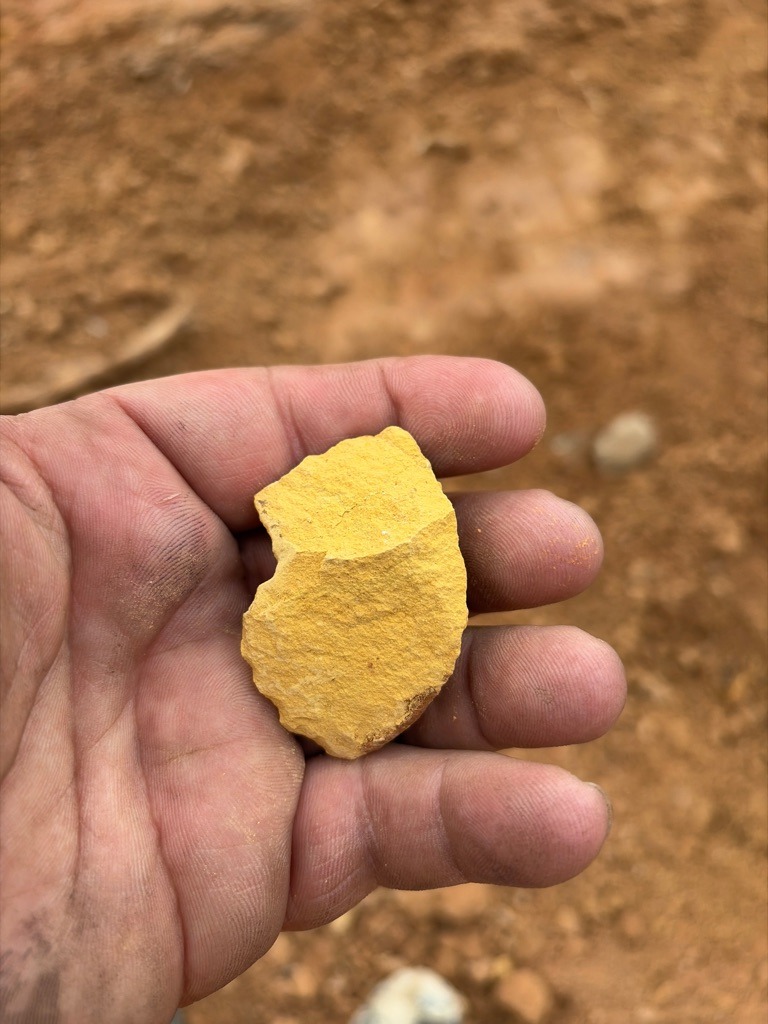
Vibrant Yellow Ochre Clay Subsoil
Clay / Weathered Saprolite · Deeply weathered subsoil horizon (B or C horizon) from a temperate or subtropical region, possibly exposed via excavation, roadcuts, or severe topsoil erosion.
AI Disclaimer
This soil report was produced by AI from a single photo. Treat it as a starting point, not laboratory truth.
pH, drainage, fertility, and composition are visual estimates — send a sample to an accredited lab before any decision that would be painful to get wrong.
Crop and amendment tips are general guidance — local climate, microclimate, and gardening history always win over an AI's best guess.
pH
Strongly to moderately acidic (pH 4.8 to 5.8) due to intense leaching of basic cations over long periods of weathering. Needs confirmation via test strips or lab probe.
Drainage
Poorly drained. Due to the very fine clay particle matrix and lack of macro-pores, water movement is severely restricted, leading to perched water tables and seasonal saturation.
Organic Matter
Very low (<1%), as evidenced by the bright mineral coloration, lack of visible plant residues, and dense, massive clod structure.
Erosion Risk
High water erosion risk on slopes due to low infiltration rates generating rapid surface runoff, and high vulnerability to gullying when exposed without vegetative cover.
Overall Read
A challenging mineral subsoil with high clay and iron oxide content, poor drainage, and low organic matter. While difficult to work with initially, it can be transformed into productive soil through sustained organic matter additions, pH adjustment, and biological cultivation.
Texture
Fine, powdery when dry, but extremely smooth and plastic when wet. Forms a long, flexible ribbon easily in the ribbon test, indicating a high concentration of clay-sized particles.
Color Analysis
Bright vivid yellow to yellowish-brown (approximate Munsell 10YR 7/8), indicating high concentrations of hydrated iron oxides such as goethite, and a severe lack of dark organic matter.
Estimated Composition
15 percent sand, 25 percent silt, 55 percent clay, and less than 1 percent organic matter.
Water Retention
High total water holding capacity, but a very low proportion of plant-available water because clay particles hold onto moisture with high matric suction, often becoming rock-hard when dry.
Aeration
Low aeration, especially when wet, as the microscopic pore spaces fill entirely with water, restricting oxygen diffusion to roots and beneficial microbes.
Compaction Level
Severely compacted. The sample is a dense, hard natural ped (clay lump) showing high bulk density and resistance to crumbling.
Structure & Aggregation
Massive to blocky subsoil structure. Individual aggregates lack high biological stability and tend to break down into dense, impermeable layers when exposed to heavy rain or tillage.
Fertility Indicators
Low overall fertility. The bright yellow color signifies heavily weathered, leached mineral subsoil devoid of humus, active biological life, and readily available macronutrients.
Climate Suitability
Thrives best in humid subtropical or temperate climates with consistent moisture, though intensive management for drainage and organic building is required regardless of climate.
Crops Worth Trying
Deep-rooting trees, certain resilient pasture grasses (like fescue or bahiagrass), and pioneer species capable of handling heavy subsoil conditions.
Plants To Avoid
Fine root vegetables like carrots and radishes (which will deform in heavy clay), acid-sensitive plants without pH adjustment, and drought-sensitive annuals.
Home Garden Use
Unsuited for direct in-ground gardening without heavy amendment; best addressed by building raised beds over the top or undertaking a multi-year organic remediation program.
Agricultural Use
Typically kept in permanent pasture, forest, or managed with intensive subsoiling, liming, and cover cropping (such as daikon radish or rye) to break up hardpan.
Landscaping Use
Difficult for turf and ornamental beds without extensive tilling and incorporation of organic matter; often used as subgrade fill where low permeability is required.
Common Problems
Surface crusting, severe shrinking and cracking during dry periods, waterlogging after rain, difficult root penetration, and low nutrient availability.
Amendments Needed
Massive applications of compost, aged manure, cover crop root channels, and agricultural lime to raise pH and flocculate clay particles.
Try These At Home Tests
Perform a ribbon test to confirm high clay content, a jar settling test for particle percentages, and an infiltration test in the ground to measure slow drainage rates.
Professional Lab Recommendation
Send a sample to a commercial lab for a complete nutrient analysis, cation exchange capacity (CEC), buffer pH, and heavy metal screening if used for food production.
Fun Facts
Bright yellow ochre clays pigmented by goethite have been used by humans as natural earth pigments for cave paintings and art for tens of thousands of years.