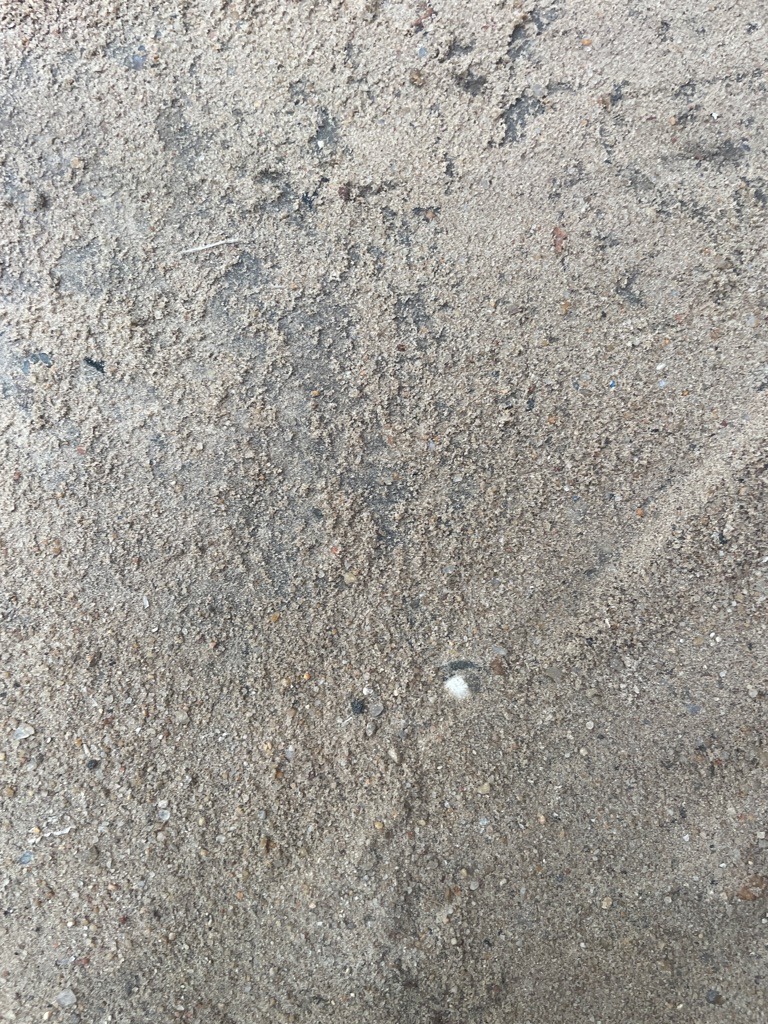
Coarse Siliceous River Sand
Sand · Alluvial or glacial outwash deposits; typically found in riparian zones, coastal plains, or as 'builder's sand' from a quarry.
AI Disclaimer
This soil report was produced by AI from a single photo. Treat it as a starting point, not laboratory truth.
pH, drainage, fertility, and composition are visual estimates — send a sample to an accredited lab before any decision that would be painful to get wrong.
Crop and amendment tips are general guidance — local climate, microclimate, and gardening history always win over an AI's best guess.
pH
Neutral to slightly acidic (6.0–7.0). The lack of visible carbonate crusts or reddish iron leaching suggests a relatively inert chemical profile.
Drainage
Excessively Drained. The high macro-porosity and lack of clay/silt barriers allow water to move vertically almost instantly.
Organic Matter
Very Low (<1%). The pale color and absence of dark humus or visible biological detritus indicate a nearly sterile mineral substrate.
Erosion Risk
High susceptibility to wind erosion when dry and water washouts on slopes due to lack of cohesive binding agents.
Overall Read
This is a challenging, low-fertility mineral substrate. While poor for traditional gardening, it is a blank canvas for specialty plants that require 'dry feet' and perfect drainage.
Texture
Gritty, non-plastic, and single-grained; fails to form a ball or ribbon, falling apart immediately when handled.
Color Analysis
Light gray to pale brown (10YR 7/1 to 7/3), suggesting very low organic matter and quartz-dominated mineralogy with minimal iron oxidation.
Estimated Composition
90% Sand, 7% Silt, 2% Clay, 1% Organic Matter. Confidence is high due to visible crystalline grains and lack of aggregation.
Water Retention
Very Low. Dries out rapidly within hours of sun exposure; possesses minimal field capacity for plant-available water.
Aeration
Exceptional. High oxygen availability due to massive pore spaces, making it nearly impossible for this soil to become anaerobic.
Compaction Level
Loose and friable when dry, though can pack tightly (physical settling) when wet; lacks the structural compaction seen in clay soils.
Structure & Aggregation
Single-grain. There is no measurable structure or peds; individual grains do not adhere, providing no stability against movement.
Fertility Indicators
Low. Lack of cation exchange capacity (CEC) sites and organic matter suggests poor nutrient storage and rapid leaching.
Climate Suitability
Arid to Temperate. Requires frequent irrigation and heavy mulching in hot climates to prevent total desiccation of root zones.
Crops Worth Trying
Cacti, succulents, lavender, Mediterranean herbs (rosemary/thyme), and certain root crops like carrots (if heavily fertilized).
Plants To Avoid
High-moisture lovers like ferns, hydrangeas, or heavy feeders like corn and large leafy brassicas which require stable nitrogen.
Home Garden Use
Excellent for rock gardens, xeriscaping, or as a base layer for drainage in raised beds; not suitable for stand-alone fruit/veg gardening.
Agricultural Use
Limited without intensive irrigation and fertigation; sometimes used for specialty turf (golf greens) or as a substrate for hydroponic-style farming.
Landscaping Use
Ideal for paver base, sand bunkers, dry creek bed aesthetics, and as a drainage amendment for ornamental succulent beds.
Common Problems
Nutrient leaching (starvation), rapid drying (drought stress), and hydrophobicity if a small amount of organic matter dries out.
Amendments Needed
Heavy incorporation of finished compost, biochar to increase CEC, and peat moss or coconut coir to improve moisture retention.
Try These At Home Tests
Jar Test: Expect almost immediate settling (within 30 seconds). Squeeze Test: The soil will crumble instantly when the hand is opened.
Professional Lab Recommendation
Request a Basic Nutrient and CEC test. Low results will confirm that fertilization frequency must be high but at low doses.
Fun Facts
Sand particles are defined as being between 0.05mm and 2.0mm. This specific sample appears to be 'sharp' sand, indicating it hasn't been tumbled smooth by long-term water travel.