Coastal Sandy Loam
Sandy Loam · Alluvial floodplain deposit, coastal marine terrace, or glacial outwash plain dominated by quartzose parent materials.
AI Disclaimer
This soil report was produced by AI from a single photo. Treat it as a starting point, not laboratory truth.
pH, drainage, fertility, and composition are visual estimates — send a sample to an accredited lab before any decision that would be painful to get wrong.
Crop and amendment tips are general guidance — local climate, microclimate, and gardening history always win over an AI's best guess.
pH
Likely slightly acidic ranging from 6.0 to 6.8 based on typical weathering patterns in sandy coastal or glacial outwash environments. Visual inspection cannot confirm pH; a test strip or electronic meter is recommended.
Drainage
Well drained. The high proportion of coarse sand particles creates large macro-pores that allow water to infiltrate and percolate rapidly through the profile after heavy rain.
Organic Matter
Low, approximately 1 to 2 percent. The light color and lack of deep surface humus indicate minimal decayed plant residues, resulting in slower microbial cycling compared to dark prairie soils.
Erosion Risk
Moderate to high. Highly susceptible to wind erosion when dry and bare, and vulnerable to water erosion on slopes due to weak aggregate bonding and loose particle arrangements.
Overall Read
A warm, highly workable, and well-draining soil with fantastic aeration and root penetration potential, though it requires diligent additions of organic matter and water management to maintain high fertility and crop yields.
Texture
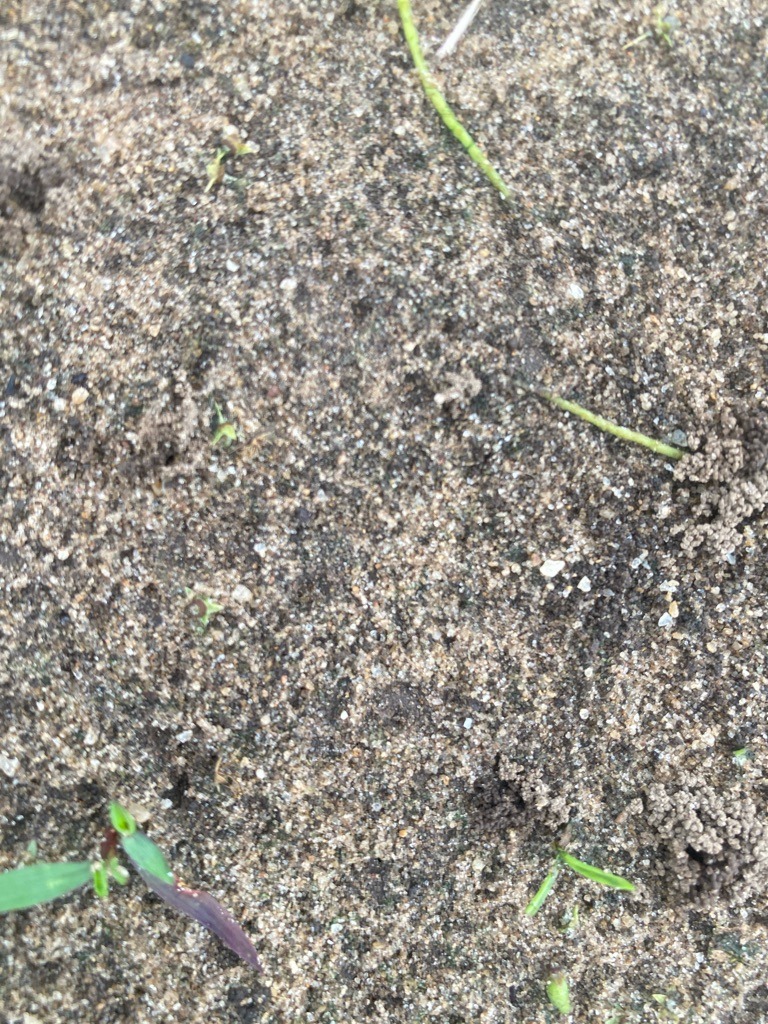
Coarse and gritty with visible individual quartz sand grains; exhibits weak crumbly behavior and fails to form a stable ribbon during a ribbon test due to low clay content.
Color Analysis
Greyish-brown to light olive-brown hue with medium value and low chroma, approximately 10YR 5/2. Suggests moderate mineral weathering, limited organic matter accumulation, and adequate free drainage with minimal waterlogging history.
Estimated Composition
Roughly 70 percent sand, 20 percent silt, 8 percent clay, and 2 percent organic matter. This visual estimate carries moderate confidence and requires particle-size analysis for lab confirmation.
Water Retention
Low to moderate. It dries out quickly under direct sun and wind due to rapid drainage and limited capillary forces, holding significantly less plant-available water than an ideal silt loam.
Aeration
Excellent. The abundance of macro-pores guarantees high oxygen diffusion rates to the root zone and soil microbes, virtually eliminating risks of anaerobic waterlogging.
Compaction Level
Loose and friable when moist, showing very low natural resistance to root penetration, though it can form a slight surface crust if heavily puddled and dried rapidly.
Structure & Aggregation
Single-grain to weakly granular structure with poor aggregate stability. The lack of strong binding agents means particles easily dislodge under mechanical disturbance or heavy downpours.
Fertility Indicators
Low overall fertility. Visual clues include pale mineral grains, scattered fine roots, and sparse organic residues. Nutrient reserves are easily depleted by leaching.
Climate Suitability
Thrives across temperate, subtropical, and Mediterranean climates where supplemental irrigation and regular organic mulching can counteract its dry, leaching tendencies.
Crops Worth Trying
Root vegetables like carrots and radishes, potatoes, strawberries, warm-season cover crops like cowpeas, and drought-tolerant turfgrasses that benefit from loose, easily penetrated soil.
Plants To Avoid
Heavy moisture-loving plants that require constant heavy clay moisture retention, or crops sensitive to rapid drought stress without dependable irrigation.
Home Garden Use
Ideal for raised beds, warm-season vegetable plots, and herb gardens where good drainage and fast spring warm-up are advantageous.
Agricultural Use
Well-suited for irrigated commercial vegetable production, potato farming, and orchards with managed fertigation to overcome nutrient leaching.
Landscaping Use
Great for drought-tolerant xeriscaping, ornamental bulb beds, and permeable turf areas, provided irrigation is installed for establishment.
Common Problems
Rapid nutrient leaching, quick drying during dry spells, low cation exchange capacity, and susceptibility to wind erosion when unplanted.
Amendments Needed
Heavy applications of finished compost, aged manure, or leaf mold to boost organic matter, paired with slow-release organic fertilizers and cover cropping to build structure.
Try These At Home Tests
Perform a standard glass jar sedimentation test to confirm the sand-silt-clay ratios, and try the squeeze test to see if the soil crumbles instantly upon opening the hand.
Professional Lab Recommendation
Send a sample to a local extension service for a complete nutrient panel, organic matter percentage, and cation exchange capacity to properly tailor fertilizer inputs; typically costs 20 to 40 dollars.
Fun Facts
Sandy loams warm up much faster in the spring than heavy clays, allowing farmers and gardeners to plant their crops weeks earlier in the season.