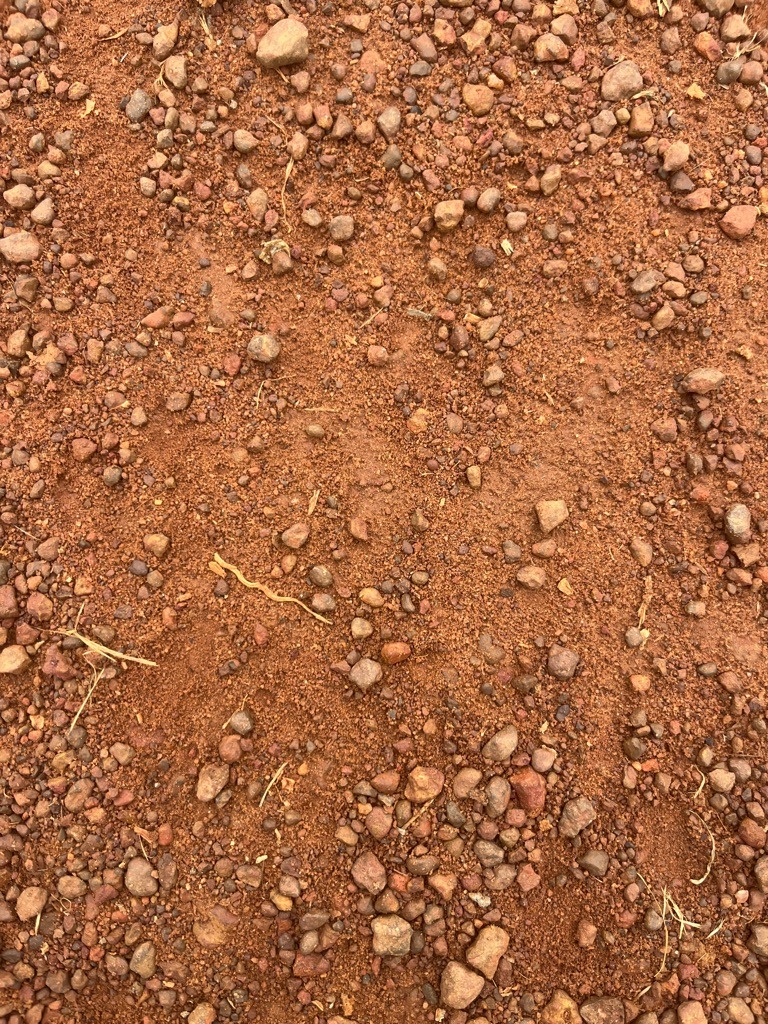
Gravelly Red Clay Loam / Ferruginous Lateritic Soil
Gravelly Clay Loam to Gravelly Sandy Clay Loam (Oxisol / Ultisol / Laterite) · Weathered residual or colluvial soil common in tropical/subtropical shield regions, such as the Southeastern US Piedmont, Brazilian Cerrado, Western Australia, or parts of Sub-Saharan Africa and Peninsular India.
AI Disclaimer
This soil report was produced by AI from a single photo. Treat it as a starting point, not laboratory truth.
pH, drainage, fertility, and composition are visual estimates — send a sample to an accredited lab before any decision that would be painful to get wrong.
Crop and amendment tips are general guidance — local climate, microclimate, and gardening history always win over an AI's best guess.
pH
Moderately to strongly acidic (pH 4.5 - 5.8). High iron/aluminum oxide concentration and intense tropical/subtropical leaching typically lead to acidic soil conditions.
Drainage
Well Drained to Somewhat Excessively Drained in upper layers due to high macro-porosity around coarse gravel, though dense clay sublayers can cause localized surface runoff during intense rain.
Organic Matter
Low (1-2%). The bright red coloration reflects minimal humus stabilization and rapid oxidation of organic matter typical of warm or exposed environments.
Erosion Risk
High risk for water splash and sheet erosion on slopes; coarse surface gravel forms a partial protective protective pavement, but fine particles wash away easily when unprotected.
Overall Read
Overall Rating: Poor to Fair in raw state, but Highly Transformable. Strengths include good structural foundation and high iron; weaknesses are acidity, low natural fertility, and high graveliness. Priority action: Add organic compost, apply lime, and mulch surface heavily.
Texture
Coarse, gritty, and gravelly on the surface due to ironstone nodules and pebbles; fines consist of a sticky, plastic clay-rich matrix when wet, hardening to a blocky or crusty state when dry.
Color Analysis
Deep reddish-orange to dusky red (Munsell equivalent roughly 2.5YR 4/8 to 10R 4/6). This vivid reddish hue indicates intense weathering, high concentration of hematite and oxidized iron minerals, and good internal aeration despite low organic carbon accumulation.
Estimated Composition
40% coarse gravel/ironstone nodules, 30% sand/coarse silt fines, 25% iron-rich clay fines, 5% organic matter (Confidence Level: Moderate visual estimate based on surface lag gravel and iron oxides).
Water Retention
Low to Moderate effective plant-available water capacity. Coarse gravel fragments hold no water, and highly weathered iron-bound clays have lower water holding capacity than typical smectite or illite clays.
Aeration
Good macro-aeration through gravel inter-spaces, but root oxygenation in the underlying fine matrix may become restricted during prolonged saturation.
Compaction Level
Moderately high surface compaction with severe hardpan/crust potential. Surface shows a dense lag of ironstone gravel and exposed mineral surface with sparse loose fines.
Structure & Aggregation
Weak fine granular to subangular blocky intermixed with single-grain coarse ironstone nodules. Poor aggregate stability when disturbed, making it prone to crusting under heavy raindrop impact.
Fertility Indicators
Low overall fertility rating. High iron oxide presence often binds available phosphorus (P-fixation), and low organic matter suggests low Cation Exchange Capacity (CEC) and nitrogen deficiency.
Climate Suitability
Thrives best in warm temperate, subtropical, or tropical wet-dry climates with warm soils. Requires intensive water management and mulching in dry spells.
Crops Worth Trying
Drought-tolerant woody perennials, citrus, stone fruits, cassava, sweet potato, eucalyptus, tea, coffee, leguminous cover crops (pigeon pea, cowpea), and deep-rooted native grasses.
Plants To Avoid
Shallow-rooted fine vegetables (lettuce, spinach) without soil amendments, calciphiles (cabbage, lavender, brassicas needing high pH/calcium), and phosphorus-sensitive delicate annuals.
Home Garden Use
Best suited for raised garden beds filled with imported topsoil/compost. In-ground planting works well for established woody shrubs, fruit trees, and acid-loving ornamental borders.
Agricultural Use
Suitable for orchards, plantations, pasture, or grain crops (soybeans, maize) provided liming and banding of soluble phosphate fertilizers are routinely practiced.
Landscaping Use
Excellent substrate for xeriscaping, native plant restoration, driveways/path bases, and tree planting pits after structural mechanical aeration and soil amendment.
Common Problems
Severe phosphorus fixation, acidity/aluminum toxicity, high gravel content frustrating hand digging, surface crusting, rapid drying, and low natural nitrogen availability.
Amendments Needed
Heavy compost/organic matter additions (2-4 inches tilled into top layers), agricultural lime to raise pH, rock phosphate or mycorrhizal inoculants, and biochar to boost nutrient retention.
Try These At Home Tests
Perform a jar test (screen out coarse gravel first), a vinegar test for carbonate presence (expect no reaction), and a jar infiltration test to measure drainage speed.
Professional Lab Recommendation
Highly recommended to send a soil sample to a university extension lab. Request a standard soil test including Mehlich-3 or Bray phosphorus, pH/buffer pH, CEC, and heavy metals screening ($15-$30).
Fun Facts
The red color comes from iron rust (hematite). In tropical regions, these soils can harden irreversibly into a brick-like material called laterite, historically used as building blocks for temples like Angkor Wat!