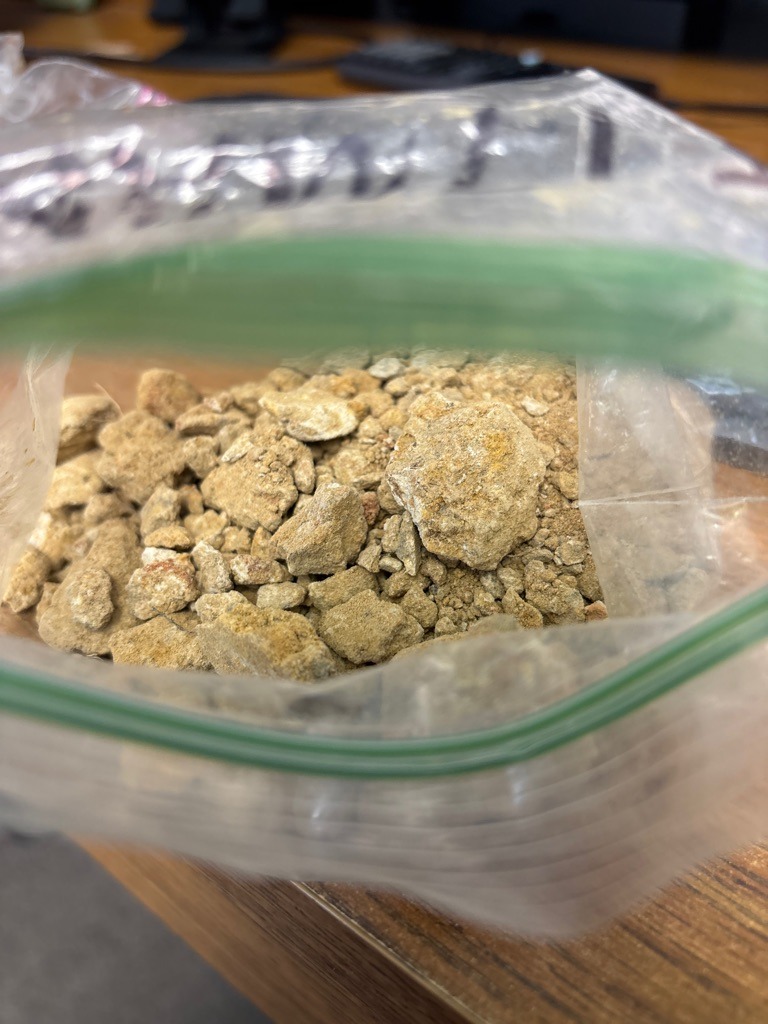
Pale Subsoil Clay-Silt Aggregate
Clay Loam · Weathered subsoil residuum or excavated subsoil fill material, common in construction sites or deeply tilled agricultural profiles.
AI Disclaimer
This soil report was produced by AI from a single photo. Treat it as a starting point, not laboratory truth.
pH, drainage, fertility, and composition are visual estimates — send a sample to an accredited lab before any decision that would be painful to get wrong.
Crop and amendment tips are general guidance — local climate, microclimate, and gardening history always win over an AI's best guess.
pH
Neutral to slightly alkaline 7.0–7.8, suggested by the pale yellowish mineralogy and lack of dark acidic organic matter. Confirm with a soil test kit.
Drainage
Moderately Poorly Drained, as the dense blocky aggregates restrict rapid water infiltration and percolation.
Organic Matter
Very low (<1%), indicated by the pale color and lack of dark humus or visible plant residues.
Erosion Risk
Moderate water erosion risk on slopes if exposed without cover, due to slow infiltration rates leading to surface runoff.
Overall Read
This is a challenging, compacted subsoil sample with low organic matter and high clay content. While nutrient-poor and structurally difficult, it can be rehabilitated into a productive medium over time with persistent additions of organic amendments and biological aeration.
Texture
Fine and blocky with strong cohesive properties, likely forming a durable ribbon when wet due to high clay content.
Color Analysis
Light yellowish-brown to brownish-yellow (Munsell 10YR 6/4), indicating well-oxidized iron minerals and very low organic matter content typical of subsurface layers.
Estimated Composition
40% sand, 20% silt, 35% clay, 5% organic matter (visual confidence is moderate for a disturbed subsoil sample).
Water Retention
High total water holding capacity, but much of the water is held tightly within micropores, reducing plant-available water.
Aeration
Low to moderate aeration when dry due to dense blocky structure; prone to localized oxygen depletion when saturated.
Compaction Level
Compacted, forming hard clods and fragments that resist gentle crushing, pointing to subsoil excavation or heavy machinery pressure.
Structure & Aggregation
Subangular blocky peds that are hard and dry, showing moderate-to-high dry aggregate stability but poor friability.
Fertility Indicators
Low fertility overall; lacking dark humus, earthworm activity, and visible biological life, with a pale, nutrient-poor appearance.
Climate Suitability
Thrives best in temperate or semi-arid climates with managed irrigation, but requires structural conditioning across most environments.
Crops Worth Trying
Deep-rooting or resilient perennials, alfalfa, winter wheat, and certain drought-tolerant grasses that can tolerate heavier subsoils.
Plants To Avoid
Fine root vegetables like carrots or radishes, delicate annuals, and acid-loving plants like blueberries.
Home Garden Use
Not recommended for direct garden beds without heavy amendment; can be used as deep subsoil layer in landscaping berms if covered with topsoil.
Agricultural Use
Requires deep ripping, subsoiling, and massive organic matter incorporation before it can support productive row crops or orchards.
Landscaping Use
Suitable for structural fill or sub-base beneath topsoil, but terrible as a direct planting medium for turf or ornamental beds.
Common Problems
Surface crusting, severe cracking when dry, waterlogging when wet, high resistance to root penetration, and poor nutrient availability.
Amendments Needed
Heavy applications of compost, aged manure, and cover cropping (like daikon radish) to break up compaction and add organic matter.
Try These At Home Tests
Perform a jar sedimentation test to confirm sand-silt-clay percentages and a ribbon test to verify the clay content.
Professional Lab Recommendation
Send a sample to an agricultural extension lab for a complete nutrient analysis, cation exchange capacity (CEC), and pH test to guide reclamation.
Fun Facts
Clods like these are often brought to the surface during deep utility trenching or foundation excavation, representing geological history thousands of years old.