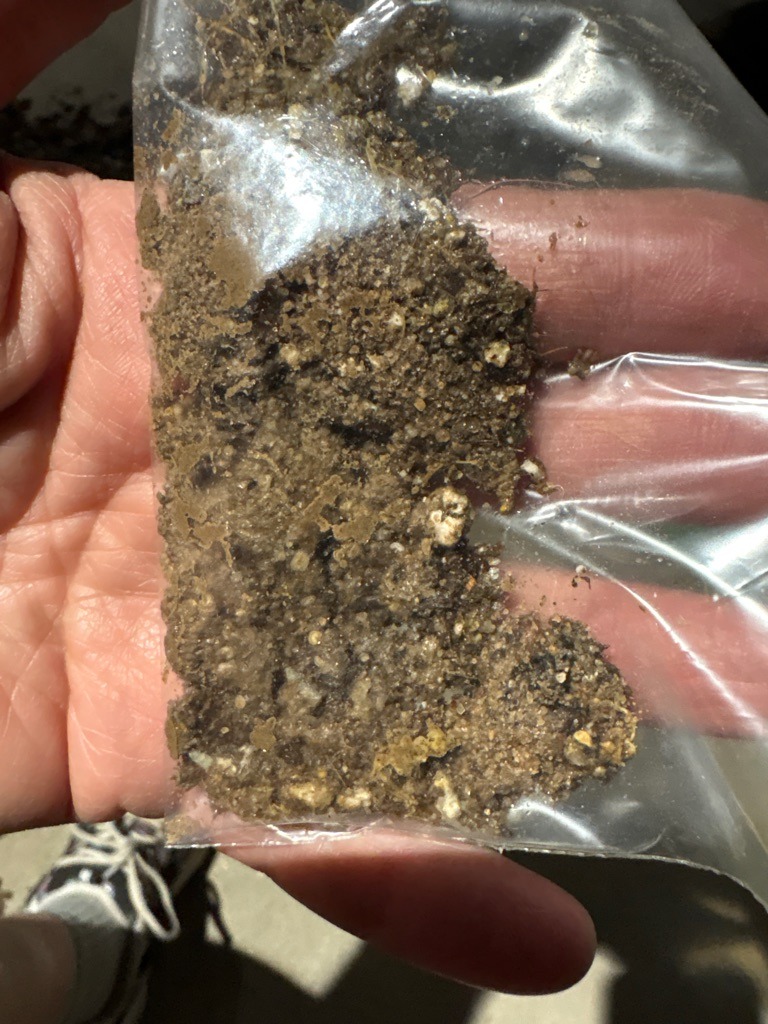
Coarse Alluvial Sandy Loam with Mineral Inclusions
Sandy Loam · Disturbed Alluvial or Human-Made Blend. It resembles a '3-way mix' or topsoil blend often found in suburban landscaping or river valley deposits with high quartz content.
AI Disclaimer
This soil report was produced by AI from a single photo. Treat it as a starting point, not laboratory truth.
pH, drainage, fertility, and composition are visual estimates — send a sample to an accredited lab before any decision that would be painful to get wrong.
Crop and amendment tips are general guidance — local climate, microclimate, and gardening history always win over an AI's best guess.
pH
Neutral to slightly alkaline (7.0–7.8). The presence of white, potentially calcareous mineral fragments and the earthy brown color often point toward balanced to higher pH rather than acidic forest soils.
Drainage
Well Drained. The high sand content and coarse particle size allow for rapid gravitational water movement and excellent macroporosity.
Organic Matter
Moderate (3–5%). Dark patches and visible fiber indicate a decent level of humus, though the mineral grit dominates the volume.
Erosion Risk
High susceptibility to water erosion. The loose, sandy nature means particles can easily wash away on slopes during heavy rain events.
Overall Read
This is a high-quality, versatile soil with excellent physical properties. Its main challenges are thirst and hunger; with consistent organic inputs and mulching, it is an elite growing medium.
Texture
Gritty and heterogeneous. Visual evidence of coarse sand, small pebbles, and larger mineral flecks suggesting a crumbly, non-plastic feel that would fail to form a ribbon over 1 inch.
Color Analysis
Variegated dark yellowish brown (10YR 4/4 to 3/3). The darkness suggests moderate organic matter, while the tan and white flecks indicate quartz and possibly calcareous minerals or perlite-like inclusions.
Estimated Composition
60% Sand, 25% Silt, 10% Clay, 5% Organic Matter/Inclusions. Visual confidence: Moderate based on particle visibility in the plastic bag.
Water Retention
Moderate to Low. It will likely dry out significantly within 2 days of full sun. It lacks the clay 'sponge' effect but holds more moisture than pure sand due to organic flecks.
Aeration
Excellent. The large pore spaces between coarse sand and mineral fragments ensure oxygen reaches the root zone readily, preventing anaerobic rot.
Compaction Level
Loose and friable. It shows no signs of platy structure or heavy clumping, suggesting it resists hardpan formation unless heavily trafficked when wet.
Structure & Aggregation
Weakly Granular. The soil appears as individual grains and small, fragile clusters (peds) that would easily break apart under pressure. This promotes good gas exchange.
Fertility Indicators
Moderate. While the mineral diversity is high, the coarse texture suggests that nutrients like Nitrogen may leach easily. No visible salt crusting is present.
Climate Suitability
Temperate to Semi-Arid. It performs well in regions with regular rainfall or irrigation where drainage is a priority over water storage.
Crops Worth Trying
Root vegetables (carrots, parsnips) which benefit from loose texture; Mediterranean herbs (lavender, rosemary); and drought-tolerant perennials.
Plants To Avoid
Water-loving moisture-hogs like Willows or Hydrangeas, and acid-loving plants like Blueberries or Azaleas if the pH is indeed near-neutral/alkaline.
Home Garden Use
Ideal for in-ground vegetable beds and raised garden beds. Excellent for native wildflower plots that require sharp drainage.
Agricultural Use
Suitable for high-value orchard crops or vineyards. For row crops, it would require frequent, timed irrigation (fertigation) due to low retention.
Landscaping Use
Excellent as a base for turf establishment or as backfill for planting pits in areas with heavy clay subsoils to improve transition drainage.
Common Problems
Nutrient leaching (especially Nitrogen and Potassium), rapid drying in summer heat, and potential for 'grit' to settle and separate if over-tilled.
Amendments Needed
Top-dress with 1-2 inches of high-quality compost annually to increase Cation Exchange Capacity (CEC). Use organic mulches to reduce evaporation.
Try These At Home Tests
Jar Test: Fill a jar 1/3 with soil, add water, shake, and watch sand settle in seconds. Squeeze Test: It should form a ball that crumbles with a light poke.
Professional Lab Recommendation
Recommended for a 'Standard Soil Health' panel ($20-50). Request CEC and Organic Matter % to determine if frequent fertilization is necessary.
Fun Facts
Sandy loams like this are often called 'early soils' by farmers because they warm up faster in the spring than clay, allowing for earlier planting dates.