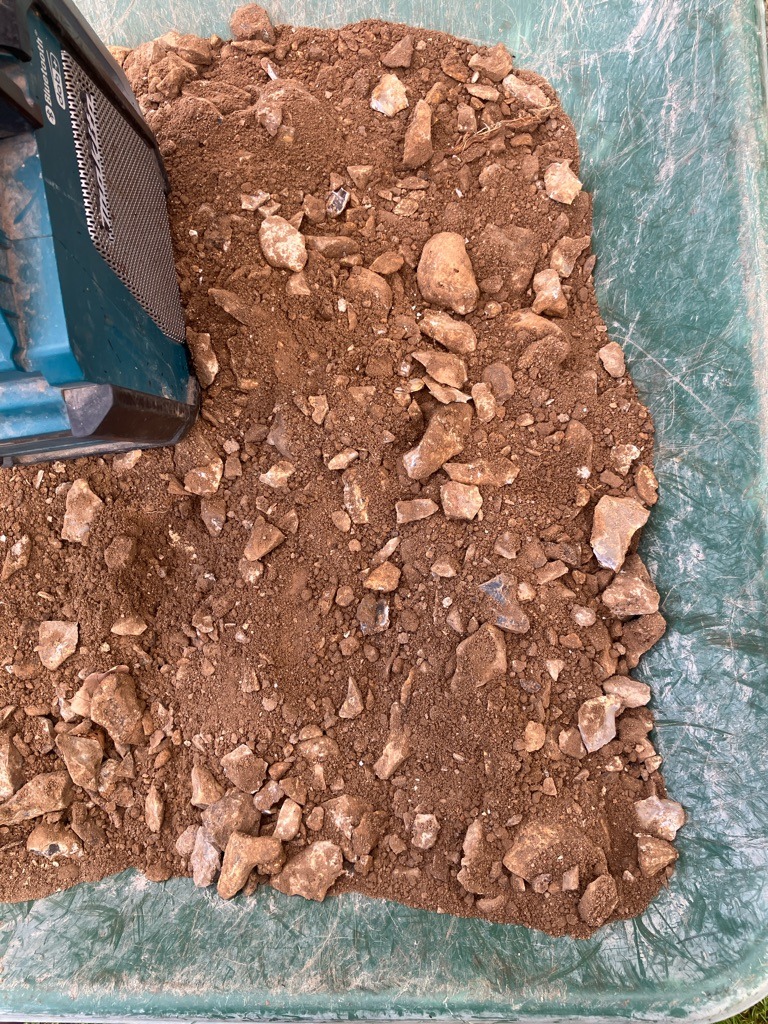
Rocky Red Clay Subsoil
Clay Loam · Weathered subsoil residuum, likely excavated from a construction site, foundation dig, or deep trenching project.
AI Disclaimer
This soil report was produced by AI from a single photo. Treat it as a starting point, not laboratory truth.
pH, drainage, fertility, and composition are visual estimates — send a sample to an accredited lab before any decision that would be painful to get wrong.
Crop and amendment tips are general guidance — local climate, microclimate, and gardening history always win over an AI's best guess.
pH
Slightly acidic to neutral (6.0 to 7.0), typical of weathered regional subsoils, though confirmation requires a lab test or pH strip.
Drainage
Moderately slow to poorly drained in its compacted state, as the heavy clay fraction and lack of macropores significantly restrict rapid water movement.
Organic Matter
Low (1-2%), as evidenced by the lack of dark humus coloration and the presence of dense, blocky mineral clods.
Erosion Risk
Moderate to high risk of water erosion if left exposed on slopes, as detached fine particles easily seal the surface and increase runoff.
Overall Read
A challenging, highly mineral subsoil featuring dense clay clods and rocks. While poor in organic matter and structure in its current state, it can be transformed over time with aggressive organic amendments, cover cropping, and patience.
Texture
Fine and dense with a strong tendency to form hard clumps, sticky when wet, and capable of forming a long, durable ribbon during a ribbon test, indicating a high proportion of fine clay particles.
Color Analysis
Reddish-brown (approximately 5YR 4/4 to 2.5YR 4/6), indicating well-aerated conditions with significant amounts of oxidized iron (hematite and goethite) and relatively low organic matter content.
Estimated Composition
45% clay, 30% silt, 15% sand, and 10% coarse fragments/stones, with less than 2% organic matter; visual confidence level is moderate.
Water Retention
High water-holding capacity. It tends to hold onto water tightly once saturated, making it slow to dry out, but it can also become drought-stressed and difficult to re-wet if allowed to bake hard.
Aeration
Low to moderate. Gas exchange is restricted due to the tight packing of clay particles and the presence of dense structural peds.
Compaction Level
High. The sample contains hard, dry clods that require mechanical force to break down, indicating significant excavation or subsurface compaction.
Structure & Aggregation
Subangular to angular blocky structure in the clods, with low natural aggregate stability when handled or overworked while wet.
Fertility Indicators
Low visible fertility indicators. The pale reddish-brown color, lack of earthworm activity in the clods, and low organic debris point to low baseline nutrient availability; overall fertility is rated Low.
Climate Suitability
Well-suited to temperate and subtropical climates with moderate, predictable rainfall, though irrigation management is needed during dry spells.
Crops Worth Trying
Established deep-rooted trees, native prairie grasses, and resilient cover crops like daikon radish or crimson clover that help break up dense subsoil.
Plants To Avoid
Fine-rooted annual vegetables, delicate seedlings, and plants requiring rapid drainage or loose, sandy beds.
Home Garden Use
Not recommended for direct in-ground vegetable gardening or container mixes without extensive amendment; best used as base fill or heavily amended for raised beds.
Agricultural Use
Used for permanent pasture or extensive row cropping after deep ripping and incorporation of massive organic matter inputs.
Landscaping Use
Suitable for sub-base grading, retaining wall backfill, or establishing tough native drought-tolerant perennials once topdressed with high-quality topsoil.
Common Problems
Crusting, hard surface baking, poor root penetration, waterlogging after heavy rains, and extreme difficulty in working when either too wet or too dry.
Amendments Needed
Heavy applications of mature compost, aged manure, and coarse organic matter to improve structure, alongside gypsum if sodium-induced dispersion is present.
Try These At Home Tests
Perform a jar settling test to verify sand/silt/clay percentages, and a ribbon test by rolling moist soil between your thumb and forefinger to check plasticity.
Professional Lab Recommendation
Recommended before undertaking large landscaping or growing projects; request a complete soil fertility test, organic matter percentage, cation exchange capacity (CEC), and texture analysis.
Fun Facts
Red clay gets its vibrant color from iron oxide minerals that have coated the soil particles over thousands of years of weathering and leaching.