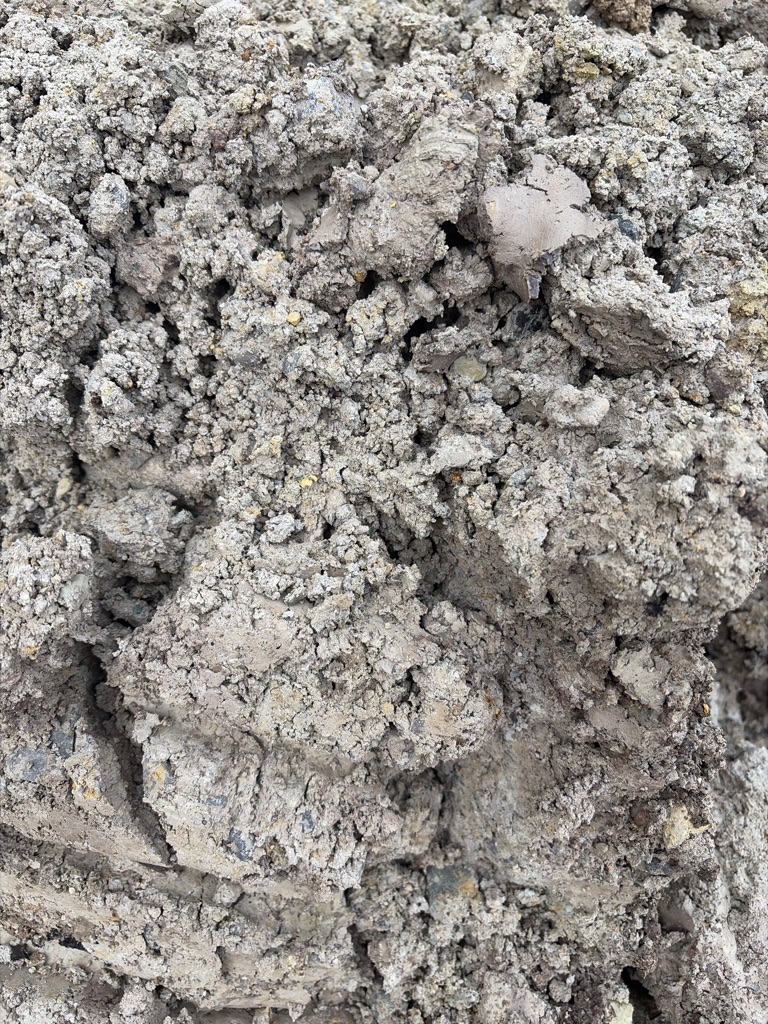
Pale Gray Subsoil Clay
Clay Loam · Glacial till subsoil or deep excavated subsoil deposit, common in regions influenced by past glaciation or sedimentary parent materials.
AI Disclaimer
This soil report was produced by AI from a single photo. Treat it as a starting point, not laboratory truth.
pH, drainage, fertility, and composition are visual estimates — send a sample to an accredited lab before any decision that would be painful to get wrong.
Crop and amendment tips are general guidance — local climate, microclimate, and gardening history always win over an AI's best guess.
pH
Likely slightly alkaline to neutral (6.8–7.5), as is common in subsoil clays derived from calcareous parent materials, though confirmation via a lab test or test strip is strongly recommended.
Drainage
Poorly Drained to Moderately Drained. The fine texture, dense aggregates, and grayish hue indicate slow water infiltration and a tendency to hold water near the surface during wet periods.
Organic Matter
Low (1-2%), evidenced by the pale gray color, lack of visible surface residue, and absence of dark crumbly humus. This limits microbial activity and native nutrient cycling.
Erosion Risk
Moderate to high water erosion risk on slopes due to slow infiltration rates leading to surface runoff, and low initial aggregate stability.
Overall Read
A challenging subsoil clay with low organic matter and high compaction, requiring significant organic amendments, patience with moisture management, and structural rebuilding to become productive.
Texture
Fine and dense with smooth, plastic qualities; sticky when wet and likely capable of forming a strong, long ribbon during a ribbon test, implying a significant high-activity clay fraction.
Color Analysis
Light gray to grayish-brown (Munsell approximation 10YR 6/2), suggesting a heavy subsoil with low organic matter content, reduced iron states due to occasional waterlogging or lack of oxygen, and minimal humus accumulation.
Estimated Composition
Roughly 30 percent sand, 30 percent silt, and 40 percent clay, with less than 2 percent organic matter. This visual estimate carries moderate confidence given the lack of dark surface horizon features.
Water Retention
High water-holding capacity, but much of it is held tightly by the clay particles as tension water. It tends to stay wet long after rain, dry out slowly, and bake into hard clods under direct sun.
Aeration
Restricted aeration. The dense packing of clay particles limits pore space for oxygen diffusion, increasing the risk of anaerobic root zones during saturated conditions.
Compaction Level
Moderately to severely compacted, displaying dense clods, slick surfaces on broken peds, and high resistance to root penetration.
Structure & Aggregation
Subangular blocky to massive structure with dense, compacted peds. Aggregate stability is moderate to low when wet, making it prone to structural breakdown and surface sealing under heavy impact.
Fertility Indicators
Low overall fertility. The pale color indicates a lack of humus, minimal biological activity, and low available nitrogen, though clay minerals themselves can hold a reserve of cations like potassium and calcium.
Climate Suitability
Thrives best in temperate or continental climates with moderate, well-distributed rainfall; requires careful water management in arid or overly wet zones.
Crops Worth Trying
Established turfgrasses, heavy-feeding brassicas (cabbage, broccoli), winter wheat, and certain deep-rooting native trees that can tolerate temporary waterlogging.
Plants To Avoid
Root crops like carrots and parsnips (which deform in heavy clay), sensitive seedlings prone to crusting, and drought-loving plants that rot in poorly draining soils.
Home Garden Use
Best utilized when heavily amended in raised beds or structurally broken down for perennial borders; generally unsuitable for direct in-ground planting without extensive conditioning.
Agricultural Use
Suitable for pasture, hay production, or heavy row crops under careful no-till or controlled-traffic farming to prevent severe compaction.
Landscaping Use
Useful as deep subsoil fill for grading or retaining walls, but requires topsoil capping and organic amendments before establishing turf or ornamental plantings.
Common Problems
Surface crusting after rain, severe cracking when dry, waterlogging, slow seed germination, root suffocation, and extreme hardness when worked outside the optimal moisture window.
Amendments Needed
Heavy incorporation of finished compost, aged manure, and organic matter to build structure, alongside gypsum if sodium or heavy clay dispersion is an issue. Apply organic mulch on top.
Try These At Home Tests
Perform a ribbon test to check plasticity and clay content, a jar test to separate sand, silt, and clay percentages, and a squeeze test to check if the soil molds into a hard ball.
Professional Lab Recommendation
Recommended before establishing large agricultural or landscaping projects. Request a standard soil test (pH, CEC, macro/micronutrients) and organic matter percentage.
Fun Facts
Clays like this are composed of microscopic layered silicate minerals that expand when wet and shrink when dry, giving them high cation exchange capacities despite their poor current fertility.