Glacial Outwash Oak-Hickory Loamy Sand
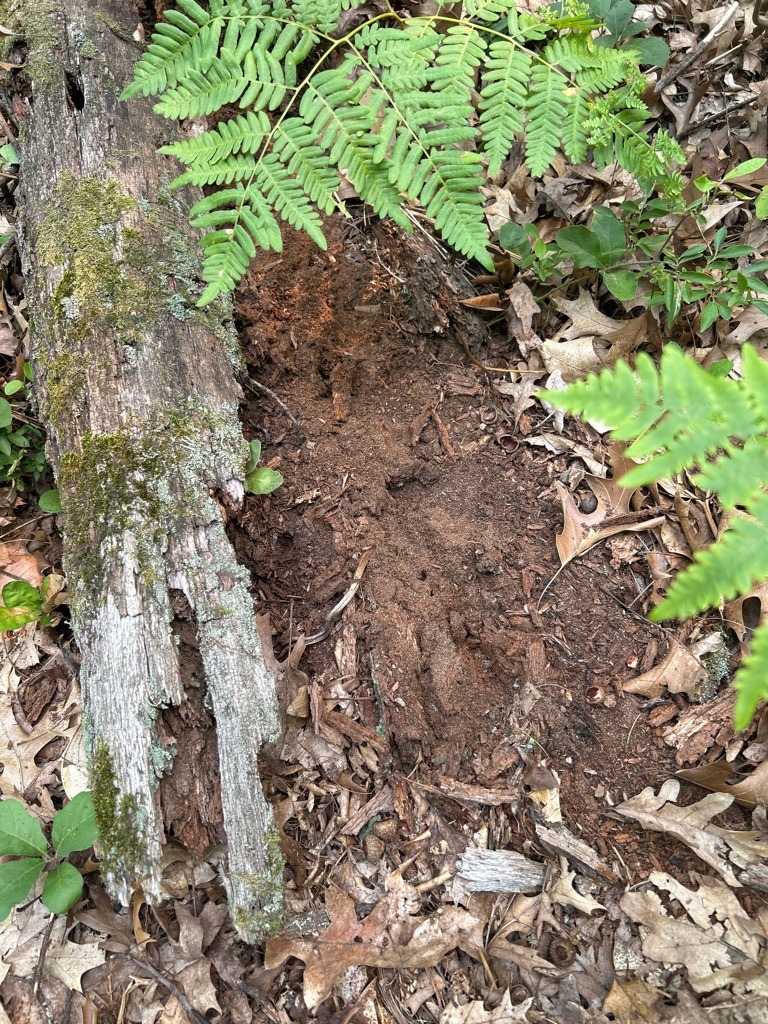
Loamy Sand · Glacial outwash or sandy moraine typical of West-Central Lower Michigan (Newaygo County area). Formed from sand deposited by melting glaciers roughly 10,000 years ago.
AI Disclaimer
This soil report was produced by AI from a single photo. Treat it as a starting point, not laboratory truth.
pH, drainage, fertility, and composition are visual estimates — send a sample to an accredited lab before any decision that would be painful to get wrong.
Crop and amendment tips are general guidance — local climate, microclimate, and gardening history always win over an AI's best guess.
pH
Moderately acidic (5.5–6.3). The presence of ferns (Bracken) and oak/beech leaf litter typically drives pH down through organic acid leaching.
Drainage
Well drained to excessively drained. The coarse texture and lack of mottling or graying indicate rapid water movement through the profile.
Organic Matter
Rich (4–8%) in the immediate surface layer (A horizon) due to decomposing logs and leaf litter; however, this drops off sharply just inches below.
Erosion Risk
High susceptibility to wind erosion if cleared of vegetation. Moderate water erosion risk on slopes due to the lack of cohesive clay particles.
Overall Read
A high-quality, natural forest soil with excellent aeration and drainage. While lean on nutrients, its structural integrity and health are high, making it a 'Goldilocks' zone for native Michigan flora.
Texture
Coarse, gritty, and friable. When rubbed between fingers, it lacks stickiness and will not form a ribbon longer than 0.5 inches (1.25 cm).
Color Analysis
Dark yellowish brown (10YR 4/4) to brown (7.5YR 4/4). The reddish tint suggests well-oxidized iron minerals, while the darker surface implies organic accumulation from forest litter.
Estimated Composition
75-85% Sand, 10-15% Silt, 5-10% Clay, 3-5% Organic Matter in the O/A horizons.
Water Retention
Low. This soil dries out quickly after rain. It lacks the clay or silt content to hold high volumes of plant-available water against gravity.
Aeration
Excellent. The high sand content ensures large macropores are filled with air even after heavy rainfall, supporting aerobic microbial life.
Compaction Level
Loose and friable. The visible footprint of decomposition and lack of heavy machinery traffic at Gerber Scout Reservation keeps this soil very uncompacted.
Structure & Aggregation
Weak granular structure. Aggregates are fragile and easily crushed. This allows for excellent root penetration but provides little resistance to physical disturbance.
Fertility Indicators
Moderate overall. High biodiversity in leaf litter and presence of fungus suggest active nutrient cycling, but the sandy base implies low Cation Exchange Capacity (CEC).
Climate Suitability
Cold-temperate humid climate. It relies on consistent rainfall to offset its low water-holding capacity.
Crops Worth Trying
Blueberries (if pH is low enough), Asparagus, Potatoes, Oak trees, White Pine, and native ferns. These thrive in well-aerated, sandy environments.
Plants To Avoid
High-water-demand crops like celery, or plants requiring heavy clay for stability like some larger fruit trees in high-wind areas.
Home Garden Use
Excellent for native woodland gardens or pollinator patches using drought-tolerant species. Not ideal for vegetable gardens without significant water and compost additions.
Agricultural Use
If irrigated, it is suitable for specialty crops like Christmas trees or carrots. In its natural state, it is best kept as timberland or wildlife habitat.
Landscaping Use
Ideal for paths and naturalized woodland areas. Its drainage makes it a great sub-base for ornamental beds, provided organic mulch is maintained.
Common Problems
Nutrient leaching (especially Nitrogen and Potassium), rapid drying in summer heat, and acidity-related nutrient tie-ups.
Amendments Needed
Incorporation of high-quality compost or biochar to increase CEC and water retention. Periodic lime applications if growing non-acid-loving plants.
Try These At Home Tests
Perform a 'Jar Test': fill a jar 1/4 with soil, add water, shake, and wait. The sand will settle in seconds, confirming the texture class.
Professional Lab Recommendation
Send a sample to Michigan State University (MSU) Extension for a standard nutrient profile and pH test to determine specific lime and fertilizer needs for gardening.
Fun Facts
The area around Twin Lake is part of the 'Manistee National Forest' ecosystem type, where sand-dependent species like the Karner Blue Butterfly are sometimes found.
Your Notes
Gerber scout reservation, twin lake