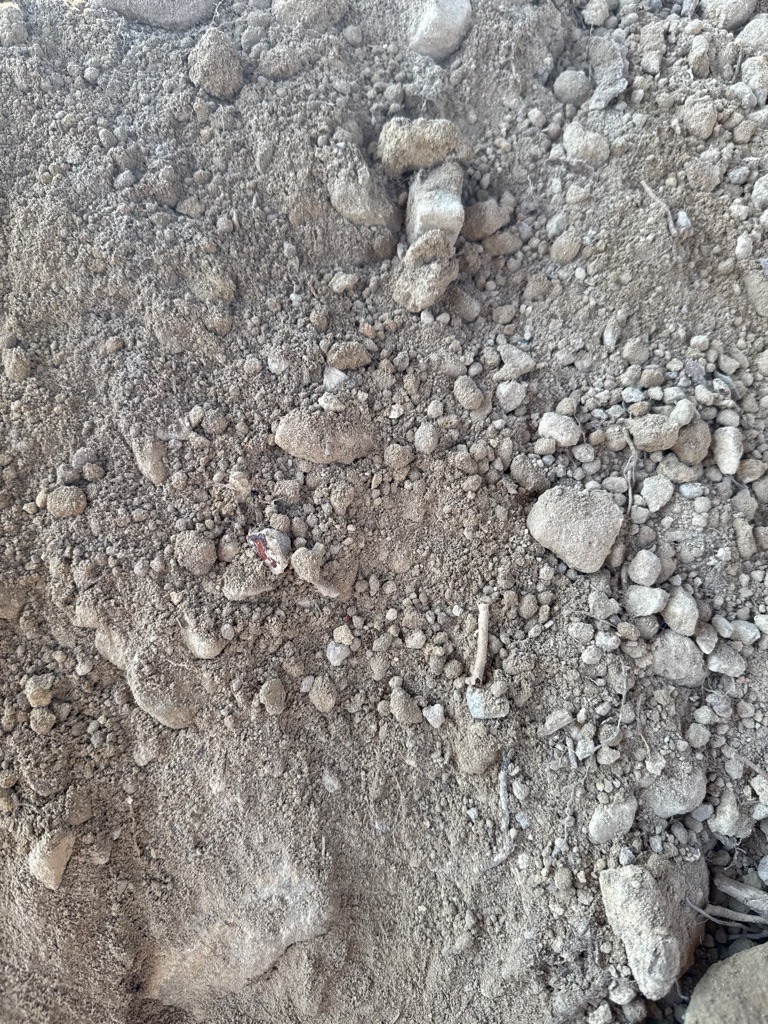
Arid Calcareous Sandy Loam with Gravel
Sandy Loam · Alluvial outwash fan, glacial meltwater deposit, or weathered parent material in a semi-arid or arid environment.
AI Disclaimer
This soil report was produced by AI from a single photo. Treat it as a starting point, not laboratory truth.
pH, drainage, fertility, and composition are visual estimates — send a sample to an accredited lab before any decision that would be painful to get wrong.
Crop and amendment tips are general guidance — local climate, microclimate, and gardening history always win over an AI's best guess.
pH
Likely slightly to moderately alkaline (pH 7.3 to 8.2), inferred from the light color and presence of weathered parent rock fragments. Confirmation requires an electrochemical pH meter or test strips.
Drainage
Well drained to excessively drained due to the high sand and gravel content, which creates large macro-pores allowing water to percolate rapidly through the profile.
Organic Matter
Low (1-2%), indicated by the pale color and lack of dark humus staining. This implies limited baseline microbial activity and minimal natural nutrient cycling capacity without amendments.
Erosion Risk
High erosion risk from both wind and water. The loose sandy texture and lack of strong structural binding agents make it susceptible to shifting when unprotected by vegetation or mulch.
Overall Read
A permeable, easy-to-work, but nutrient-poor and drought-prone soil. With the addition of organic matter and careful irrigation management, it can be transformed into a highly productive medium for a wide variety of plants.
Texture
Coarse and gritty with notable fine gravel fractions, likely forming a very weak, short ribbon that breaks easily under minor pressure, indicating low clay and moderate silt/sand proportions.
Color Analysis
Light grayish-brown (Munsell 10YR 5/2 to 6/2), suggesting low organic matter content, presence of primary minerals, and minimal accumulation of iron oxides, typical of semi-arid or disturbed earth.
Estimated Composition
Approximately 60 percent sand, 25 percent silt, 10 percent clay, and 5 percent coarse fragments or gravel, with organic matter estimated under 2 percent. Visual confidence is moderate to high based on visible particle sizes.
Water Retention
Low to moderate plant-available water holding capacity. The soil dries out relatively quickly following rainfall or irrigation and requires frequent, controlled moisture management to prevent drought stress.
Aeration
Excellent aeration due to high sand and coarse fragment content, ensuring high oxygen diffusion rates to the root zone and preventing anaerobic conditions.
Compaction Level
Moderately loose to firm depending on moisture, showing minimal natural hardpan in this loose state, but prone to surface crusting after heavy rain impact due to fine silt fractions.
Structure & Aggregation
Weak granular to single-grain structure with low aggregate stability. The peds easily crumble into loose individual particles under light mechanical pressure, making it vulnerable to wind and water displacement.
Fertility Indicators
Low overall fertility indicators. Absence of deep dark humus, limited visible root density, and pale coloration point to low inherent nutrient reserves, requiring consistent fertilization inputs.
Climate Suitability
Thrives best in arid, semi-arid, and Mediterranean climates where rapid drainage prevents root rot, though supplemental irrigation is necessary.
Crops Worth Trying
Drought-tolerant crops, root vegetables like carrots and radishes (if cleared of large stones), Mediterranean herbs such as rosemary and thyme, warm-season grasses, and certain stone fruit trees.
Plants To Avoid
Moisture-loving bog plants, heavy feeders requiring high organic reserves without amendment, and acid-loving plants like blueberries that struggle in alkaline, low-organic conditions.
Home Garden Use
Suitable for xeriscaping, rock gardens, Mediterranean herb beds, and raised beds where amendments can be easily incorporated; less ideal for unamended in-ground vegetable production.
Agricultural Use
Used for extensive grazing, specialized tree fruit production under drip irrigation, or viticulture, provided that drip lines and fertigation are carefully managed.
Landscaping Use
Ideal for dry-stack retaining wall backfill, drought-tolerant native plantings, rock gardens, and base layers for permeable pathways, but requires soil modification for lush turf lawns.
Common Problems
Rapid nutrient leaching, quick moisture depletion, surface crusting after rains, low cation exchange capacity, and susceptibility to wind erosion.
Amendments Needed
Heavy incorporation of finished compost, aged manure, or leaf mold to boost organic matter, water retention, and nutrient holding capacity. Mulching is critical.
Try These At Home Tests
Perform a standard soil jar settling test to verify sand/silt/clay percentages, conduct a ribbon test to check plasticity, and use a basic pH test kit to check alkalinity.
Professional Lab Recommendation
Recommended for commercial or intensive garden setups to test baseline macro-nutrients, micronutrients, CEC, and organic matter percentage to guide targeted fertilizer additions.
Fun Facts
Sandy loam soils warm up much faster in the spring than heavy clays, allowing for earlier planting dates in temperate regions, though they cool down rapidly at night.