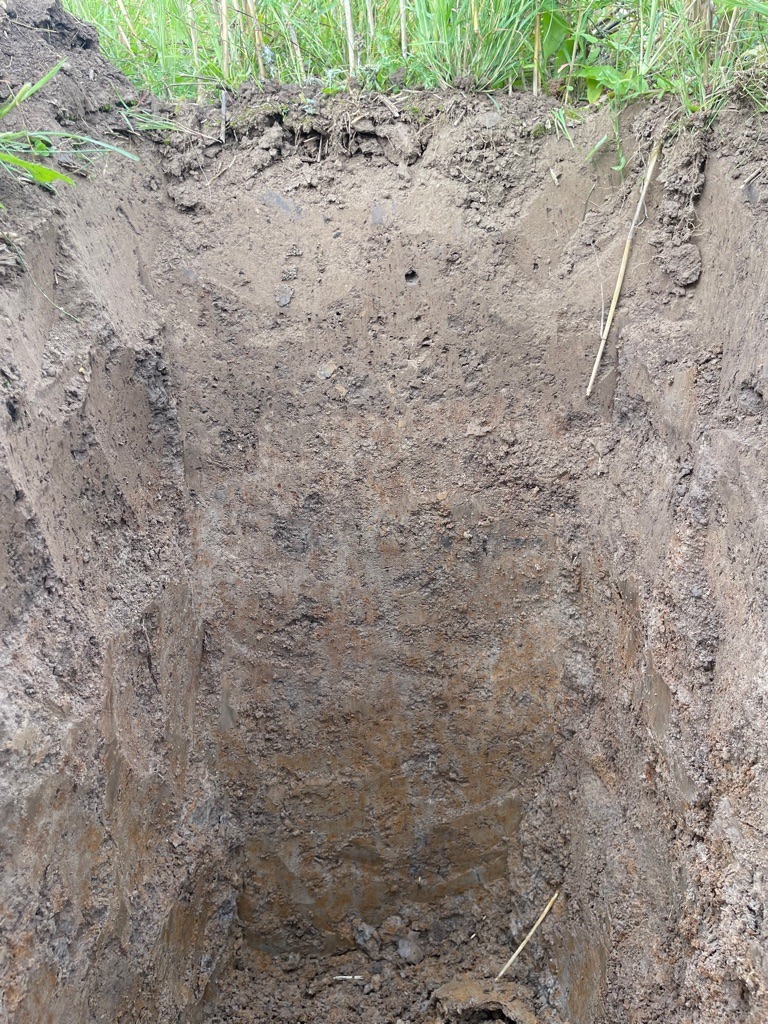
Glacial Till Silt Loam Profile
Silt Loam · Glacial till or loess-influenced deposit common in temperate agricultural regions of the Midwest, Northern Europe, or similar glaciated landscapes.
AI Disclaimer
This soil report was produced by AI from a single photo. Treat it as a starting point, not laboratory truth.
pH, drainage, fertility, and composition are visual estimates — send a sample to an accredited lab before any decision that would be painful to get wrong.
Crop and amendment tips are general guidance — local climate, microclimate, and gardening history always win over an AI's best guess.
pH
Slightly acidic to neutral 6.2–7.0, typical of weathered glacial parent materials with moderate leaching. A soil test kit or digital pH meter should be used to confirm.
Drainage
Moderately Well Drained. The profile lacks severe gleying or prominent mottling, suggesting good vertical permeability through the upper root zone with slight restriction in deeper subsoil layers.
Organic Matter
Moderate (2–4%), visible as a darker topsoil horizon (A-horizon) rich in humified organic residues and root activity, gradually fading into the lighter subsoil (B-horizon).
Erosion Risk
Moderate water and tillage erosion risk on slopes due to the high proportion of erodible silt-sized particles. Cover cropping and minimum tillage are recommended.
Overall Read
A fertile, highly productive, and versatile soil profile with excellent agricultural and gardening potential, requiring standard erosion control and organic matter maintenance.
Texture
Smooth and silky to the touch with low grittiness, forming a moderate short ribbon when wet, indicating a high silt fraction with balanced clay and sand components.
Color Analysis
Brown to grayish-brown (approx. 10YR 4/3 to 10YR 5/3) surface horizon transitioning to a lighter yellowish-brown subsoil, indicating moderate organic matter accumulation at the top and well-aerated iron oxides underneath.
Estimated Composition
Approximately 20% sand, 60% silt, 15% clay, and 5% organic matter in the topsoil layer, with moderate confidence based on visual profile indicators.
Water Retention
High plant-available water holding capacity due to the dominant silt fraction, holding moisture well between rain events without becoming excessively waterlogged like heavy clay.
Aeration
Good aeration in the topsoil transitioning to moderate aeration at depth, supporting healthy root respiration and diverse microbial activity.
Compaction Level
Moderately firm in the deeper subsoil profile exposed in the pit wall, while the upper root zone remains relatively friable and biologically active.
Structure & Aggregation
Subangular blocky structure in the subsoil with granular aggregation in the topsoil. Provides a stable balance of macropores for root growth and micropores for water storage.
Fertility Indicators
Moderate to high fertility indicated by the dark organic-rich topsoil layer, active root penetration, and balanced crumb structure. Overall fertility is rated High.
Climate Suitability
Temperate and continental climates with seasonal rainfall patterns. Requires standard management practices like winter cover crops and moisture conservation during dry spells.
Crops Worth Trying
Corn, soybeans, wheat, alfalfa, potatoes, tomatoes, brassicas, and various stone fruits due to the deep rooting potential and moisture-retentive silt loam texture.
Plants To Avoid
Strictly arid-adapted succulents or plants requiring excessively sharp, rapid drainage like deep coastal dune plants, which may suffer from prolonged moisture retention.
Home Garden Use
Excellent for in-ground vegetable gardens, fruit orchards, perennial borders, and ornamental landscaping beds with minimal amendment required.
Agricultural Use
Highly productive for row crop farming, pasture, and commercial grain production under conventional or no-till management systems.
Landscaping Use
Ideal for turf establishment, shade tree planting pits, ornamental shrub beds, and general landscape grading.
Common Problems
Surface crusting after heavy rainfall followed by rapid drying, slight susceptibility to compaction under heavy machinery or foot traffic when wet.
Amendments Needed
Annual additions of compost to maintain organic matter, cover crops to protect against silt erosion, and balanced organic fertilizers to support intensive crop yields.
Try These At Home Tests
Perform a mason jar sedimentation test to verify sand/silt/clay percentages, and a ribbon test to confirm the silt loam texture class.
Professional Lab Recommendation
Recommended before establishing high-value perennial crops or commercial fields. Request standard nutrient analysis, CEC, pH, and organic matter percentage.
Fun Facts
Silt loam soils derived from glacial loess deposits are among the most agriculturally productive soils on Earth, often providing a deep, stone-free rooting zone.