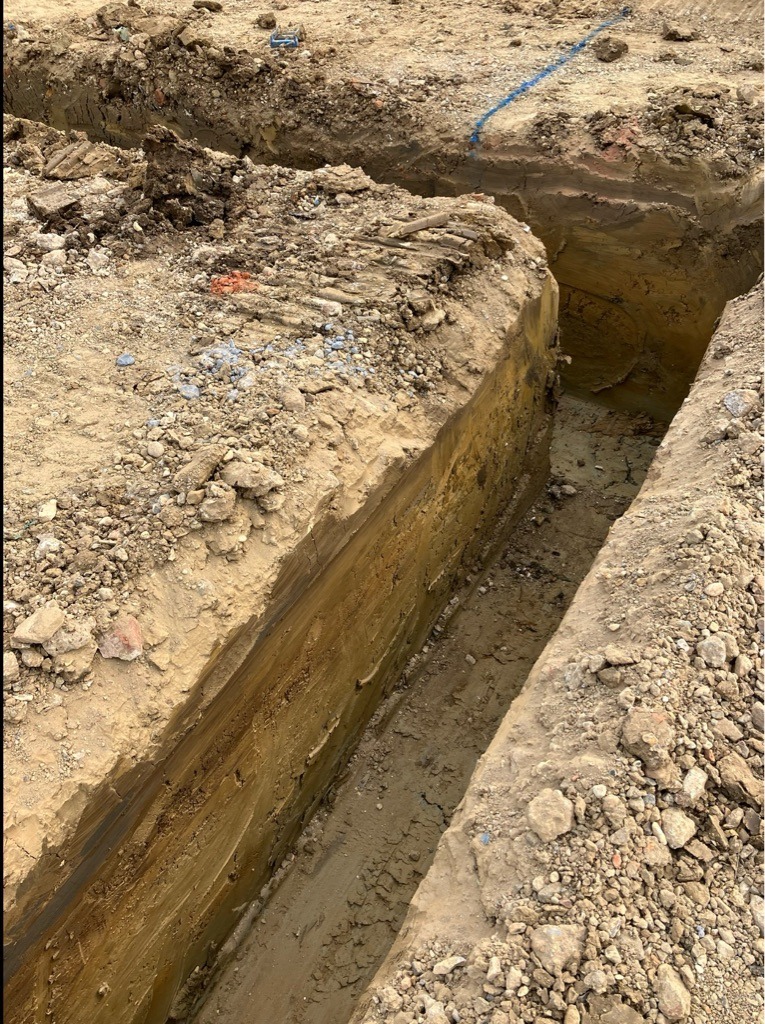
Yellowish-Brown Dense Clay Subsoil
Clay Loam to Heavy Clay · Glacial till or alluvial plain subsoil deposits; frequently seen in recently excavated construction sites in temperate regions like the Midwest US or Northern Europe.
AI Disclaimer
This soil report was produced by AI from a single photo. Treat it as a starting point, not laboratory truth.
pH, drainage, fertility, and composition are visual estimates — send a sample to an accredited lab before any decision that would be painful to get wrong.
Crop and amendment tips are general guidance — local climate, microclimate, and gardening history always win over an AI's best guess.
pH
Slightly alkaline to neutral (7.2–8.0) based on the light color and potential calcareous parenting material common in construction zones.
Drainage
Poorly Drained; the dense, massive structure and smooth trench walls indicate low hydraulic conductivity and potential for seasonal perched water tables.
Organic Matter
Very Low (<1%); the light value and lack of dark hummus or earthy aggregates suggest highly weathered mineral subsoil.
Erosion Risk
High for water erosion; the low infiltration rate means heavy rain will lead to significant surface runoff and sheet erosion.
Overall Read
Challenging but structurally sound; this is 'heavy' land that requires a long-term organic matter strategy to transform from a mineral substrate into a living soil.
Texture
Fine, smooth, and plastic; highly sticky when wet and rock-hard when dry; likely produces a ribbon longer than 2 inches.
Color Analysis
Light yellowish brown (10YR 6/4 to 5/4); suggests high mineral content (iron oxides) and low organic matter with moderate drainage history.
Estimated Composition
15% Sand, 30% Silt, 50% Clay, 5% Organic Matter/Coarse Fragments; high confidence due to visible shear planes.
Water Retention
High; holds significant water due to small pore spaces, but much of it may be held too tightly for plants to easily extract (high wilting point).
Aeration
Poor; the lack of visible horizontal air channels and the dense nature of the clay suggest limited oxygen diffusion for deep-rooting species.
Compaction Level
Severely Compacted; the smooth walls left by the excavator buck (slickensides) and large clods suggest a high bulk density and lack of pore space.
Structure & Aggregation
Massive and angular blocky; the trench shows flat shear faces with little to no granular aggregation, indicating poor root environment.
Fertility Indicators
Low Visual Fertility; lack of organic staining, absence of visible earthworm activity, and mechanical hardness suggest low biological activity.
Climate Suitability
Temperate climates; thrives in areas with consistent but not excessive rainfall; manages drought poorly due to surface cracking.
Crops Worth Trying
Deep-rooting cover crops (Tillage Radish), certain prairie grasses, and tough woody shrubs like Hawthorn or Dogwood that tolerate heavy soils.
Plants To Avoid
Root vegetables (carrots will bifurcate), blueberries (due to likely high pH/poor drainage), and Mediterranean herbs (lavender/thyme) which require drainage.
Home Garden Use
Poor candidate for in-ground gardening without massive amendment; best used as a sub-base for raised beds filled with imported topsoil.
Agricultural Use
Primarily pasture or hay production; requires specialized no-till or carefully timed tillage to avoid creating further compaction (clodding).
Landscaping Use
Suitable for pond liners or berm construction; not ideal for turf establishment without significant aeration and top-dressing.
Common Problems
Waterlogging in winter, brick-like hardness in summer, poor seed germination, and high resistance to root penetration.
Amendments Needed
Heavy applications of coarse organic matter (compost, wood chips) and potentially gypsum if sodic; do not add sand as it may create a 'concrete' texture.
Try These At Home Tests
Infiltration test (dig a hole, fill with water, time the drop); Ribbon test (see if moist soil forms a long, thin string without breaking).
Professional Lab Recommendation
Highly recommended to test for Cation Exchange Capacity (CEC) and Sodium Adsorption Ratio (SAR) to determine if textural issues are chemical (sodic) or physical.
Fun Facts
This type of heavy clay has been used for millennia in 'wattle and daub' construction and brickmaking due to its high plastic limit and strength when dried.