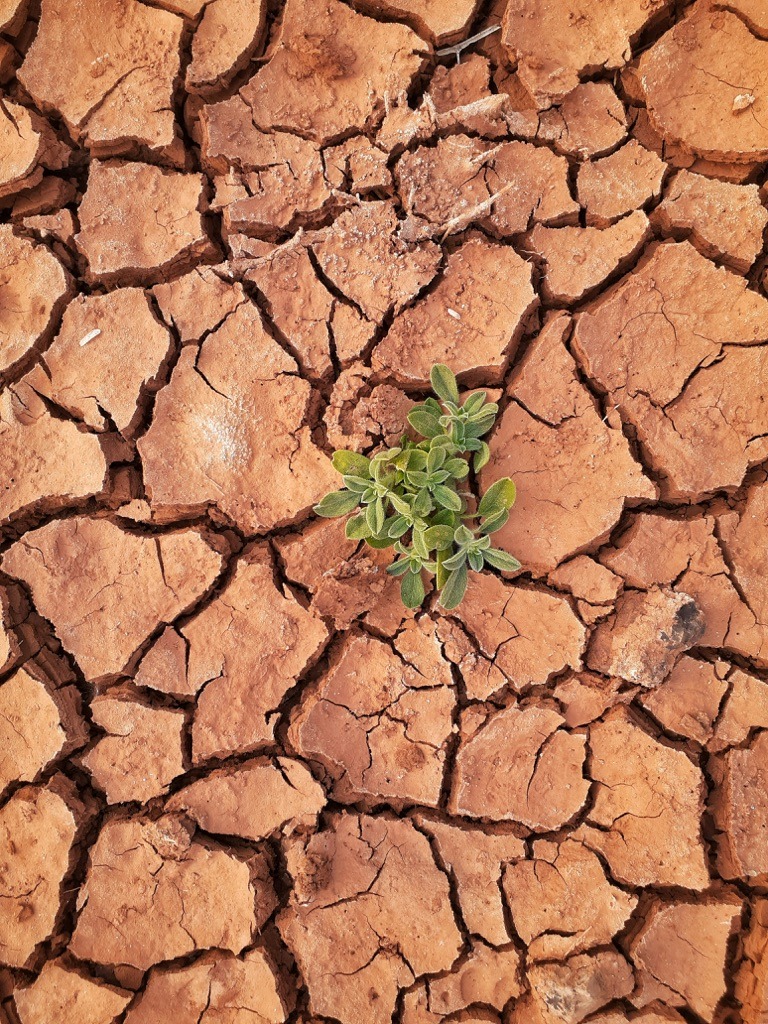
Arid Red Ferruginous Clay
Heavy Clay · Weathered residuum or alluvial deposits in semi-arid regions such as the Australian Outback, Southwestern US, or parts of Sub-Saharan Africa.
AI Disclaimer
This soil report was produced by AI from a single photo. Treat it as a starting point, not laboratory truth.
pH, drainage, fertility, and composition are visual estimates — send a sample to an accredited lab before any decision that would be painful to get wrong.
Crop and amendment tips are general guidance — local climate, microclimate, and gardening history always win over an AI's best guess.
pH
Likely slightly alkaline to neutral (pH 7.0–8.0); common in arid regions where leaching is low and mineral salts may accumulate. Visual white crusting in cracks may suggest carbonates or salts.
Drainage
Poorly Drained; the high clay content and massive structure when wet lead to low hydraulic conductivity. Water will likely pond on the surface before slowly entering cracks.
Organic Matter
Low (1–2%); the lack of dark coloration and the presence of severe surface crusting suggest very low humic content and minimal microbial cycling.
Erosion Risk
High; susceptible to water erosion (sheet wash) as water cannot infiltrate quickly, and wind erosion of the dry, flaky surface 'peds' in high-velocity events.
Overall Read
A challenging, 'heavy' soil with high mineral potential but poor physical mechanics. It requires a long-term strategy of adding structure-building organic matter and careful irrigation management.
Texture
Fine, plastic, and highly cohesive; would produce a long, flexible ribbon (>5cm) and feels smooth/sticky when wet, but rock-hard and brittle when dry.
Color Analysis
Reddish brown (approx. 2.5YR 4/6 to 5YR 4/4); the intense red hue indicates high iron oxide content (hematite) and well-oxidized conditions, typical of highly weathered or semi-arid mineral soils.
Estimated Composition
Sand: 10-15%, Silt: 25-30%, Clay: 55-65%, Organic Matter: <1.5%. Confidence is high due to the distinct desiccation cracking patterns.
Water Retention
Extremely high total water holding capacity, but plant-available water is limited because clay particles bind moisture tightly and small pore spaces restrict root access.
Aeration
Very Poor; when wet, the pores fill with water, excluding oxygen. When dry, the soil is too dense for significant air penetration except through the deep cracks.
Compaction Level
Severely Compacted; the surface displays a hard physical crust (capping) that prevents seedling emergence and gas exchange.
Structure & Aggregation
Angular Blocky to Massive; the image shows massive shrinkage cracks creating large, unstable polygons. This indicates 2:1 expanding clays that swell when wet and shrink when dry.
Fertility Indicators
Moderate Mineral Fertility / Low Biological Fertility; while likely rich in potassium and iron, it lacks nitrogen and active biology. Overall Rating: Low to Moderate.
Climate Suitability
Arid or semi-arid Mediterranean climates; this soil thrives where wet/dry cycles are distinct but requires heavy management in temperate or high-rainfall zones.
Crops Worth Trying
Deep-taprooted species like Alfalfa, hardy Mediterranean herbs (Lavender, Rosemary), or dry-land cereals (Sorghum, Millet) if moisture is managed.
Plants To Avoid
Fine-rooted vegetables (Carrots, Onions), acid-loving plants (Blueberries, Azaleas), and moisture-sensitive succulents that rot in heavy clay.
Home Garden Use
Poorly suited for direct in-ground gardening without heavy modification; best used as a base for raised beds filled with imported loam/compost.
Agricultural Use
Range-land for grazing or large-scale grain production using no-till methods to preserve what little moisture and organic matter exists.
Landscaping Use
Xeriscaping with native succulents and shrubs; unsuitable for turf/lawns without massive drainage installation and topsoiling.
Common Problems
Surface crusting blocking germination, 'cloddy' tilth that is impossible to till, high salt potential, and root suffocation during wet periods.
Amendments Needed
Heavy applications of coarse organic matter (compost, straw) to break up clay; Gypsum (Calcium Sulfate) to improve soil structure and flocculate clay particles.
Try These At Home Tests
Infiltration test: pour water on a dry patch and time how long it takes to disappear. Expect very slow results. Try a 'squeeze test'—the soil will likely form a hard, unbreakable ball.
Professional Lab Recommendation
Highly recommended; request a 'Sodicity' (ESP) test and 'CEC' (Cation Exchange Capacity) to determine if the clay is dispersible and needs specific chemical balancing.
Fun Facts
These are often called 'Vertisols' in soil taxonomy, derived from the Latin 'vertere' (to turn), because they 'self-plow' as surface material falls into the deep cracks.